Portainer Widens the Gap Between Free and Paid Tiers — and the Self-Hosting Community Is Voting with Its Feet

Portainer tightens its free tier, sparking community anxiety over open-source monetization and a search for alternatives.
Portainer is widening the feature gap between its Community Edition and paid tier, triggering widespread debate in Reddit's self-hosting community. Users recognize the pattern — CE development slows, key features move behind a paywall, and the free tier is eventually deprecated. The anxiety has spread to projects like TrueNAS, while alternatives like Komodo and Dockhand are gaining attention. Observers note, however, that these tools could follow the same path once they reach sufficient scale. The underlying tension remains: open-source projects need revenue to survive, but self-hosters expect free tiers to stay intact — and trust erodes before policies even change.
Portainer's Free vs. Paid Shift Sends Shockwaves Through the Community
Recent news about Docker container management tool Portainer has stirred up considerable debate in Reddit's self-hosting community — specifically, that Portainer is widening the gap between its Community Edition (free) and its commercial offering. For users who have long relied on the free tier for visual container management, this is a signal worth taking seriously.
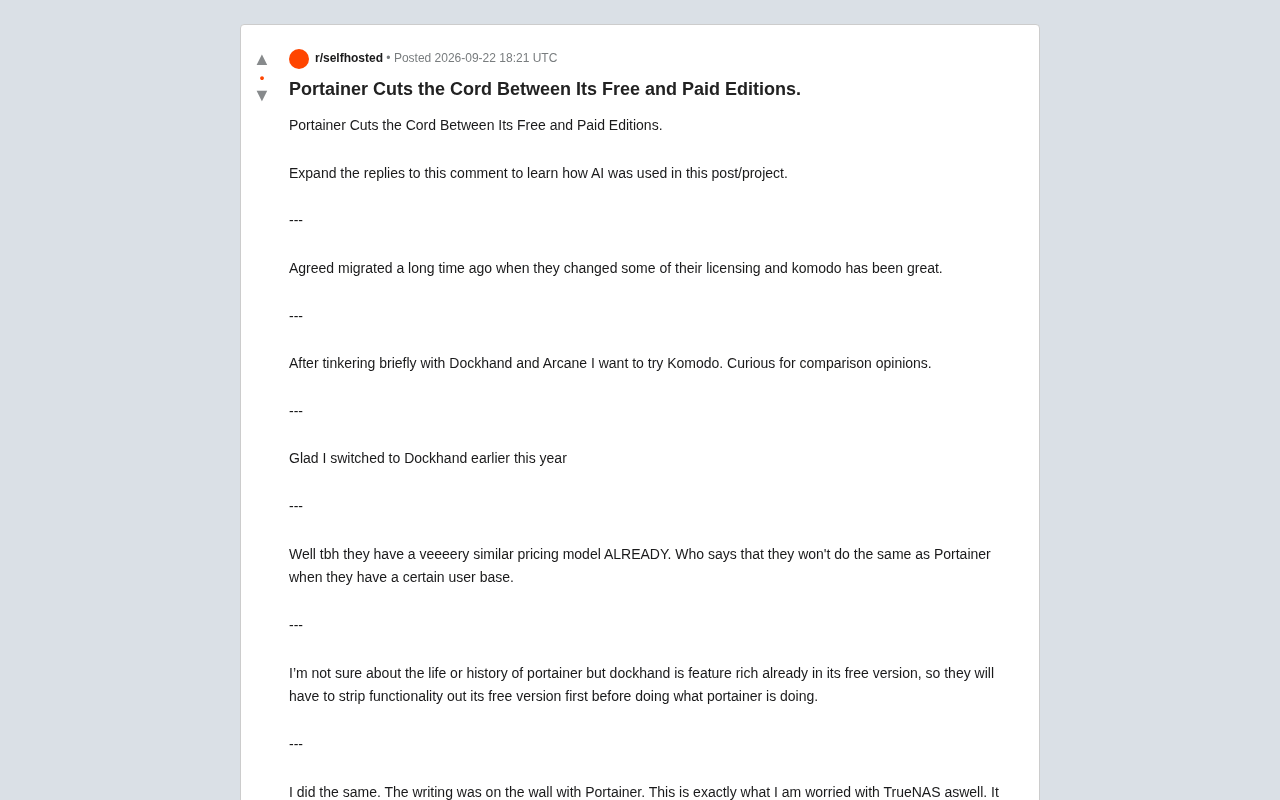
Judging by community discussions, many users saw this coming. One commenter put it bluntly: "The writing was on the wall," noting they had already migrated ahead of the change. This "read the room and leave" mentality reflects just how sensitive the self-hosting community is to open-source projects turning commercial.
The Classic "Boiling Frog" Pattern Users Fear
One of the most resonant observations in the thread was the community's wariness of what they described as a familiar open-source monetization playbook. As one user summed it up: "It always starts with development on the CE slowing down, then certain features only being deployed in the paid version, and then after a while the CE is no longer maintained."
This concern isn't baseless. Open-source projects pivoting to more aggressive monetization after reaching critical user mass is a well-worn pattern in the industry. The free tier slowly gets hollowed out — features get pulled, updates slow down, and it's eventually marginalized — nudging users toward paid subscriptions or driving them away entirely.
Notably, this anxiety has spread beyond Portainer. Some users expressed the same concerns about TrueNAS, with a few already planning to abandon it entirely in favor of native FreeBSD setups. This shows how one project's commercial decisions can undermine community trust in an entire category of tools.
Alternatives: Komodo, Dockhand, and Arcane
As Portainer's policies tighten, the community has naturally turned to discussing replacements. A few names kept coming up in the Reddit threads:
Komodo
Komodo received considerable positive feedback. One user mentioned migrating to Komodo when Portainer changed its licensing and said it "has been great." Another user, after trying both Dockhand and Arcane, said they planned to give Komodo a spin for comparison.
Komodo (full name: Komodo Deploy) is an open-source server and container management platform that lets you manage Docker containers, Compose stacks, and deployment pipelines across multiple servers through a unified interface. Its backend is written in Rust, with performance and low resource usage as key selling points, alongside a web-based visual interface. Like Portainer, Komodo supports centralized multi-node management, but takes a different approach to permissions modeling and CI/CD integration. Its core feature set is currently free for self-hosted users, and the project is hosted on GitHub with reasonably active maintenance. For users migrating from Portainer, the learning curve is slightly steeper, but the feature coverage is sufficient for most home lab or small-to-medium self-hosted setups.
Dockhand
Dockhand is another popular option. One user expressed relief at having switched to it "earlier this year." The community generally agrees that Dockhand's free tier is already quite feature-rich — which is seen as a strength, though some also view it as a potential risk factor.
Dockhand is a lightweight tool focused on Docker container lifecycle management, offering a web interface for common operations like starting/stopping containers, viewing logs, and managing images. Compared to Portainer and Komodo, Dockhand is more narrowly scoped, targeting single-host or small multi-host scenarios without emphasizing enterprise-grade features. Its free tier is fairly complete — a point repeatedly highlighted in community discussions. Because the gap between its paid and free tiers is relatively small, there's less commercial pressure to gut the free version anytime soon. That said, Dockhand's community size and documentation still lag behind Portainer's, and its long-term maintenance trajectory is worth keeping an eye on.
A Sober Counterpoint
One notably clear-eyed voice in the discussion pointed out that these alternatives "already have very similar pricing models — what's to stop them from following Portainer's path once they've built up enough users?" It's a fair challenge. Others pushed back, arguing that Dockhand's free tier is so fully featured that to replicate Portainer's move, "they'd have to strip features from the free version first" — making the short-term risk relatively contained.
The Trust Economy of the Self-Hosting Community
At its core, this Portainer discussion exposes a fundamental tension in the open-source and self-hosting ecosystem: projects need to monetize to remain sustainable, while users want the free tier to stay fully functional indefinitely.
For self-hosters, the cost of migration isn't just time — it's also the trust they invest in a new tool's stability and long-term maintenance commitment. Constantly swapping out core management tools means repeated learning curves, reconfiguration, and migration risk. So "leaving early" may look drastic, but it's actually a rational move to avoid even higher migration costs down the road.
This is also a cautionary note for any open-source project on a commercial path: once the community forms the expectation that "this project will eventually gut its free tier," user attrition can begin well before any actual policy change. Once trust erodes, even the richest feature set struggles to retain core users.
Self-hosting refers to the practice of individuals or organizations deploying and running software services on their own servers or local hardware, rather than relying on third-party cloud platforms. The core motivations include data sovereignty, privacy control, and cost predictability. Because self-hosters have already chosen to take on operational responsibility in exchange for autonomy, they tend to have far less tolerance for upstream commercial uncertainty than typical SaaS users. When a tool introduces unpredictability, "migrating away" becomes a natural extension of preserving that autonomy. The appeal of open-source software for this community rests heavily on the promise of auditable code and freedom from dependence on any single commercial entity — making sudden license or feature policy shifts feel like a betrayal of that promise.
Closing Thoughts
Portainer's latest adjustment is just one more chapter in the broader commercialization wave sweeping the self-hosting space. For everyday users, now is a good time to seriously evaluate alternatives like Komodo and Dockhand — but it's worth keeping a clear head. Today's "community-friendly alternative" isn't guaranteed to stay that way. When choosing a tool, look beyond current feature sets and pay close attention to the project's business model and how its community governance is structured.
Related articles

Making AI Agents Prove "Done": The Verification Loop Determines the Scaling Ceiling of Agents
WorkOS at AI Engineer workshop: the bottleneck to agent scaling is self-verification. A three-layer verification loop—verification CLI, Playwright assertions, and System 1 semantic judgment—plus tools like CTX and Riker let agents prove completion and self-heal failures.

Omarchy Partners with Alibaba on China Edition, Sparking Debate Over Open-Source Neutrality and Censorship Red Lines
Omarchy Linux founder DHH partners with Alibaba on Omarchy China, pre-installing WeChat and DingTalk. We break down DHH's defense and critics' rebuttals on open-source neutrality and censorship.

ProtoArc EM06 Trackball Mouse In-Depth Review: The Clever No-Scroll-Wheel Design
In-depth review of the ProtoArc EM06 trackball: the no-scroll-wheel design takes getting used to, 7 programmable buttons, wired/wireless dual mode, cross-platform web configuration, excellent build quality but scroll lock is easy to trigger accidentally. Priced at $89.99, suited for medium to large hands.