Post-Training Doesn't Change Model Representations—It Changes How They're Read

Post-training changes how models read out internal representations, not the representations themselves.
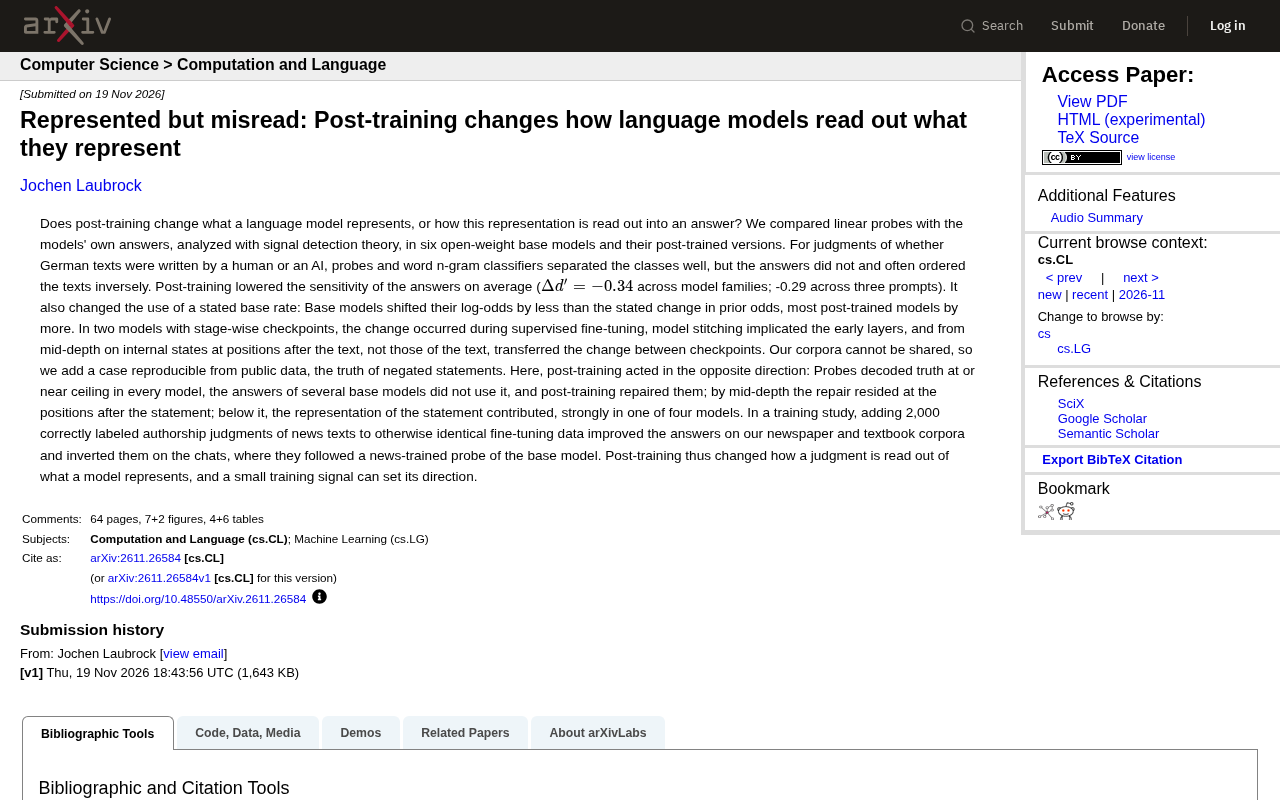
A new study compared six open-source base models and their post-trained versions using linear probes and signal detection theory. In a German text authorship judgment task, probes and n-gram classifiers distinguished human from AI text well, but model answers performed poorly or even reversed, showing that internal representations contain the information but it is misread. Post-training on average reduced answer sensitivity (Δd'=-0.34) and changed base-rate use: base models under-shift, most post-trained models over-shift. The change occurs during supervised fine-tuning; model stitching points to early layers, and internal states at post-text positions at intermediate depths transfer the change. In a negated-statement truthfulness task, post-training acted in the opposite direction, repairing the readout deficit. A small amount of correctly labeled data can set the readout direction, improving answers on some corpora and reversing them on chat corpora. The study suggests that evaluating internal knowledge from outputs alone can be misleading, and that fine-tuning data distribution systematically changes the readout direction.
Language models undergo significant behavioral changes after post-training (e.g., supervised fine-tuning, RLHF). But a core question has long remained unresolved: does post-training actually change the content of a model's internal representations, or does it merely change the way the model "reads out" existing representations into answers? A new study systematically compared six open-source base models and their post-trained versions using linear probes and signal detection theory, arriving at a clear answer: models often know more than they say, and what post-training changes is the direction of the "readout."
Experimental Design: Separating Probes from Answers
The research team chose a binary judgment task: determining whether a German text was written by a human or by AI. They compared two types of signals: linear probes—which directly decode class labels from the model's internal states—and the model's own generated answers. They also trained word-level n-gram classifiers as a baseline.
The results showed a clear dissociation. Both probes and n-gram classifiers could distinguish human from AI text well, but the models' answers performed poorly—often even ranking the texts in the opposite order. This means the information needed for the judgment is encoded in the model's internal representations, but the model fails to use it correctly when generating answers. This is a textbook case of "representation present but misread."
Signal detection theory analysis further quantified this gap. Post-training on average reduced answer sensitivity (d'), with a mean change of -0.34 across model families and -0.29 across three prompts. In other words, post-training made models worse at distinguishing the two categories at the answer level, even though internal representations still contained the discriminative information.
Linear probe is a common tool in mechanistic interpretability research, referring to training a simple linear classifier (such as logistic regression) on a model's internal state at a given layer to detect whether a specific concept or label is linearly encoded in that state. High probe accuracy indicates that information is linearly separable in the representation; but it only reflects "whether the information exists," not whether the model uses that information when generating answers.
Signal Detection Theory (SDT) characterizes judgment behavior using two metrics: sensitivity d' (d-prime) measures the ability to distinguish two classes of signals, computed as the difference in means between signal and noise distributions divided by their common standard deviation; the criterion reflects decision bias. A decrease in d' means reduced discriminability, while a criterion shift corresponds to changes in prior or base-rate integration. This paper uses changes in d' to quantify the effect of post-training on answer sensitivity.
Base-Rate Use: Post-Training Amplifies Prior Shifts
The experiment also examined models' use of explicitly provided base rates. In the judgment task, if the prompt states the prior proportion of human versus AI text, an ideal model's log-odds should shift proportionally with changes in prior odds.
Base models show under-shifting: their log-odds change less than the stated prior odds change. Most post-trained models, however, over-shift—changing more than the prior change. This indicates that post-training affects not only sensitivity but also how models integrate prior information.
Where the Change Happens: Supervised Fine-Tuning and Middle Layers
Using two models with staged checkpoints, the study pinpointed the training stage where the change occurs: supervised fine-tuning. Model stitching experiments further attributed responsibility to early layers. Starting from intermediate depths, internal states at positions after the text (rather than at the text itself) can transfer this change across checkpoints.
This finding echoes the concept of "readout position" in mechanistic interpretability: models do not read judgments directly from the representations of text tokens, but rather from aggregated states at certain positions after the text (such as the end of the sequence or after a specific delimiter). What post-training changes is precisely this readout pathway.
Model stitching is an experimental technique used to localize differences in representations and computation: the early-layer outputs of model A are fed into the later layers of model B (with a trainable linear or lightweight stitching layer inserted in between), and the stitched model is examined to see whether it can recover original performance. If stitching succeeds, the representations of the two models at the stitching point are sufficiently compatible; if it fails, the difference occurs before the stitching point. This paper uses this technique to determine whether post-training changes are mainly located in early or later layers.
Readout position refers to which position in the sequence the model extracts the internal state used for decision-making when generating an answer. For classification or judgment tasks, models often do not directly read the token representations of the text being judged, but rather read aggregated states at positions after the text (such as the end of the sequence or after a delimiter). Post-training's adjustment of the readout pathway is reflected precisely in representational changes at these positions.
A Reproducible Case: Judging the Truthfulness of Negated Statements
Since the original corpus could not be shared, the researchers added a case reproducible from public data: judging the truthfulness of negated statements. In this task, the direction of post-training's effect is opposite to that in the authorship judgment task.
Probes could decode truthfulness at near-ceiling levels in all models, but the answers of several base models did not use this information, and post-training repaired them. Depth-wise analysis showed that the repair occurred at intermediate depths at positions after the statement; at shallower layers, the statement's own representation also contributed, but this contribution was strong in only one of four models.
The same mechanism—readout position and post-training's adjustment of the readout pathway—was validated in two tasks with opposite directions, strengthening the robustness of the conclusions.
The Directional Role of Training Signals
In a training study, researchers added 2,000 correctly labeled news-text authorship judgments to otherwise identical fine-tuning data. The result was that model answers improved on newspaper and textbook corpora, but reversed on chat corpora—answers on chat corpora followed the direction of the news probe trained on the base model.
This shows that a small amount of training signal can set the direction in which judgments are read out. Post-training does not simply "enhance" or "weaken" a capability; it steers the readout pathway toward the direction preferred by a particular data distribution. This explains why the choice of fine-tuning data is so critical: it is not only teaching the model new knowledge but also recalibrating how the model reads existing knowledge.
Implications for Model Evaluation and Alignment
This research has multiple implications for practice. First, evaluating a model's internal knowledge solely from its outputs can be misleading—probes show information the model "knows," but answers may completely misread it. Second, the distribution of post-training data systematically changes the readout direction, requiring greater attention to data representativeness during alignment and fine-tuning. Finally, mechanistic localization (supervised fine-tuning, early layers, post-text positions) provides concrete targets for intervention.
The gap between model representations and answers is not a simple lack of capability but a shift in the readout mechanism. Understanding this is essential for more accurately diagnosing model behavior and designing more targeted training strategies.
Base rate refers to the prior proportion of each class in a judgment task. An ideal Bayesian observer would integrate prior odds proportionally into posterior judgments—that is, the change in log-odds should match the change in prior odds. Base models' "under-shifting" means their log-odds adjustment is smaller than the prior change, reflecting insufficient use of prior information; post-trained models' "over-shifting" means their adjustment is larger than the prior change, reflecting over-reliance on the base rate given in the prompt. This phenomenon corresponds to criterion shifts in signal detection theory, indicating that post-training changes how models integrate prior information.
One-line Summary
Post-training changes how models read out internal representations, not the representations themselves.
Paragraph Summary
A new study compared six open-source base models and their post-trained versions using linear probes and signal detection theory. In a task judging the author of German text (human or AI), linear probes and n-gram classifiers distinguished the two classes well, but model answers performed poorly—sometimes even reversing the order—showing that internal representations contain the information but it is misread. Post-training on average reduced answer sensitivity (Δd'=-0.34) and changed base-rate use: base models under-shift, while most post-trained models over-shift. The change occurs during supervised fine-tuning; model stitching points to early layers, and internal states at positions after the text at intermediate depths transfer the change. In a negated-statement truthfulness task, post-training acted in the opposite direction, repairing the readout deficit. A small amount of correctly labeled data can set the readout direction, improving answers on some corpora and reversing them on chat corpora. The study suggests that evaluating internal knowledge from outputs alone can be misleading, and that fine-tuning data distribution systematically changes the readout direction.
Related articles

ChatGPT Plus Subscription Pitfall Guide: Go/Plus/Pro Tier Comparison and Quick Activation
A complete ChatGPT Plus subscription guide based on a Bilibili tutorial: from registering an account, comparing Go/Plus/Pro tiers, to the practical steps for quickly completing your subscription.

GPT-6.2 Sol/Astra Released! A Step-by-Step ChatGPT Plus Subscription Guide and Tier Comparison
GPT-6.2 Sol/Astra is out—here's a ChatGPT Plus subscription guide: register an account, compare Go/Plus/Pro tiers, and subscribe in a minute.

Comparing Three Channels for Subscribing to GPT Plus in China: Is Website Top-Up the Easiest?
How to subscribe to GPT Plus in China? This article compares website top-up, credit card, and mobile top-up channels—process, cost, and risk—with steps and tips to help you choose wisely.