PPO + Distributional Critic: A New Framework for Conservation Planning Reinforcement Learning

Replacing evolution strategies with PPO and distributional RL boosts training efficiency and enables risk-sensitive conservation planning.
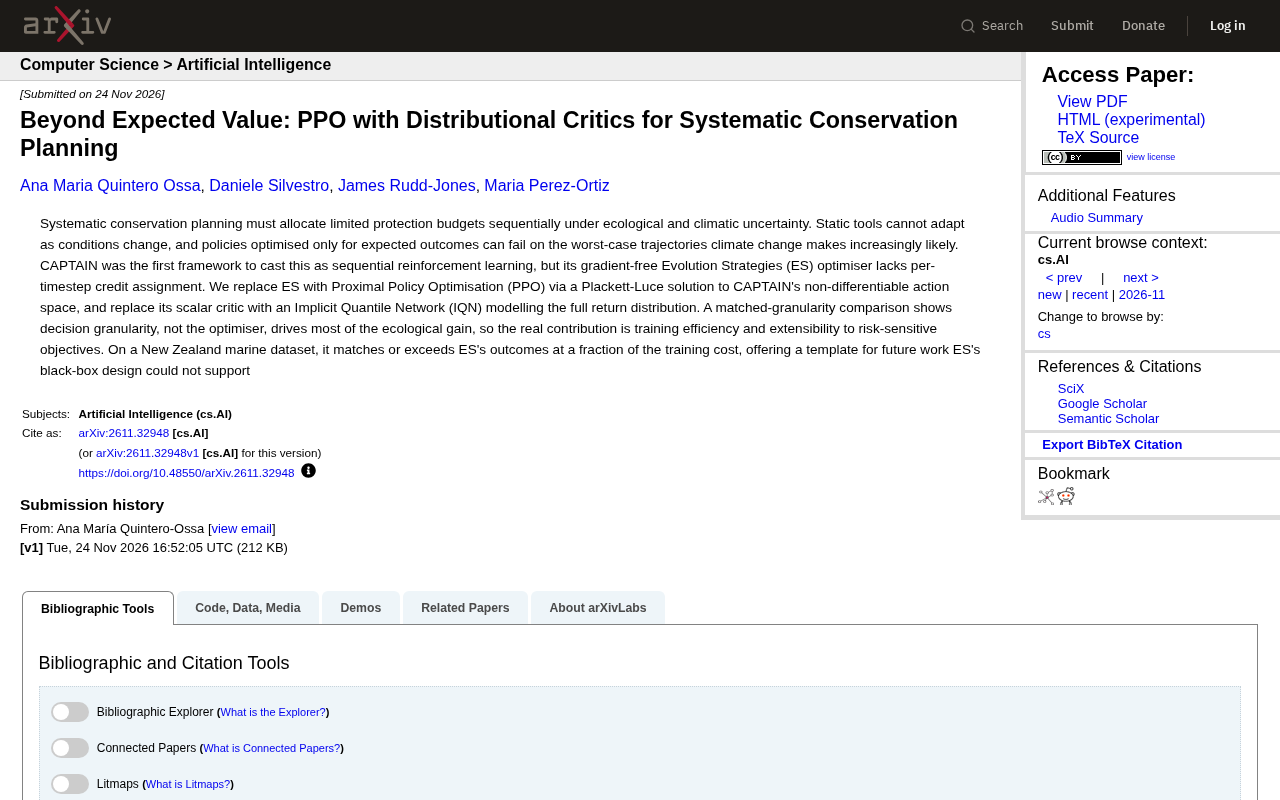
The study replaces CAPTAIN's gradient-free Evolution Strategies with PPO, using a Plackett-Luce model to make discrete parcel selection differentiable for step-wise credit assignment, and adds an Implicit Quantile Network to model full return distributions for risk-sensitive objectives. On the New Zealand marine dataset, it matches or exceeds ES at far lower training cost. Matching-granularity experiments show decision granularity, not the optimizer, drives most ecological gains.
Systematic conservation planning requires sequentially allocating limited conservation budgets under ecological and climate uncertainty. Static tools cannot adapt to changing conditions, and policies optimized solely for expected outcomes may fail on the worst-case trajectories that climate change may bring. CAPTAIN was the first framework to model this problem as sequential reinforcement learning, but its gradient-free Evolution Strategies (ES) optimizer lacks step-wise credit assignment. A new study replaces ES with Proximal Policy Optimization (PPO), uses a Plackett-Luce model to address CAPTAIN's non-differentiable action space, and replaces the scalar critic with an Implicit Quantile Network (IQN) to model the full return distribution.
From Expected Value to Distribution: The Risk-Sensitive Turn in Conservation Planning
Traditional conservation planning often focuses only on expected returns, but climate change is making worst-case scenarios increasingly common. Policies that optimize only for expected values may collapse under extreme climate trajectories. This study introduces distributional reinforcement learning into conservation planning, using IQN to capture the full return distribution rather than just the mean. This enables policies to be optimized for risk-sensitive objectives, such as avoiding worst-case outcomes or meeting specific quantile requirements.
According to the paper, combining the IQN critic with PPO extends the framework to risk-sensitive objectives—something the original ES black-box design could not support.
The core idea of Distributional RL is to learn the full probability distribution of returns rather than estimating only the expected value. Traditional reinforcement learning uses a scalar value function to represent the mean of future cumulative rewards, which implicitly assumes a risk-neutral decision-maker. But in scenarios with enormous uncertainty such as climate change, return distributions may be highly skewed or heavy-tailed, and looking only at the mean can mask the risk of catastrophic outcomes. By modeling distributional representations such as quantiles, histograms, or Gaussian mixtures, distributional reinforcement learning enables agents to distinguish between policies that are "good on average but occasionally terrible" and those that are "reliably stable," thereby supporting risk-sensitive decisions such as minimizing Conditional Value-at-Risk (CVaR) or optimizing specific quantiles.
The Implicit Quantile Network (IQN) is a value function modeling method in distributional reinforcement learning. It does not assume a specific form for the return distribution; instead, it learns an implicit mapping from quantile levels τ∈[0,1] to corresponding quantile values. During training, τ is randomly sampled, and a quantile Huber loss is used to approximate the true return distribution. IQN's advantage lies in its ability to flexibly represent distributions of arbitrary shape, including skew and heavy tails, and to directly extract arbitrary quantiles or risk measures (such as CVaR) from the learned distribution. In conservation planning, this means decision-makers can choose conservative or aggressive quantile objectives based on risk preferences without changing the network architecture.
Technical Core: PPO and Plackett-Luce Solve the Non-Differentiable Action Space Problem
CAPTAIN's action space is non-differentiable—selecting which parcels to protect is discrete and combinatorially complex. The original framework used a gradient-free ES optimizer, but ES lacks step-wise credit assignment, making efficient training difficult. The researchers use a Plackett-Luce model to transform discrete choices into differentiable ranking probabilities, allowing PPO to directly optimize the policy.
The introduction of PPO brings substantial gains in training efficiency. On the New Zealand marine dataset, the new method matches or exceeds ES performance at far lower training cost. The paper notes that the real contribution lies in training efficiency and scalability rather than large improvements in ecological outcomes.
The Plackett-Luce model is a classic ranking probability model often used to describe the process of sequentially drawing without replacement from a set of candidates. Its core idea is to assign each candidate a positive parameter (such as an exponentiated score); the probability that a candidate is selected first equals its score divided by the sum of all candidates' scores. After selection, the process continues on the remaining set under the same rule until a complete permutation is formed. The model's key advantage is that discrete combinatorial choices are transformed into ranking probabilities based on continuous parameters, making them differentiable with respect to the parameters. In CAPTAIN's conservation planning scenario, where actions consist of selecting a set of parcels, Plackett-Luce learns a score for each parcel, enabling PPO to directly optimize the selection policy via gradients without relying on gradient-free evolutionary strategies.
Proximal Policy Optimization (PPO) is a policy-gradient-based reinforcement learning algorithm that constrains policy updates within a trust region by clipping the importance sampling ratio, thereby balancing sample efficiency and training stability. Compared with Evolution Strategies (ES), PPO uses a value function for step-wise credit assignment—attributing returns to each step's action in a trajectory—whereas ES scores entire parameter perturbations based only on final returns, lacking fine-grained credit assignment. In addition, PPO naturally supports distributed sampling and parallel environment interaction, offering greater training scalability. These properties make it a reasonable choice for replacing ES in optimizing the CAPTAIN framework.
Matching-Granularity Comparison: Decision Granularity Is the Main Driver of Ecological Gains
A key finding is that decision granularity (i.e., the temporal or spatial resolution of planning), rather than the optimizer itself, drives most of the ecological gains. Through matching-granularity comparison experiments, the researchers found that when granularity is held constant, PPO and ES differ little in ecological outcomes. This implies that previously observed ecological improvements may have partly stemmed from granularity differences rather than the optimization algorithm.
This conclusion reminds us that when comparing different reinforcement learning frameworks, the confounding variable of decision granularity must be controlled. Otherwise, algorithmic improvements may be incorrectly credited.
Training Efficiency and Scalability: The Practical Value of the New Framework
Although improvements in ecological outcomes are limited, the new framework has clear advantages in training efficiency. ES requires extensive sampling and is difficult to parallelize, whereas PPO supports more stable gradient updates and distributed training. On the New Zealand marine dataset, the new method matches or exceeds ES performance at far lower training cost.
Moreover, the introduction of the distributional critic opens the door to risk-sensitive objectives. Conservation planners can adjust policies based on risk preferences—for example, being more conservative to avoid worst-case outcomes. This flexibility is something the original ES framework could not provide.
Future Directions: A Template for Risk-Sensitive Conservation Planning
The researchers view this work as a template for future research: replacing black-box optimization with PPO and a distributional critic enables conservation planning to handle more complex risk-sensitive objectives. As climate change intensifies, this capability will become increasingly important.
However, the paper also acknowledges that the dominant role of decision granularity in ecological gains means that, beyond algorithmic improvements, granularity choices in planning practice are equally critical. Future work could further explore how to adaptively select granularity and how to integrate distributional information throughout the conservation decision-making process.
One-line Summary
Replacing evolution strategies with PPO and distributional reinforcement learning improves training efficiency in conservation planning and supports risk-sensitive objectives.
Paragraph Summary
Addressing the limitations of the CAPTAIN framework's reliance on gradient-free Evolution Strategies (ES) for sequential conservation budget allocation under ecological and climate uncertainty, this study proposes replacing ES with Proximal Policy Optimization (PPO) and uses a Plackett-Luce model to transform non-differentiable discrete parcel selection into differentiable ranking probabilities, enabling step-wise credit assignment. It also introduces an Implicit Quantile Network (IQN) to model the full return distribution, supporting risk-sensitive objectives. On the New Zealand marine dataset, the new method matches or exceeds ES performance at far lower training cost. Matching-granularity comparison experiments reveal that decision granularity, rather than the optimizer itself, drives most of the ecological gains, reminding future comparisons to control for this confounding variable.
Related articles

A 19-Year-Old's Rental Horror Story: Ceiling Collapse, Bug Infestation, and the Lessons It Taught Me
At 19, my first off-campus rental brought bug infestations, no heat, a collapsed ceiling, and a ruined laptop with no renter's insurance. Here are the hard-won lessons for first-time student renters.

Veda Nurse's Cranial Nerve Exam: Why ASMR Role-Play Is Going Viral
Bilibili creator Veda's cranial nerve exam ASMR video goes viral, blending humor and sensory triggers through nurse role-play. This article analyzes its unique appeal and the audience psychology behind ASMR role-play.

LG Cinebeam AI Review: 120-Inch Giant Screen + 3000 Lumens, a New Choice for the Living Room Theater
LG Cinebeam AI projector review: 3000 ANSI lumens, 4K, 100 inches from about 8 cm and 120 inches from about 18 cm. Built-in webOS, AI Concierge voice recommendations, AI Sound Pro 11.1.2 virtual surround, and Game Optimizer—positioned for fixed living room installation, complementing the portable Cinebeam S.