Praxa: A Governance Framework for AI Agent Execution with Traceable Chains from Proposal to Verification

Praxa makes AI agent execution traceable by explicitly separating proposal, authorization, dispatch, and verified effect.
Praxa is a governance framework for AI agent execution whose core contribution is explicitly separating five distinct states — proposal, authority, dispatch, verified effect, and serving promotion — breaking the implicit assumption that "the model said to do it" means "it's done." The paper supports its design with four evidence chains including unit tests, a Terminal-Bench pilot, a coordination-proxy comparison, and deployment evidence, while honestly disclosing each chain's limitations. Notably, adding a reliability layer incurred 37–51% extra token overhead without improving task success rates. The paper explicitly states that current evidence does not demonstrate adversarial safety, production safety, or user benefit — a rare display of engineering honesty in today's agent research landscape.
Large language model agents can propose and execute actions — but between "proposing" and "producing verifiable external effects," there lies a formidable gap. A new paper published on arXiv introduces Praxa, an agent execution harness that aims to make the entire chain from authorization to effect fully transparent and testable. The value of this work lies not in claiming superior performance, but in its disciplined honesty about its own capability boundaries — a quality remarkably rare in today's agent research landscape, which is saturated with inflated claims.
The Core Problem: Five Distinct Claims
Praxa begins by clarifying a commonly conflated concept. In agent systems, the following five things are entirely different claims — yet they are routinely treated as one and the same:
- Proposal: the agent suggests taking an action;
- Authority: whether the system approves that action;
- Dispatch: the action is actually sent for execution;
- Verified external effect: the action has produced a verifiable result in the external world;
- Serving promotion: the action is incorporated into formal service after review.
Many real-world agent frameworks implicitly assume that "the model said to do something" is equivalent to "the thing has been done correctly." Praxa's design philosophy is to explicitly separate and model these states. Through five stages — deterministic admission, brokered execution, external read-back, reconciliation, and reviewed promotion — every "authorization to effect" transition is made explicit and testable.
Deterministic admission means the system evaluates whether an action is permitted to enter the execution queue based on clear, predictable rules — rather than relying on the model's own "judgment." Brokered execution means actions are not triggered directly by the agent, but are dispatched through an intermediate broker layer responsible for isolation, logging, and rate-limiting, preventing the agent from bypassing governance logic to directly operate external systems. External read-back means actively querying the external system after execution to confirm whether the action actually took effect, rather than inferring results solely from the execution call's return value. Together, these three mechanisms form the technical foundation by which Praxa transforms the implicit leap between "authorization" and "effect" into explicit, auditable steps. For agent frameworks accustomed to calling tools directly and trusting return values, this additional layer of state verification represents an important architectural paradigm shift.
Four Evidence Chains: Rigorous, but Each with Caveats
What makes the paper most interesting is that it does not use a single clean number to "prove" system superiority. Instead, it honestly presents four evidence chains and candidly acknowledges the limitations of each.
Chain 1: Repository Local Audit
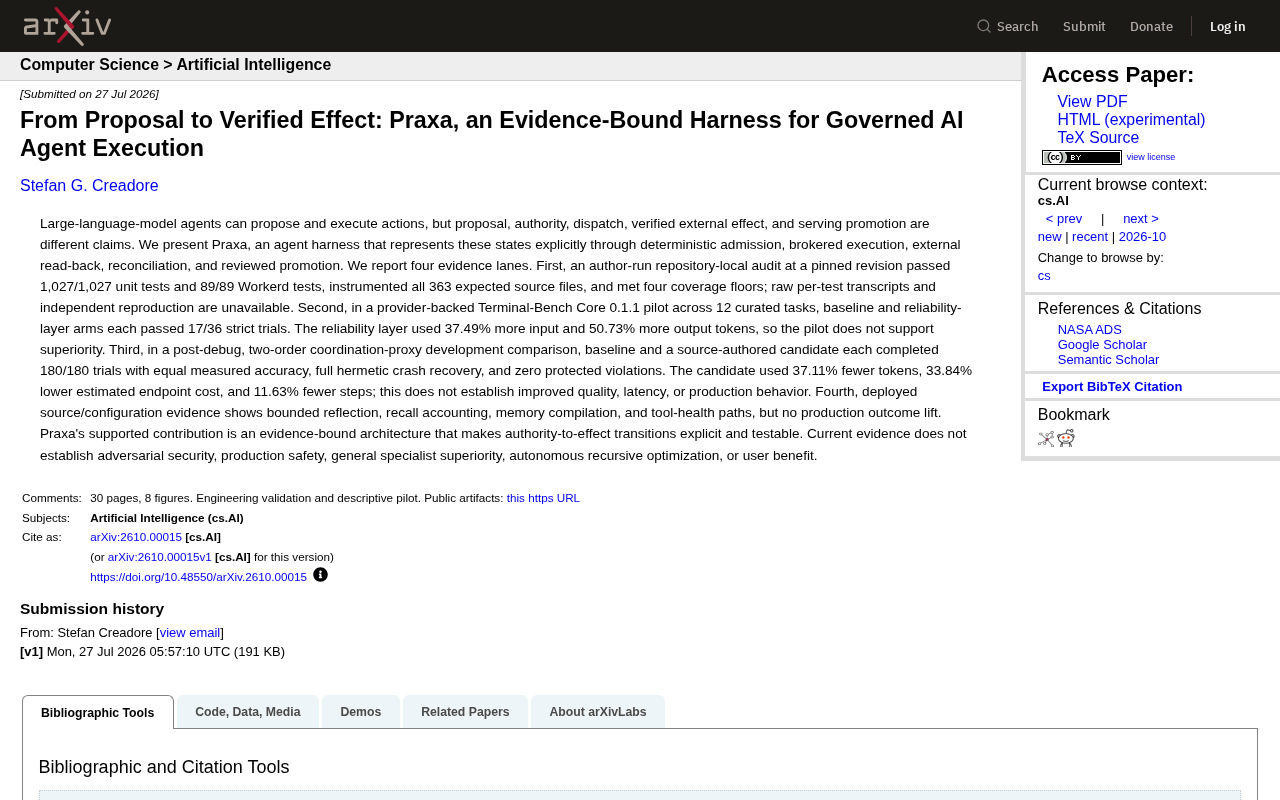
The authors ran a repository audit on a fixed revision, passing 1,027/1,027 unit tests and 89/89 Workerd tests, instrumenting all 363 expected source files, and meeting four coverage lower bounds. However, the paper also notes: raw per-test logs and independent reproduction are not yet available. This means this evidence was produced by the authors themselves, and external verifiability is limited.
Chain 2: Terminal-Bench Pilot
In a provider-supported Terminal-Bench Core 0.1.1 pilot across 12 curated tasks, both the baseline group and the reliability-layer group each passed 17/36 trials under strict conditions. Critically, the reliability layer consumed 37.49% more input tokens and 50.73% more output tokens. In other words, the reliability layer did not yield a better success rate — it was simply more expensive. The paper explicitly acknowledges: this pilot does not support a superiority conclusion.
Terminal-Bench is a benchmark framework for evaluating AI agents' ability to complete tasks in terminal environments; Core 0.1.1 is a version of its core task set. Unlike knowledge-QA benchmarks, Terminal-Bench requires agents to complete tasks with clear success/failure criteria by actually executing shell commands and file operations, making it closer to real-world production challenges. This pilot selected 12 curated tasks and ran 36 trials each — a relatively limited sample. Since tasks were selected by the provider, selection bias is a concern to watch for in external replications. A pass rate of 17/36 (approximately 47%) means baseline and reliability layer performed equivalently — an important calibration for those expecting a governance layer to automatically improve task completion rates.
Chain 3: Coordination-Proxy Development Comparison
In a post-debug two-phase coordination-proxy development comparison, both the baseline and the source-author-written candidate completed 180/180 trials with equal measurement precision, full isolated crash recovery, and zero protected violations. The candidate used 37.11% fewer tokens, reduced estimated endpoint costs by 33.84%, and reduced steps by 11.63%. However, the authors again emphasize: this does not demonstrate improvements in quality, latency, or production behavior.
Chain 4: Deployed Source/Configuration Evidence
The final chain presents deployment evidence for mechanisms such as bounded reflection, recall accounting, memory compilation, and tool health paths — but again, no improvement in production outcomes was observed.
The Real Contribution: A Testable "Authorization to Effect" Architecture
Praxa positions itself very clearly — its substantive contribution is an evidence-bound architecture that makes agent state transitions from authorization to effect explicit and testable. It makes no attempt to present itself as a performance champion.
The paper's conclusion lists a lengthy catalog of what "current evidence does not demonstrate" — and this list may be the most consequential part of the entire paper:
- Does not demonstrate adversarial security;
- Does not demonstrate production environment safety;
- Does not demonstrate general expert-level superiority;
- Does not demonstrate autonomous recursive optimization capability;
- Does not demonstrate user benefit.
In a landscape where agent research enthusiastically claims "autonomy," "surpassing humans," and "end-to-end optimization," this kind of proactive boundary-drawing reflects a rare engineering integrity. It reminds researchers and engineers that between an agent "proposing" an action and that action "actually, correctly taking effect in the external world," there are far too many steps that require verification.
The concept of an evidence-bound architecture draws on ideas from formal verification and trusted computing: every state transition in the system must be accompanied by verifiable evidence, not merely logical inference or a chain of trust. In the agent context, this means "action has been authorized" must have an explicit authorization record, and "action has taken effect" must have confirmation from an external read-back — neither is sufficient alone. This is conceptually aligned with "idempotency verification" and "transaction logs" in traditional software engineering, but systematically applying it to non-deterministic LLM agent execution pipelines is Praxa's key engineering contribution. For compliance-audited industries such as finance and healthcare, this kind of traceable state chain is particularly important — regulators typically require systems to be able to reconstruct a complete evidence chain of "who approved what, when it was executed, and what effect it produced."
Implications for Agent Engineering Practice
For teams building production-grade AI agent systems, Praxa's approach offers practical reference value. Explicitly modeling proposal, authority, dispatch, verified effect, and serving promotion as separate states means the system can audit and roll back at every node, rather than treating model output as a fait accompli. The external read-back and reconciliation mechanisms are especially critical — they force the system to confirm with the external world whether an action actually took effect, rather than blindly trusting internal state.
The cost is also clear: as the second evidence chain shows, adding a reliability layer incurs significant token and cost overhead without necessarily improving success rates. This is precisely the trade-off that governance-oriented agent architectures must confront — the benefits of auditability and reliability often come at an efficiency cost. The significance of this paper may lie precisely in surfacing these trade-offs for subsequent research to examine with more rigorous, reproducible experiments.
Related articles

Gaussian Process Bandit Optimization: Exploration Strategies and Inference Regret Guarantees
Cumulative regret guarantees in Bayesian optimization fail to reflect final recommendation quality. This article examines a new study that provides inference regret guarantees for Gaussian process bandit optimization through exploration query strategies and fill distance analysis, validated on hyperparameter optimization and control tasks.

The Most Detailed Codex Guide on Bilibili: From Installation to Real-World Practice
The most detailed Codex guide on Bilibili: from app store installation to daily work mode configuration, with a real coffee shop project demonstrating file organization, data extraction, dashboard creation, and other practical tasks. Learn to use Plan Mode and desktop pets to leverage Codex efficiently.

Appearance Compensation in Volume Rendering: Why RGB Accuracy Cannot Guarantee Density Correctness
Volume rendering research reveals that volumetric data perfectly reproducing external RGB views may still contain density errors: appearance compensation can double central density and keep external rays unchanged even when L2 error exceeds 14.52%. Density recovery depends on appearance capacity, spatial resolution, and measurement design.