Predicting Grain Growth with Time Series: Thermal-Conditioned Model Breaks Through Non-Isothermal Scenarios

A thermal-conditioned time-series framework achieves second-level prediction of non-isothermal grain growth with high accuracy but limited generalization.
This study proposes a thermal-conditioned time-series prediction framework that treats grain size distributions as time series, using a CNN to encode distributions, an MLP to embed thermal descriptors, and an RNN to predict temporal evolution, explicitly incorporating instantaneous temperature and thermal rate to rapidly predict grain growth trajectories under non-isothermal conditions. Trained on data generated by front-tracking simulations, the model achieved average relative errors of 2.99% and 4.51% for one-hour and four-hour thermal cycles in k-fold cross-validation, with R² exceeding 0.99. Under four unseen thermal histories of increasing complexity, the average relative error ranged from 1.91% to 14.66%, indicating limited generalization to complex thermal histories. The framework reduces computations that traditionally take hours in PDE simulations to seconds, providing a practical tool for rapid screening and parameter exploration in heat treatment processes, and its modular design offers a scalable approach for computational materials science.
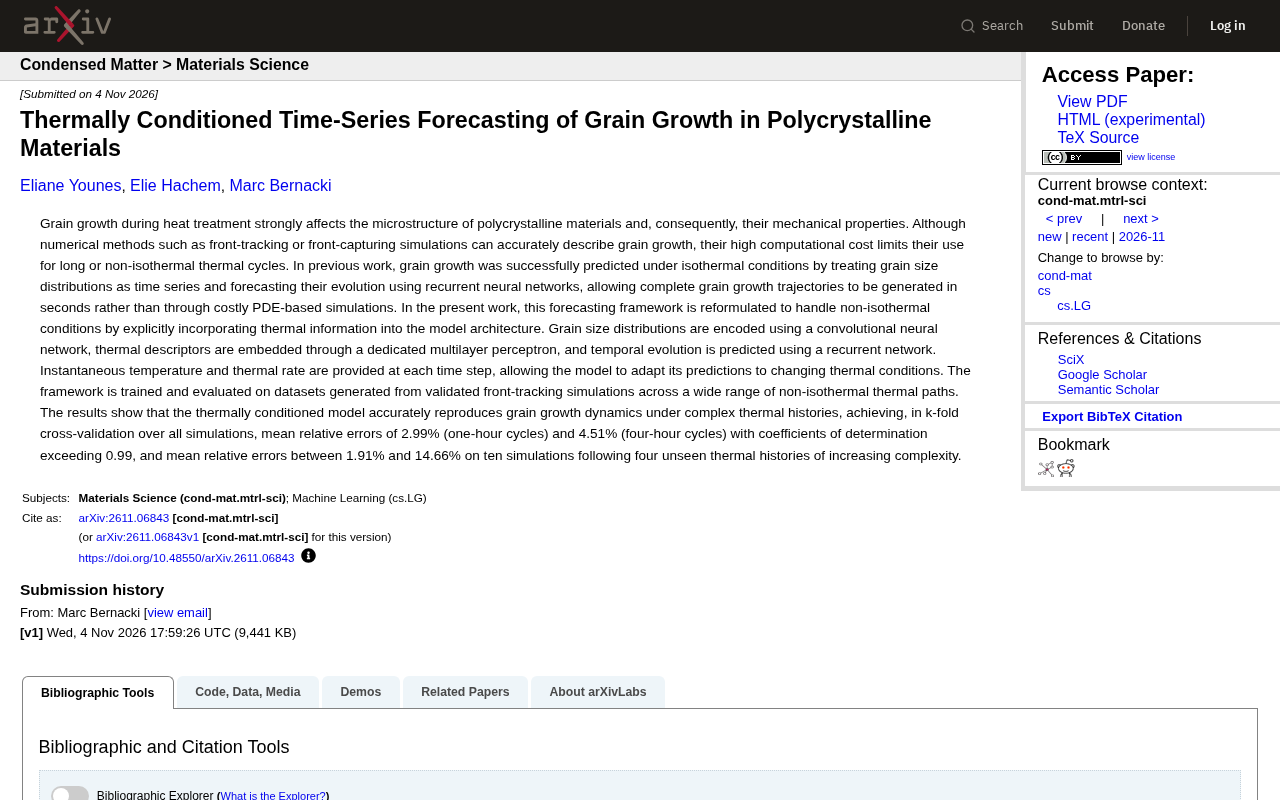
Grain growth is a key factor determining the microstructure of polycrystalline materials during heat treatment, directly affecting the mechanical properties of materials. Although traditional front-tracking or front-capturing numerical simulations can accurately describe this process, they are extremely computationally expensive and difficult to apply to long-duration or non-isothermal thermal cycles. A recent study proposed a thermal-conditioned time-series prediction framework that treats grain size distributions as time series and, by explicitly incorporating thermal information, achieves rapid prediction of grain growth trajectories under non-isothermal conditions.
From Isothermal to Non-Isothermal: An Architectural Redesign
The research team's previous work had already demonstrated that under isothermal conditions, grain size distributions can be treated as time series and their evolution predicted using recurrent neural networks (RNNs), thereby generating complete grain growth trajectories within seconds without running expensive partial differential equation (PDE) simulations. However, practical heat treatment often involves non-isothermal processes in which temperature varies with time, and the original framework cannot be directly applied.
To this end, the researchers redesigned the prediction framework, with the core idea of explicitly embedding thermal information into the model architecture. Specifically, grain size distributions are encoded via a convolutional neural network (CNN), thermal descriptors are embedded through a dedicated multilayer perceptron (MLP), and temporal evolution prediction is still handled by a recurrent network. At each time step, the model receives the instantaneous temperature and thermal rate as inputs, enabling it to adjust predictions according to changing thermal conditions.
This modular design allows the model to retain its time-series prediction capability while gaining awareness of thermal history. Unlike simply increasing the input dimensionality, thermal information is processed through an independent embedding pathway, avoiding potential interference from early fusion with grain size distribution features.
Recurrent neural networks (RNNs) are a class of neural network architectures specifically designed for sequential data, whose core feature is that hidden layer states are passed recurrently across time steps, enabling the network to retain historical information and model temporal dependencies. In grain growth prediction, the RNN treats the grain size distribution at each time step as an element in a sequence, accumulating information from all previous time steps through the hidden state, thereby learning the evolution patterns of grain size distributions over time. Compared with traditional PDE numerical simulation, which requires step-by-step solving of spatial partial differential equations, once an RNN is trained, it can generate complete time-series predictions within seconds through forward propagation—this is precisely the key to the computational acceleration achieved by this framework.
Convolutional neural networks (CNNs) undertake the task of encoding grain size distributions in this framework. Grain size distributions are typically presented as histograms or discrete intervals and possess structural characteristics such as local correlation and translation invariance. CNNs extract local patterns by sliding convolutional kernels over the distribution and then compress them into low-dimensional feature vectors via pooling layers, effectively capturing salient features of distribution shape (such as peak position, distribution width, and skewness) while significantly reducing input dimensionality. This encoding approach avoids the parameter explosion problem caused by directly feeding high-dimensional distributions into recurrent networks, providing a compact and information-rich representation for subsequent time-series modeling.
Training and Validation: Based on a Front-Tracking Simulation Dataset
To train and evaluate the model, the research team used validated front-tracking simulations to generate a large dataset under non-isothermal thermal paths. These thermal paths covered a wide range of conditions, ensuring that the model could learn grain growth behavior under different thermal histories.
In k-fold cross-validation, the thermal-conditioned model demonstrated high accuracy across all simulations: the average relative error was 2.99% for one-hour thermal cycles and 4.51% for four-hour thermal cycles, with coefficients of determination (R²) exceeding 0.99 in all cases. This means that the grain size distributions predicted by the model are highly consistent with the simulation results.
More noteworthy is the model's generalization ability to unseen thermal histories. In ten simulations following four unseen thermal histories of increasing complexity, the average relative error ranged from 1.91% to 14.66%. The wide error range reflects the fact that the more complex the thermal history, the greater the prediction difficulty; nevertheless, overall the model can still capture the main dynamic trends of grain growth.
k-fold cross-validation is a standard statistical method for evaluating model generalization performance. It involves randomly partitioning the dataset into k subsets of similar size, using one subset as the validation set and the remaining k-1 as the training set each time, repeating k times, and taking the average performance as the final evaluation metric. This method can make full use of limited simulation data and reduce evaluation bias caused by the randomness of a single training/validation split. In this study, k-fold cross-validation was used to test the prediction accuracy of the thermal-conditioned model on simulations with different thermal paths, ensuring that the reported error metrics (such as the average relative errors of 2.99% and 4.51%) are statistically reliable rather than incidental results under a particular data split.
The Trade-off Between Speed and Accuracy
The core value of this work lies in greatly lowering the computational threshold for predicting non-isothermal grain growth. Traditional PDE simulations may require hours or even longer to complete grain growth calculations for a single long-duration thermal cycle, whereas this framework can generate a complete trajectory within seconds. Although the accuracy is not perfect—especially under complex thermal histories, where the error can reach 14.66%—for many engineering applications, this speed advantage is sufficient to support rapid screening and parameter exploration.
From a methodological perspective, treating the evolution of material microstructure as a time-series prediction problem and designing dedicated embedding modules for specific physical conditions (such as temperature) provides a scalable approach for computational materials science. In the future, similar frameworks may be extended to predict other microstructural features or coupled with other physical fields.
Limitations and Outlook
The current model relies on data generated by front-tracking simulations for training, and its predictive capability is limited by the coverage of the training data. For extreme thermal paths or changes in material systems, the model may require retraining or fine-tuning. In addition, the error increases markedly under complex thermal histories, indicating that the model still has insufficient modeling capability for highly nonlinear thermal histories.
The research team points out that the modular design of the framework facilitates subsequent improvements, such as introducing more refined thermal descriptors or adopting more powerful sequence models. With continuous optimization of data generation and model architecture, thermal-conditioned time-series prediction is expected to become a practical tool for heat treatment process design and microstructure control.
One-line Summary
A thermal-conditioned time-series framework enables second-level prediction of non-isothermal grain growth with relatively high accuracy but limited generalization.
Paragraph Summary
This study proposes a thermal-conditioned time-series prediction framework that treats grain size distributions as time series, uses a CNN to encode distributions, an MLP to embed thermal descriptors, and an RNN to predict temporal evolution, explicitly incorporating instantaneous temperature and thermal rate to rapidly predict grain growth trajectories under non-isothermal conditions. The model was trained on a dataset generated by front-tracking simulations. In k-fold cross-validation, the average relative errors for one-hour and four-hour thermal cycles were 2.99% and 4.51%, respectively, with R² exceeding 0.99 in both cases. Under four unseen thermal histories of increasing complexity, the average relative error ranged from 1.91% to 14.66%, indicating limited generalization capability for complex thermal histories. The framework shortens computations that traditionally take hours in PDE simulations to seconds, providing a practical tool for rapid screening and parameter exploration in heat treatment processes, and its modular design also offers a scalable approach for computational materials science.
Related articles
 Tech Frontiers
Stylome Bot Slammed as Useless Junk: Why Do AI Detection Tools Keep Failing?
Reddit users test the Stylome AI detection bot: Gemini-rewritten text judged human-written, consistently low confidence. An analysis of AI text detection's technical dilemmas, privacy concerns, and credibility crisis in community governance.
 Tech Frontiers
When AI Becomes a Productivity Divide: Clarity or "AI Psychosis"?
A civil engineer's deep use of agentic AI boosted efficiency but bred contempt for peers who refuse to learn. Is this clarity or AI psychosis? An analysis of the cognitive and psychological challenges behind the AI productivity divide.
 Tech Frontiers
Opus 5.5 Benchmark Scores Climb, Community Says Its "Weights Are Blessed"
Reddit community discusses Opus 5.5's rising scores on the Benchmaxxing Bench, with users describing its performance as "weights are blessed." This article interprets the community reaction and cautions against conflating benchmark scores with real capability.