Premortem: Using AI Agents to Run a "Pre-Death Autopsy" on Your Startup Idea

Premortem uses AI agents to run a premortem on startup ideas, systematically exposing failure risks to counter founder optimism bias.
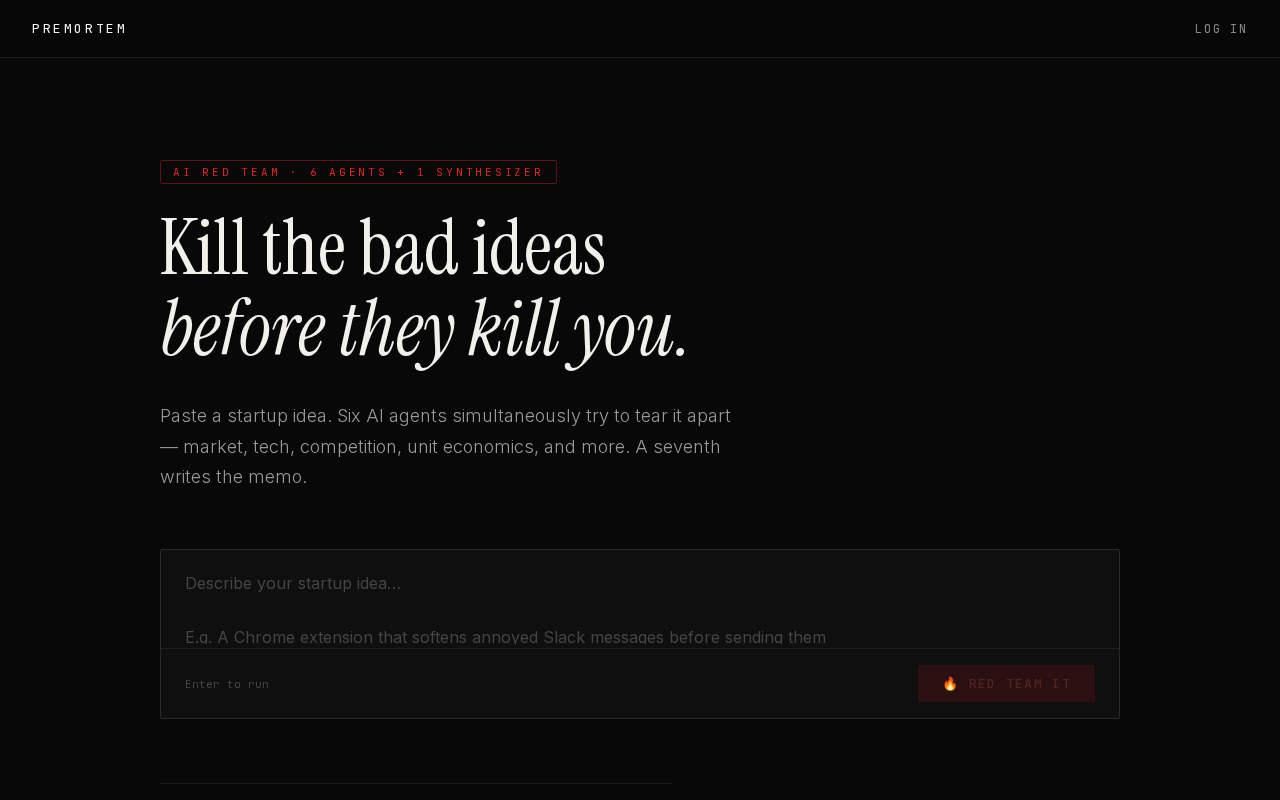
Premortem is a startup validation tool that combines the premortem methodology with AI agents, prompting them to red-team startup ideas rather than offer the typical agreeable feedback of general-purpose AI. It challenges market demand, business models, competitive moats, and execution feasibility across multiple specialized agent roles to help founders spot risks before committing resources. While the approach is conceptually sound as a counter to confirmation bias, the tool remains early-stage and faces a core limitation: LLMs struggle to capture industry-specific regulatory, channel, and user nuances, risking generic output. It's best used as a low-cost first-pass risk checklist, not a substitute for real market validation.
A Startup Validation Tool Built on Reverse Thinking
A tool called Premortem sparked a small but interesting discussion in the Show HN section of Hacker News. Its core idea is straightforward, yet it targets one of the most uncomfortable blind spots for founders: before committing real resources, let AI agents red-team your startup idea — systematically surfacing every reason it might fail.
The concept of "premortem" itself comes from psychology and project management. It asks teams to assume, before a project even launches, that it has already failed catastrophically — then work backward to identify what went wrong. Compared to conventional optimistic assessments, this failure-first framework significantly reduces cognitive blind spots, helping decision-makers uncover risks that excitement tends to obscure. Premortem the tool hands this methodology over to AI to execute.
Red-Team Thinking Meets AI Agents
The concept of "red-teaming" originates in military and cybersecurity contexts — it refers to a dedicated team that plays the adversary, actively probing for weaknesses. Applied to startup ideas, it means the AI doesn't respond the way a typical ChatGPT conversation would, offering encouraging feedback at every turn. Instead, it deliberately takes a critic's stance, challenging market demand, business model viability, competitive moats, and execution feasibility.
This framing addresses a widespread problem with AI-assisted decision-making: large language models are naturally inclined to be agreeable and generate positive responses. If a founder simply throws an idea at a general-purpose AI, they'll often receive a stream of cheap validation — "this is a great idea" — which only reinforces confirmation bias. Premortem deploys multiple AI agents, each playing a different skeptical role, in an attempt to construct a genuinely adversarial evaluation environment.
Why Founders Need Someone to Pour Cold Water on Their Ideas
The root cause of most startup failures isn't poor execution — it's that the original directional assumptions never held up. No real market demand, underestimated customer acquisition costs, overestimated user willingness to pay. Traditional early-stage validation relies on user interviews and MVP testing, which are expensive and time-consuming. A tool that can produce a structured risk checklist in minutes — even if only as a first-pass filter — has real practical value.
Multi-agent architecture is the technical foundation for tools like Premortem. Unlike a conversation with a single large model, a multi-agent system decomposes tasks across multiple specialized AI roles — one dedicated to questioning market size, another to stress-testing financial assumptions, another to simulating a competitor's perspective. The significance of this division of labor is that in a single conversation, an AI is easily steered by the user's own narrative framing. Multiple independent "skeptics" can apply pressure from different angles, reducing the probability that any particular blind spot goes unexamined. That said, multi-agent architecture also introduces new complexity: the quality of each agent's role definition and the coordination mechanism between them directly determine whether the output is genuinely adversarial or merely a surface-level performance of division of labor.
Confirmation bias is one of the most dangerous cognitive traps in the early stages of a startup. Psychological research shows that once people form an initial judgment, they unconsciously filter for information that supports it and discount contradicting evidence. Founders have typically invested enormous emotional energy and sunk costs into their ideas, making confirmation bias especially acute — mildly positive signals in user interviews get amplified, while doubts get dismissed as "they just don't get it." The premortem methodology works precisely because the premise of "assume failure has already occurred" forces a cognitive reframe, temporarily bypassing emotional defenses and making it easier to generate and accept negative information. This is why the method has documented real-world application in project reviews at institutions like McKinsey and Google.
The Tool's Positioning and Limitations
Judging by its reception on Hacker News — just 4 upvotes and 2 comments at launch — Premortem is still very much in early days, with a muted community response. The core skepticism these tools face is also clear: how much of an AI-generated risk analysis represents genuine insight, and how much is just generic templates drawn from training data?
Startup failures are often buried in industry-specific details — a particular regulatory policy, the hidden costs of a specific distribution channel, the genuine pain points of a user segment that are difficult to surface from the outside. These are precisely the areas where general-purpose large language models struggle to deliver accurate analysis. A more reasonable way to use Premortem is as a supplement to brainstorming, not as a basis for decisions. It can help founders quickly generate a list of assumptions that need further validation — but the actual validation still requires going to market and talking to real users.
AI Tools Exploring the Decision-Support Space
Premortem represents an interesting direction for AI applications: not replacing human decision-making, but improving decision quality by simulating an adversarial perspective. The same thinking extends naturally to contract review, investment assessment, product design critiques — putting AI in the role of "devil's advocate" to proactively expose the weak points in a plan.
The value of this kind of "adversarial AI assistance" depends on whether the agents can be designed to be sharp and specific enough. If the criticism is just packaged into formulaic boilerplate, users will lose interest quickly. Whether these tools can integrate industry data and real case libraries to sharpen their analysis will determine whether they become a flash in the pan or earn a permanent spot in the founder's toolkit.
The limitations of large language models on industry-specific knowledge fundamentally stem from the distribution of their training data. Detailed information about regulatory nuances, hidden channel costs, and regional market differences is severely underrepresented on the public internet. A model's "knowledge" in these dimensions is often a statistically averaged generalization, not genuine expert insight. This is why similar AI analysis tools perform far worse in heavily regulated industries — financial compliance, healthcare, government procurement — than in general-purpose scenarios. For Premortem specifically, integrating structured industry databases or connecting to a real failure case library (such as CB Insights' startup post-mortem reports) would fundamentally sharpen the quality of its analysis — but that also means significantly higher costs for data acquisition and maintenance.
Conclusion
Premortem combines the classic premortem decision-making method with AI agents, targeting the high-value but deeply uncertain space of startup validation. The underlying thinking deserves credit — using an adversarial perspective to counterbalance the optimism bias founders inevitably carry. But the tool remains early-stage, and its real-world effectiveness depends heavily on the depth and industry specificity of its AI analysis. For founders, the most sensible approach is to treat it as a low-cost starting point for risk self-assessment, while reserving final judgment for feedback from the real market.
Related articles

Running Full iOS 16.5 Firmware on Android Devices: Technical Demo or Marketing Gimmick?
A Hacker News post claims full iOS 16.5 firmware can run on Android, with 315 upvotes. This analysis argues it is more likely a web UI simulation than a true firmware port, and explores the value and risks of such projects.

Etsy Cracks Down on AI Slop: Addressing Buyer and Seller Anxieties
Etsy introduces stricter rules limiting AI-generated content in listings, addressing buyer confusion over AI products and seller fears of original work being diluted by AI slop.

When AI Agents Have Nothing to Do: MIT Experiment Reveals They Spontaneously Start Playing Games
MIT researchers placed 13 AI agents on a virtual desert island with no tasks. They spontaneously invented games, simulated emotional mourning, and performed better on later tasks. The experiment reveals insights for multi-agent system design.