Privatized AI Programmers: The Best Solution for Enterprises to Escape Token Anxiety

Privatized GPU deployment frees enterprises from SaaS token limits with unlimited AI coding.
AI-assisted programming has become a productivity standard, but third-party SaaS tools impose costly token limits and raise data security concerns. This article examines how enterprises can deploy open-source models like DeepSeek on private GPU servers to achieve unlimited, Token-Free AI programming. Beyond cost savings, private deployment uniquely enables model fine-tuning and customization using enterprise data — capabilities unavailable through SaaS providers.
AI-Assisted Programming Has Become a Productivity Standard
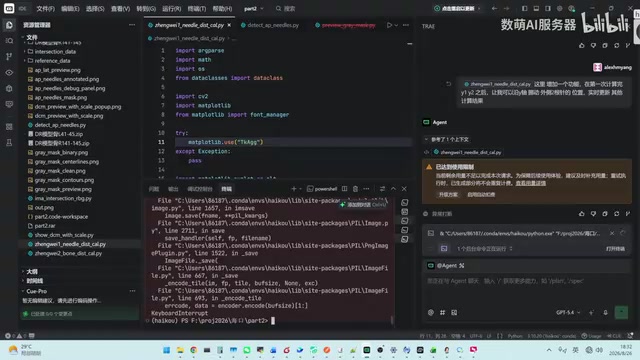
Over the past two years, AI-assisted programming has evolved from a concept into everyday practice. A practitioner from "Shumeng An Server" shared their firsthand experience: as a team originally providing AI algorithm and software development services, writing code became much easier after adopting AI Agent programming tools like ByteDance's Trae.
Their core point is straightforward: nowadays, whether it's big tech companies, startups, or individual developers, almost nobody writes code entirely from scratch anymore — the productivity is simply too low. The developer's role is shifting from "writing code" to "defining requirements and communicating with AI." You just need to clearly describe what you want, and the AI Agent handles the implementation details.
How AI Agents Differ from Traditional Conversational AI
One important detail: the emphasis here is on AI Agents, not simple conversational assistants. Tools like Trae, Codex, Claude, and Cursor don't just offer a chat window — they provide a complete programming assistant with planning, execution, and testing capabilities.
AI Agents represent the most significant paradigm shift in large language models over the past two years. Unlike traditional conversational AI's single-turn Q&A, Agent architecture gives AI the ability to autonomously plan (Planning), use tools (Tool Use), manage memory (Memory), and self-reflect (Reflection). The core operating mechanism is a "think-act-observe" loop — known in academia as the ReAct framework — where the AI first analyzes user requirements, breaks them down into subtasks, then sequentially invokes code editors, terminal commands, file systems, and other tools to complete the implementation, automatically correcting itself based on error feedback during execution. This architecture transforms AI from a passive responder into an active executor.
It can:
- Directly call APIs to modify code without repetitive copy-pasting
- Access more system permissions and autonomously handle multiple task steps
- Perform deep, long-chain reasoning instead of simple one-off Q&A
- Reference all files in the project (including images), delivering more accurate results based on hundreds of thousands of tokens of ultra-long context
It's worth noting that "hundreds of thousands of tokens of ultra-long context" represents a key capability breakthrough for current large models. A token is the basic unit of text processing in large language models — in Chinese, approximately 1.5-2 characters correspond to one token. The early GPT-3.5 had a context window of only 4K tokens (about 3,000 Chinese characters), while today Claude supports 200K tokens and Gemini 1.5 Pro even supports 1 million tokens. For coding Agents, ultra-long context means the model can "read" the entire project's codebase, documentation, and configuration files at once, providing more accurate and consistent code suggestions based on an understanding of the overall architecture, rather than only seeing fragments of the current file.
Real-World Case: Automating Complex Image Processing
A complex image processing example clearly demonstrates the practical capabilities of AI Agents. The code was almost entirely generated by AI, with the developer only responsible for defining requirements.
Specifically, the AI completed these tasks: grayscale conversion and threshold preprocessing of images — when steel pins and bones were hard to distinguish, simply raising the threshold separated the two; calculating centerlines and extracting contours, with excellent results. These operations traditionally rely on computer vision libraries like OpenCV, requiring developers to master numerous function parameters and processing pipeline combinations — a steep learning curve. The AI Agent encapsulates these low-level technical details behind natural language interaction, so developers only need to describe high-level intent like "separate the steel pin from the bone background."
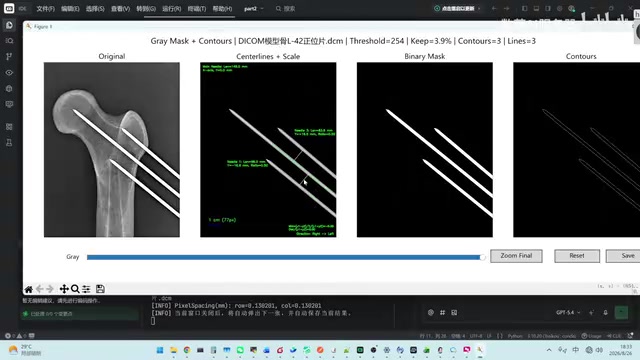
In the past, achieving such results often required trying multiple implementation approaches, consuming significant time, and sometimes never succeeding at all. Now, tasks including computing perpendicular distances and complex calculation formulas can be handled by AI as long as requirements are clearly described in natural language. Even trivial engineering issues like Chinese character encoding problems and popup dialogs can be automatically resolved by AI.
This is the core value of AI programming: freeing developers from tedious trial-and-error and debugging, letting them focus on problem definition and solution design.
The Pain Points of Third-Party APIs: Token Anxiety and High Costs
However, using third-party SaaS services comes at a cost. A very real problem looms — insufficient token quotas.
To understand this issue, you need to know the billing logic of AI services: tokens are not just a technical concept but also the core billing unit for AI services. Take OpenAI's GPT-4o as an example — input pricing is approximately $2.5 per million tokens, and output is approximately $10 per million tokens. Programming scenarios consume tokens extremely intensively because they require inputting extensive context (the entire project's code files, requirement descriptions, error logs) and outputting complete code blocks — a single programming conversation with full project context can consume tens of thousands or even hundreds of thousands of tokens. The monthly subscription model used by tools like Cursor is essentially a monthly token usage package, and when users exceed expected usage, they hit rate limits or are forced to upgrade.
During busy project periods, the $20/month quota can be exhausted in just a few days, with the system promptly suggesting a plan upgrade. Do the math: if you choose the $100/month tier, that's over ten thousand yuan per year in subscription fees — almost enough to buy a GPU outright.
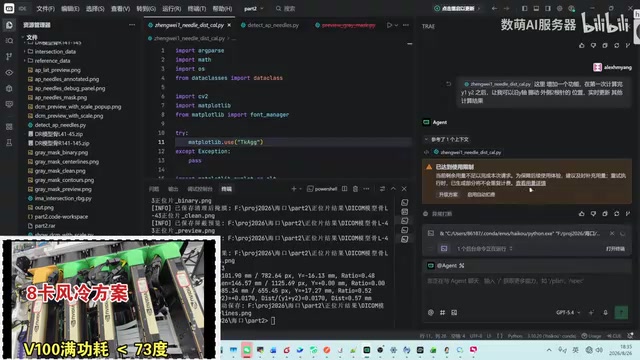
What's even more unsettling is the experience of "being at someone else's mercy": facing potential rate limiting, forced upgrades, and price increases at any time. For teams that heavily use AI programming, the long-term costs and uncertainty of the SaaS model are considerable. Additionally, sending enterprise core code to third-party APIs poses data security risks — code may contain business logic, encryption keys, database structures, and other sensitive information, and the consequences of a data breach would be immeasurable.
Privatized Deployment: Building Your Enterprise's Own AI Programmer
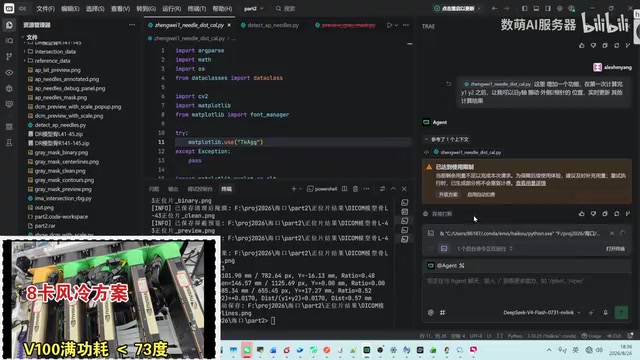
To address these pain points, the privatized GPU server solution has emerged. The core concept is achieving "Token Free" usage freedom — no longer being subject to others' control, using it however and as much as you want, with unlimited usage.
Open-Source Models Are the Key Prerequisite for Private Deployment
The feasibility of this approach is highly dependent on the evolution of open-source models. By locally deploying open-source models like DeepSeekAd to replace closed-source solutions, you can achieve essentially the same programming results.
DeepSeek is an open-source large language model series developed by the Chinese AI company DeepSeek, whose DeepSeek-Coder series performs excellently on mainstream code generation benchmarks like HumanEval and MBPP — approaching and even surpassing GPT-4 and other closed-source models on certain tasks. Privatized deployment typically relies on open-source inference frameworks such as vLLM, Ollama, and Text Generation Inference (TGI) to load model weights onto local GPUs. On the hardware selection front, the key metric is GPU memory (VRAM): a 70B parameter model at FP16 precision requires approximately 140GB of VRAM, but INT4 quantization can compress this to about 35GB, meaning a single 80GB NVIDIA A100 or two 24GB RTX 4090s can run it.
That said, we should be objective — the success of this approach depends on three factors:
- Inference speed of open-source models — directly impacts the development experience. Inference speed depends on GPU compute (measured in TFLOPS) and memory bandwidth (measured in GB/s). Under autoregressive generation, memory bandwidth is often the primary bottleneck, which is why at equal compute levels, HBM3 memory in A100/H100 outperforms GDDR6X memory in consumer GPUs for long text generation.
- Degree of algorithm optimization — determines hardware utilization efficiency. Technologies including FlashAttention, PagedAttention, Speculative Decoding, and Continuous Batching can multiply inference throughput several times over without changing hardware.
- Intelligence level of open-source models — affects code generation quality.
Fortunately, the open-source community is evolving extremely rapidly with frequent model iterations, steadily improving intelligence levels, and the gap with closed-source models is narrowing quickly. Since 2024 in particular, open-source models like Llama 3, Qwen2.5-Coder, and DeepSeek-V3 have reached or approached GPT-4 levels on multiple coding benchmarks, providing a solid model foundation for private deployment.
The Unique Value of Privatization: Beyond Inference to Training
Here's a key distinction: third-party tools like Trae can only help you generate tokens and write code, but they cannot help you fine-tune models.
With your own GPU server, your capabilities go further:
- Custom models: Optimize for specific business scenarios
- Modify models: Adjust to your team's coding style
- Train models: Continuously improve results using enterprise-owned data
Fine-tuning refers to further training a pre-trained large model using enterprise-owned domain data to better adapt it to specific business scenarios. Current mainstream efficient fine-tuning techniques include LoRA (Low-Rank Adaptation) and QLoRA (Quantized LoRA), which dramatically reduce the compute and memory required for fine-tuning by training only a small fraction of model parameters — typically less than 1% of total parameters. For example, a team can use their code repository commit history, coding standards documentation, and code review comments to fine-tune a model, making its generated code style consistent with the team's, and even automatically following internal API calling conventions, exception handling patterns, and logging formats. A single 24GB RTX 4090 with QLoRA technology can fine-tune 7B-13B scale models, with a much lower barrier than full training.
This is equivalent to upgrading from "renting external labor" to "hiring and training your own team," truly privatizing and controlling your AI programming capabilities.
Choosing and Thinking About Enterprise AI Programming Paths
Overall, this practitioner's insights convey signals on two levels:
Trend level — AI-generated code is an irreversible trend of the era. Both enterprises and individuals need to build their own AI programming capabilities, as the era of purely manual coding is coming to an end. According to GitHub's 2024 annual report, GitHub Copilot has helped developers complete over 46% of code writing, with even higher percentages in languages like Python and JavaScript. McKinsey's research also shows that developers using AI programming tools see a 35%-45% efficiency improvement on common coding tasks.
Cost and autonomy level — For high-frequency, large-scale users, privatized deployment offers clear advantages in cost and data sovereignty, especially the ability to train and customize models — something third-party SaaS cannot provide.
Of course, a rational perspective is needed: privatized deployment has a high hardware threshold and operational costs, and its cost-effectiveness is highly dependent on whether open-source models can match closed-source ones. Specifically, a production-ready GPU server (such as a workstation equipped with two A100 80GB GPUs) requires an initial investment of 100,000-300,000 RMB, plus ongoing costs for electricity, cooling, and operations staff. It typically takes 6-12 months of intensive use to recoup the cost difference compared to SaaS subscriptions. For small and medium teams, there's still a need to weigh the out-of-the-box convenience of SaaS against the long-term autonomy of private deployment based on actual usage and technical capabilities. A compromise approach is a hybrid architecture — using SaaS services for routine lightweight tasks while switching to private deployment for core business code or heavy tasks requiring large amounts of tokens.
Regardless of which path you choose, the assertion that "every enterprise needs its own AI programmer" is being validated by an increasing number of real-world practices.
Key Takeaways
Related articles

AI-Powered SRC Vulnerability Hunting: A Hands-On Guide to Building the Hermes Agent Workbench
Based on a hands-on Bilibili video: how to build an AI-powered SRC vulnerability hunting workbench—three-step method, four report elements, Agent mode vs web chat, and tool selection.

CLI-Anything Complete Beginner's Guide: How AI Operates Software — Principles and Practice
A complete beginner's guide to CLI-Anything: how AI Agents operate professional software via the command line, covering the three-layer architecture, CLI Hub installation, DrawIO practice, generator principles, and limits.

Carbon-X: A 14.8B Open-Source Model That Handles DNA and Text Simultaneously
Carbon-X is a 14.8B open-source multimodal model on Hugging Face where DNA and text share a token stream. 6-mer tokenization, 302B token mid-training, deployable on a single 80GB GPU, 66.7% average on five DNA benchmarks, Apache 2.0 license.