Proactive AI Agents: Using Scheduled Triggers to Enable Autonomous Background Execution

Scheduled triggers are the most practical first step toward building truly proactive, background-running AI agents.
Most AI agents today operate in a passive command-response mode, but proactive agents flip this by launching tasks autonomously in the background without user prompts. Scheduled triggers offer the most accessible entry point — driving task execution on a fixed cadence while keeping autonomous behavior within predictable, trustworthy boundaries. Event-driven, condition-based, and subscription-based triggers serve as complementary paths, and mature systems often combine all of them. For agent product teams, the pragmatic strategy is to establish user trust through scheduling first, then expand toward more complex trigger networks rather than attempting full autonomy from the start.
From Passive Response to Proactive Execution
Most AI agents today remain stuck in a "question-and-answer" passive mode: the user issues a command, the agent gets to work, and once the task is done, it goes dormant. While intuitive, this interaction model limits the full value agents can deliver. A perspective shared on Twitter points toward what comes next — Proactive Agents should run autonomously in the background, and scheduled triggers (Schedules) are one of the key paths to making that happen.
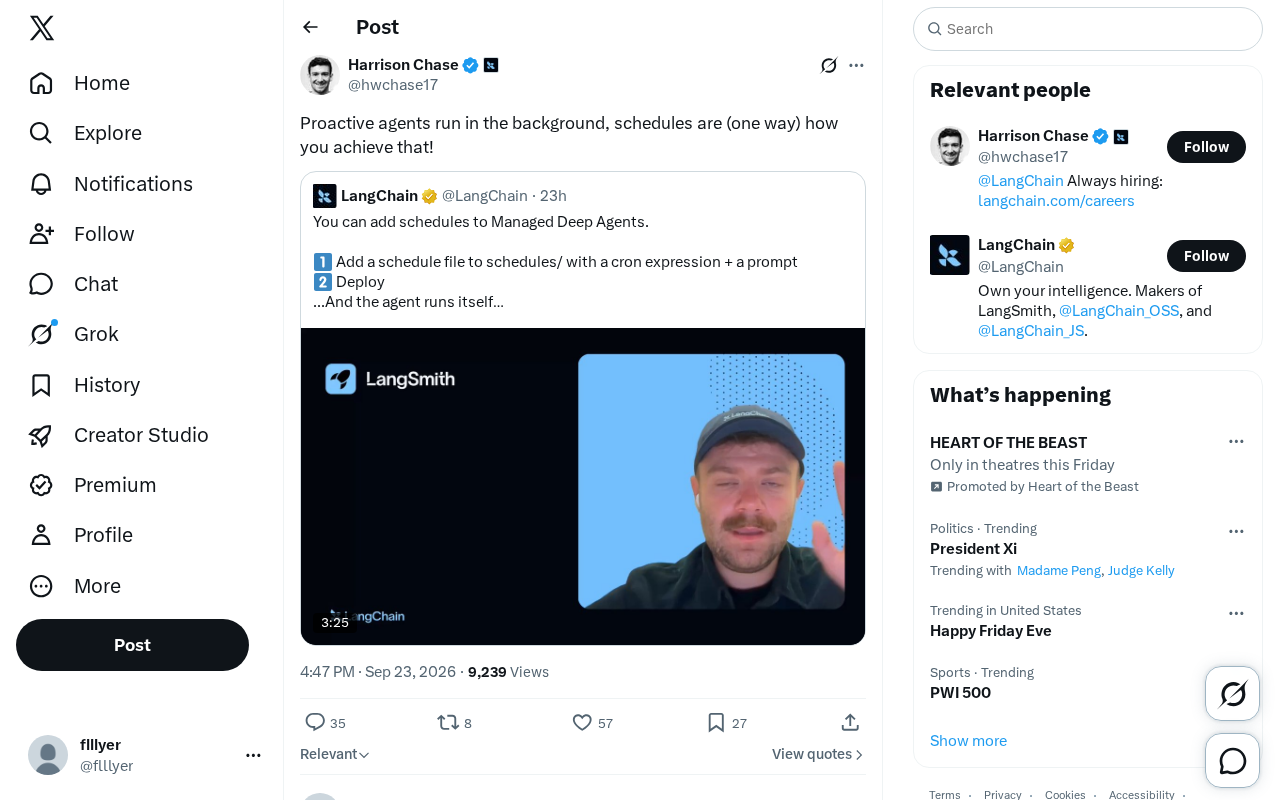
The core distinction of a proactive agent lies in who initiates the action. Every move a traditional agent makes is triggered by a human, whereas a proactive agent can launch tasks on its own — based on preset conditions or time-based rules — without any human intervention. It's no longer a tool waiting for commands; it's closer to a digital assistant quietly standing watch in the background.
Why Scheduling Mechanisms Matter
The original post carefully describes scheduling as "one way" to enable background execution — a measured phrasing, but one with clear intent. Scheduling becomes a natural entry point for proactive agents because it offers a simple, controllable triggering framework.
Time-Driven Task Execution
By setting fixed schedules — hourly, daily, weekly — an agent can periodically carry out predefined tasks: scraping industry news and generating summaries, organizing to-dos every morning, or compiling weekly data reports. The strength of this approach lies in its predictability, controllability, and ease of debugging. Developers know exactly when the agent will do what.
On the technical side, scheduled execution typically relies on Cron expressions or similar time-description syntax (e.g., 0 8 * * * for 8 AM daily) — a mechanism with decades of history in server automation and a highly mature infrastructure footprint. Modern agent frameworks such as LangGraph, AutoGen, and Temporal are integrating scheduling capabilities directly into the agent's task orchestration layer, sparing developers from maintaining separate Cron services. One critical distinction between scheduled tasks and ordinary API calls is that scheduling runs unattended: no user is present to confirm when the trigger fires. This means agent outputs must be idempotent (consistent results across repeated executions under the same conditions), and robust logging and alerting systems are essential for tracing failures when they occur.
Containing the Risks of Autonomy
Fully autonomous agents face real challenges around trust and safety: if an agent can take any action at any moment, users struggle to form stable expectations about its behavior. Scheduling acts like a metronome for autonomy — it constrains the agent's independent actions within clear temporal boundaries, preserving the ability to execute proactively while avoiding unpredictable, random triggering.
Other Paths Beyond Scheduling
The original post specifically uses the parenthetical "one way," signaling that scheduled triggers aren't the only means of achieving proactive agency. Several complementary triggering mechanisms can also power autonomous background execution:
- Event-driven: Wake the agent when something changes in an external system — a new email arrives, a code repository receives a commit, or a monitoring metric crosses a threshold.
- Condition-based: The agent continuously observes certain states and acts once predefined conditions are met.
- Subscription-based: The agent subscribes to specific data streams or message queues and responds in real time to newly arriving information.
Scheduled triggers aren't mutually exclusive with these mechanisms. Mature proactive agent systems often combine multiple trigger types, forming a composite network of "time + event + condition" triggers.
Event-driven architecture (EDA) is already a well-established paradigm in traditional software engineering, but integrating it into agent systems introduces a new challenge: the agent's reasoning process carries inherent uncertainty and latency, while event streams often demand near-real-time responses. To address this, some systems adopt an "event enqueue + async consume" pattern — external events are written to a message queue (e.g., Kafka, SQS) first, and the agent consumes them as a subscriber at its own pace, decoupling the event production rate from the agent's processing rate. Condition-based triggering requires the agent to continuously perceive its environment, which can impose significant compute and token costs in long-running scenarios. This typically calls for a two-phase architecture: a lightweight probe to check whether conditions are met at low cost, followed by a full LLM reasoning chain only when the condition is satisfied.
Implications for Agent Product Design
Brief as this perspective is, it carries real weight for teams building agent products. It suggests that when evolving from passive to proactive agents, you don't have to leap straight to a fully autonomous, highly complex form. Instead, start with the scheduling mechanism — the easiest to ship and the most grounded.
Scheduled triggers are something most users can understand and trust as a first step. They make the value of background agent work tangible — users don't have to watch constantly; tasks just get done on time. Once solid scheduling is up and running, you can progressively layer in event-driven and condition-based triggers to build what truly qualifies as a proactive intelligent agent.
It's worth noting that the original source is intentionally concise, conveying a product philosophy rather than a complete technical blueprint. Developers looking to go deeper will still need to design scheduling strategies, handle concurrent execution, and manage error recovery for agents running without human supervision — all in the context of their specific frameworks and business requirements.
Related articles

Felix Rieseberg Personal Homepage
Felix Rieseberg's personal homepage sparks attention on Hacker News. This article covers the Slack engineer's technical background, the rise and fall of nativefier, and the value of a developer homepage as a tech calling card.

@ai-sdk/vue 3.0.306 Patch Release Syncs with [email protected] Update
@ai-sdk/vue 3.0.306 released, synced with [email protected]. A routine patch release for the Vercel AI SDK ecosystem with no public API changes; the Vue adapter layer stays version-aligned with the core package.

Gemini 4 Argon API Launches: The Era of Million-Token Output Begins
Google launches Gemini 4 Argon with sparse MoE architecture, up to 1M output tokens, and a 68.90% Vals Index score, available across API, AI Studio, and the Gemini app.