Proc-CLI: A Process and Port Management CLI Tool Designed for AI Agents

Proc-CLI brings agent-friendly design to process and port management, filling the interface gap for agents controlling local environments.
The article introduces Proc-CLI, an "agent-friendly" CLI tool on Hacker News focused on process and port management. Traditional CLIs are designed for humans with output relying on human reading, while AI agents need structured output, deterministic behavior, and clear error codes. Proc-CLI is released as an open-source Show HN, emphasizing composability for coding agents like Claude Code and Cursor. While project maturity is unverified, the direction reveals that AI programming bottlenecks lie in how well tool interfaces adapt to agents.
As AI agents gradually take over development workflows, a seemingly minor yet critical question has surfaced: how can agents reliably manage local processes and ports? Proc-CLI, newly unveiled on Hacker News, attempts to provide an answer.
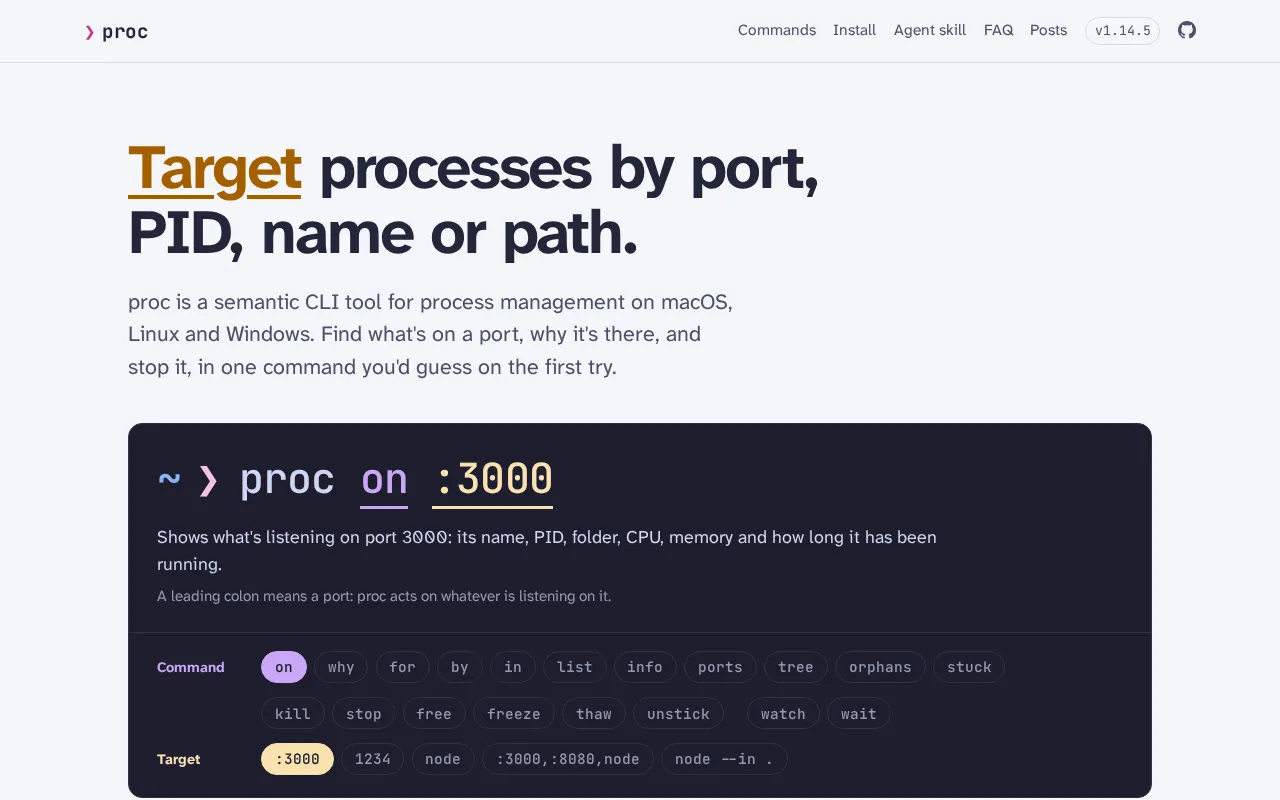
When Agents Need to "Get Hands-On" with Process Management
Traditional CLI tools are designed for humans—output is meant for human eyes, error messages rely on contextual understanding, and interaction flows assume the operator has system knowledge. But when AI agents call tools, they need structured output, deterministic behavior, and clear error codes.
Proc-CLI positions itself as "agent-friendly," meaning it was designed from the start with machine invocation scenarios in mind. Although the project has only received 6 points on Hacker News with no comments yet, this direction touches on a real pain point in current AI engineering: for agents to complete development tasks, they cannot avoid manipulating the local runtime environment.
Processes and Ports: The Hidden Bottleneck in Agent Workflows
Imagine a typical agent workflow: start a dev server, detect port occupancy, clean up zombie processes, restart services. These operations take just a few commands in human hands, but for an agent, parsing the text output of ps aux or lsof -i and making correct judgments is far more difficult than one might imagine.
Proc-CLI focuses on the two high-frequency scenarios of processes and ports, providing a more regular interface. This reflects a broader trend: toolchains are being redesigned for AI consumers, not merely optimized for human users.
Speaking of
ps auxandlsof -i, it's worth explaining why they're unfriendly to agents.ps auxoutputs a columnar snapshot of processes, with column widths that float with content, process names that may be truncated, and a STAT column that uses single-letter codes for states (e.g., S for sleeping, R for running, Z for zombie)—agents must rely on precise assumptions about headers and column positions to parse it.lsof -ioutputs network file handles, with fields separated by spaces but missing columns present, and the mapping between ports and processes requires multi-line correlation to reconstruct. Both lack a stable machine-readable format (such as JSON), and errors are returned in natural language, making it difficult for agents to use deterministic logic to judge "is this port occupied" and "which PID holds it"—this is precisely the interface ambiguity that Proc-CLI aims to solve.
The Fit Between Open Source and the Agent Ecosystem
Released as a Show HN, the project falls into the open-source tool category. At a stage when agent frameworks are flourishing, the value of such low-level tools lies in composability—it can be called directly by coding agents like Claude Code and Cursor, or embedded into custom automation scripts.
However, it should be viewed objectively: information from a single-source Show HN post is limited, and the project's maturity, cross-platform support, and specific API design have not yet been fully vetted by the community. Whether such tools can become standard components of the agent toolchain depends on subsequent iteration and actual adoption.
The "composability" mentioned here, in the agent context, refers to tools being dynamically discoverable and orchestrated by models via function calling or MCP (Model Context Protocol) and similar mechanisms. MCP is an open protocol proposed by Anthropic that lets agents connect to external tools and data sources in a unified way; if a CLI provides a stable parameter schema and structured JSON output, it becomes easier to wrap as an MCP server or function tool for hosts like Claude Code and Cursor to invoke on demand. Conversely, interactive CLIs with human-oriented output are difficult to automatically compose into multi-step workflows. Therefore, "agent-friendly" is essentially about making design trade-offs for the orchestrability of the toolchain.
Implications for Developers
The emergence of Proc-CLI reminds us: the bottleneck of AI programming lies not only in model capabilities but also in the degree of adaptation of tool interfaces. As more and more agents participate in development workflows, optimizing CLI output for agents, providing structured errors, and reducing ambiguity will become a clear direction for tool development.
One-line Summary
Proc-CLI focuses on process and port management with an agent-friendly design, filling the interface gap for agents to control local environments.
Paragraph Summary
The article introduces Proc-CLI, which appeared on Hacker News, an "agent-friendly" CLI tool focused on process and port management. Traditional CLIs are designed for humans, with output that relies on human reading and contextual understanding, whereas AI agents calling tools need structured output, deterministic behavior, and clear error codes. Typical agent workflows such as starting dev servers, detecting port occupancy, and cleaning up zombie processes—parsing the text of ps aux or lsof -i is far harder than imagined. Proc-CLI is released as an open-source Show HN, emphasizing composability, and can be called by coding agents like Claude Code and Cursor. The article also notes that project information is limited and maturity unverified, but the direction reveals that the bottleneck of AI programming lies not only in model capabilities but more in the degree of adaptation of tool interfaces for agents.
Related articles

MEV Dataset: A Multi-Event Video Resource for Long-Take Generation
MEV is a multi-event video dataset for long-take generation, offering precise temporal boundaries and fine-grained event annotations to address temporal inconsistency caused by insufficient supervision in existing text-to-video data.

Should Coding Agents Follow Precedent or Task Intent?
A study of 5,625 trials reveals coding agents prioritize repository precedents over task intent, but written priority rules (59/60) outperform code examples (38/60) when intent conflicts.

Rubricon: Automatically Generating Rubrics to Boost LLM Evaluation and Training Efficiency
Rubricon automatically generates discriminative rubrics for LLM evaluation and training without human annotation, improving alignment by 9% and outperforming RRD by 4.5% on HealthBench.