Programmer's Guide to the AI Era: Application Development Is a Real Opportunity for Ordinary Developers

A practical framework for programmers to pivot into AI via Agent and large model application development.
This article breaks down three levels of AI adoption for programmers — tool usage, algorithm engineering, and application development — and argues that AI Agent development and large model secondary development are the most realistic entry points for ordinary developers. It covers learning timelines, salary trends, and key risks like shrinking premiums and limited job supply, recommending a dual-track strategy of AI skills plus traditional backend development.
In today's AI-driven IT landscape, countless programmers are anxious: Will traditional development roles become obsolete? How should they pivot? According to a live stream by an instructor from Bilibili's Mashi Group, the path for ordinary programmers to embrace AI is actually quite clear — the key is understanding which level you can realistically reach, and what window of opportunity you need to seize.
This article distills that sharing into a practical AI transition framework, with an in-depth look at both the opportunities and the pitfalls.
Three Levels of Embracing AI
The instructor breaks down how ordinary people can embrace AI into several progressive levels — a framework that's highly useful for self-assessment.
Level 1: Using AI as a Tool
The most basic level is using AI as a productivity tool — generating PPTs, summarizing reports, or getting coding assistance (AI Coding Assistant) with tools like DeepSeek or ChatGPT. The core skill at this level is Prompt Engineering.
Prompt Engineering refers to the practice of carefully designing input text to guide large language models toward desired outputs. Between 2022 and 2023, as ChatGPT went viral, "Prompt Engineer" was briefly hyped as a lucrative new career. However, with the emergence of next-generation models like GPT-4 and Claude 3, capabilities such as Instruction Following and contextual understanding improved dramatically, reducing the reliance on precisely crafted prompts. This is largely due to the maturation of RLHF (Reinforcement Learning from Human Feedback) training, which enables models to better interpret vague intent. As a result, dedicated "Prompt Engineer" roles are now rarely seen. That said, strong prompting skills remain a worthwhile foundational capability for anyone who wants AI to assist them efficiently.
For professionals in any field, resisting these tools is unwise — this is the lowest barrier to entry, and it's non-negotiable.
Level 2: Algorithm Engineer (Out of Reach for Most)
A true algorithm engineer is someone who invents AI algorithms — the teams behind technologies like ChatGPT, Gemini, DeepSeek, Claude, and Cursor.
This is one of the two highest-paying career tracks in the IT industry, but the barrier to entry is extremely high. Training a foundation model at the level of GPT-4 reportedly cost OpenAI over $100 million in compute, requiring thousands of A100/H100 GPUs. This enormous resource requirement creates a natural "compute moat" that bars the vast majority of companies and individuals from foundational model research. Even technically, core breakthroughs — such as the Transformer architecture, RLHF training paradigms, and MoE (Mixture of Experts) — have come from PhD teams at top universities and elite research labs. In China, the institutions actually capable of foundational model R&D are few: Baidu's ERNIE, Alibaba's Tongyi, Zhipu AI, Moonshot AI, and DeepSeek, among others — and they absorb very limited talent. The instructor was blunt: to join the algorithm team at a decent company, you most likely need a graduate degree from a top-tier Chinese university (985), with a relevant technical background.
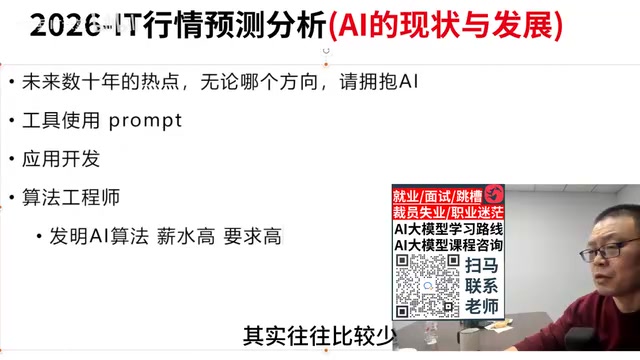
The instructor offered two sobering observations:
- These teams are inherently small: Innovation isn't a numbers game — packing in unqualified people won't produce breakthroughs, so these teams are naturally lean.
- The resource barrier is extreme: Compute resources and top-tier talent are typically only accessible to large enterprises; smaller companies simply can't play.
The conclusion is realistic — for most people, the algorithm engineer path is out of reach.
AI Application Development: Where Ordinary Programmers Can Actually Make an Impact
Since algorithm engineering is out of reach and basic tool usage is too low-level, the real opportunity for ordinary programmers lies in AI application development. This level breaks down into two sub-tiers.
Sub-tier 1: Agent Development
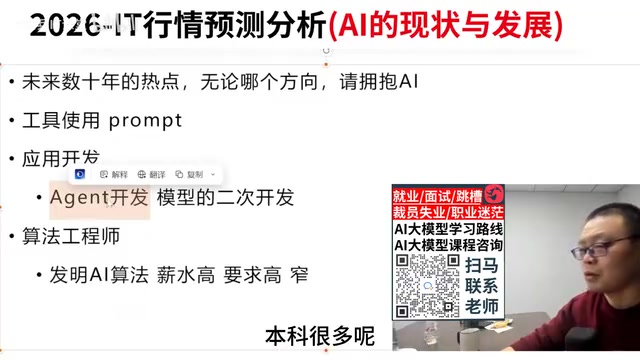
AI Agents represent one of the most important paradigms for deploying large language models in production. A typical Agent architecture includes: an LLM as the "brain" for reasoning and decision-making, Tool Use / Function Calling for executing specific actions, a Memory system for context storage, and a Planning module for decomposing complex tasks. Popular frameworks include LangChain, LlamaIndex, and AutoGen. Key skills include API integration, Workflow Orchestration, RAG (Retrieval-Augmented Generation), and multi-agent collaboration. At its core, Agent development enables people to interact with intelligent systems in a streamlined way, delegating processes that once required manual intervention to automated agents — with full integration and tool-calling capabilities. This tech stack is relatively mature and doesn't require deep math, making it the ideal entry point for application-layer developers breaking into AI.
According to the instructor, Agent development roles are currently in the early stages of an explosion — the number is growing, but the absolute count is still limited.
The most critical data point is the learning curve: for someone with roughly the academic ability of a second-tier university graduate, learning just the Agent development portion takes about one month of part-time study to become job-ready. (Part-time is defined as two hours per weekday and six hours each day on weekends.)
The instructor backed this up with a real example: a student from a lower-ranked 211 university who started learning in their first year of graduate school, focusing on both Java backend and AI large model development. Upon graduation, they received 8 job offers — including a position at ICBC's R&D Center (¥210K pre-tax, ¥300K after five years, with Beijing hukou), Hikvision's Shanghai Research Institute (¥390K pre-tax), and a Java backend role at Naura Technology (¥400K pre-tax but 996), along with AI Agent development roles from BYD and the Tianjin Cement Industry Research Institute.
Two trends emerge from this offer breakdown: backend roles currently pay slightly more than Agent development roles, but the volume of Agent development offers is growing steadily.
Sub-tier 2: Large Model Secondary Development
The second sub-tier involves building applications on top of open-source models (such as Tongyi Qianwen or DeepSeek) — deploying them in vertical domains like foreign trade, legal services, or healthcare, or within enterprise environments, feeding them domain-specific data, fine-tuning them, and exposing business interfaces. This is commonly referred to as "model secondary development" or the "large model engineer" role.
The core technical paths in this area are primarily two: first, RAG (Retrieval-Augmented Generation), which uses vector databases (such as Faiss, Milvus, or Chroma) to inject proprietary knowledge into the model's context without modifying model weights — low cost, fast iteration; second, Fine-tuning, which adjusts model parameters using domain-specific data on top of open-source base models, typically using parameter-efficient methods like LoRA or QLoRA that can run on consumer-grade GPUs. Deployment involves model Quantization, inference acceleration frameworks (such as vLLM and Ollama), and API wrapping. This stack requires Python programming, Linux server operations, and basic deep learning concepts — but does not require designing algorithms from scratch.
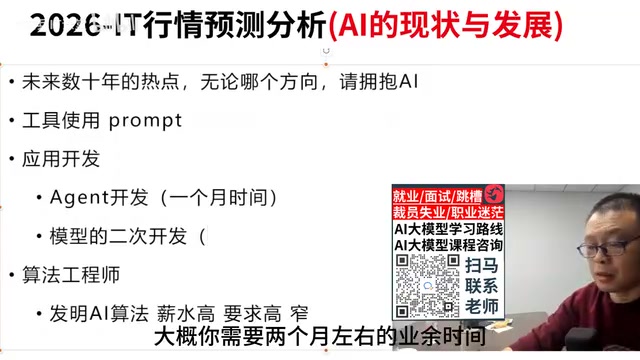
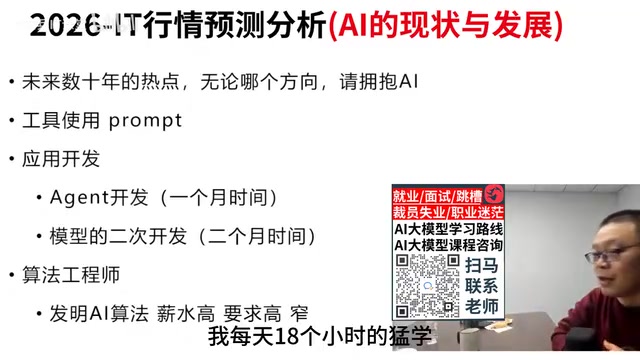
In terms of the learning timeline, given a foundation in Agent development, large model secondary development requires approximately two additional months of part-time study. Combined, the entire application development stack can be covered in roughly three months of part-time effort.
A practical note: many job listings labeled "Algorithm Engineer" actually require large model secondary development skills. So don't be intimidated by the title — check the detailed requirements, and you may well be qualified to apply. Also, your résumé must include project experience with meaningful complexity and technical depth; otherwise, it simply won't stand out.
Three Hidden Risks Behind the Opportunity
While laying out the opportunities, the instructor also offered some of the sharpest risk assessments in the entire talk — this is arguably the most valuable part.
Risk 1: The Easier the Skill, the Less It Retains Long-Term Value
This is the core logic. Technical skills in the IT industry follow a clear lifecycle curve: when a new technology emerges, few people know it, and the salary premium is significant. As training programs proliferate, the open-source ecosystem matures, and documentation improves, the learning barrier drops quickly. Supply-side talent floods in, the premium narrows and disappears, and the skill becomes a baseline expectation. This pattern has played out historically in mobile development (iOS/Android engineers, 2010–2015), frontend frameworks (React/Vue engineers, 2015–2018), and cloud-native infrastructure (K8s/Docker engineers, 2018–2021).
The reason application development commands a premium today is precisely because it's new enough that many companies haven't caught on yet. But the instructor was clear:
"Within the next two to three years, application development will become something every programmer is expected to know. By then, you'll have to learn it anyway — and knowing it won't earn you extra credit."
In other words, today's window exists because the market hasn't fully processed this yet. Some companies have already realized it's not that hard to learn and are pushing their existing developers to pick it up to support new business lines.
Risk 2: Job Openings Are Still Limited and Heavily Concentrated in Tier-1 Cities
The instructor offered a rough comparison: if Java roles are indexed at 10 and C/C++ at 5, then Agent and large model development currently sits somewhere between 1 and 2. The low count, combined with a heavy concentration in Tier-1 cities, means that if you're based in a smaller city, relying solely on application development skills may not be enough.
Risk 3: Low Barriers Mean Fierce Competition
Precisely because the learning barrier is low (accessible to second-tier university graduates within a month), competition will intensify rapidly. Developers who only specialize in application development will, in the instructor's assessment, find their competitive edge fading "within two to three years."
Practical Advice: A Dual-Track Strategy of Frontier + Foundation
Based on all of the above, the instructor's final recommendation is worth taking seriously:
- Embrace AI without question — choose a direction that's relevant both now and over the coming decades;
- But given that application development alone has a narrow job market and low barriers, pair it with a broader foundational skill set as a safety net — specifically Java or C/C++.
This "frontier plus foundation" combination is essentially a risk-hedging approach: use AI application development to capture today's early-mover premium, while solid traditional development skills ensure long-term employability. For those pressed for time who want to break into cutting-edge roles quickly, doubling down on application development makes sense. But for a more durable and resilient career path, running both tracks in parallel is the safer choice.
Final Thoughts
The most valuable aspect of this talk isn't that it hypes AI's opportunities — it's that it calmly distinguishes between what's within reach and what isn't, between short-term premiums and long-term value. For the average programmer, algorithm engineering is a distant summit, basic tool usage is the floor everyone must clear, and AI application development is the middle ground worth sprinting toward right now — but only if you move while the window is still open.
Be an early mover — because two to three years from now, today's rare skill may well become the bare minimum everyone is expected to have.
Related articles

The Truth Behind Codex 'Build a Website in 5 Minutes': AI Isn't Creating Sites—It's Helping You Copy Them
Exposing the truth behind viral Codex 5-minute website videos: creators aren't building original sites with AI—they're copying shared prompts or scraping others' work. Learn AI coding tools' real limits.

Getting Started with AI Agent Development: A Complete Guide from Concept to Practice
A comprehensive guide to AI Agent architecture and development, covering automated marketing, intelligent customer service, and investment analysis scenarios with single and multi-agent collaboration.

The Truth Behind Codex 'Build a Website in 5 Minutes': AI Isn't Creating Sites — It's Helping You Copy Them
Exposing the truth behind viral Codex 5-minute website videos: creators aren't building original sites with AI — they're copying shared prompts or scraping others' work.