Prompt Engineering for Beginners: A Six-Step Method from Vague Instructions to Stable Output

Prompts are the direct means to control AI, but you need systematic methodology and must recognize its capability boundaries.
Based on a Bilibili prompt engineering tutorial, this article clarifies the difference between prompts and prompt engineering: prompts are one-off instructions with four functions—communication bridge, task navigation, style control, and boundary constraints; prompt engineering is a six-step systematic method of requirement decomposition, design, testing, evaluation, iteration, and codification for reuse. The article notes the low learning barrier and significant efficiency and commercial value, while focusing on limitations: prompts cannot break through model capability ceilings, face hard constraints like context length, instability on complex tasks, and no long-term memory, and pure prompts are hard to engineer—enterprise applications need code integration and must watch token costs. The conclusion: prompts are a tool, not a master key; building systematic understanding matters more than memorizing templates.
Many people think prompts are just messages sent to AI, but it's far more than that. A popular prompt engineering tutorial on Bilibili makes this clear from the start: prompts are the most direct means you have to control AI, while prompt engineering is a methodology for getting AI to reliably produce usable results. This article builds on the core framework of that tutorial, combined with consensus from creators across multiple platforms, to lay out the complete picture from basic understanding to practical limitations.
What Is a Prompt? More Than Just "Sending a Message"
The tutorial offers a minimalist definition: any instruction you give AI—whether a question or a description—is a prompt. It's like a neural signal: whatever signal you send, AI thinks in that direction. With the same model, some people can only get it to write elementary-school essays, while others can produce professional industry reports. The difference isn't the AI itself—it's the input instructions.
The specific functions of prompts can be broken into four layers:
- Communication bridge: Translating vague needs in your head into clear instructions AI can understand. It's like ordering takeout—you can't just say "bring me some food"; you need to specify the dish, spice level, and whether to add rice.
- Task navigation: Telling AI exactly what to do and where the boundaries are. Say "help me process this file" and AI can only guess; specify whether it's statistical analysis or visualization, and it won't go off track.
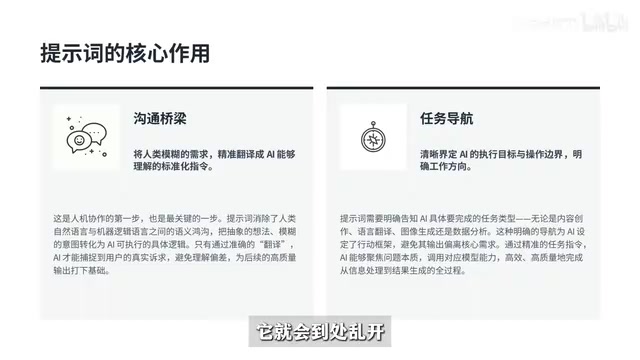
- Style control: Getting AI to write commentary in Lu Xun's style, a diary in an elementary student's voice, or a paper in academic language—saving you from extensive post-editing.
- Boundary constraints: This is an effective way to curb AI fabrication. For example, limiting it to "only look at a certain quarter's financial report, don't bring in macro policy" makes the output more focused.
The tutorial uses a "spring" writing example to compare: a basic prompt just says "write an article about spring"—too broad, so AI can only guess, and the result is generic. The optimized prompt assigns a role (essay writer), limits word count (800 words), specifies the scene (spring in Jiangnan), and defines the style (elegant language, focusing on the misty, rainy water-town atmosphere)—and the output quality improves immediately.
Role Prompting is the technique behind "assigning a role" in the tutorial's example: specifying a role for AI in the prompt, such as "you are an essay writer." The principle is that the model has seen large amounts of corpus from different identities during training; role setting activates vocabulary, tone, and knowledge distributions from relevant domains, making output more aligned with that identity. Role prompting is often combined with task descriptions and style requirements, and can significantly improve output quality in professional scenarios. But role setting isn't a panacea—it can't give the model knowledge it doesn't have, and over-relying on roles while ignoring task details still leads to generic output.
Prompts vs. Prompt Engineering: One-Off Tricks vs. Systematic Method
Many people conflate these two concepts. The tutorial emphasizes that prompts are one-off—like writing a line of code to execute once; change the question and it may not work. So-called "universal prompts" don't exist; there are only prompts tailored to specific scenarios.
Prompt engineering, by contrast, is a complete process: without modifying model code or parameters, you design input instructions to get general-purpose AI to reliably solve specific business problems. It doesn't rely on inspiration but on scientific method, and it solves not one problem but a class of problems.
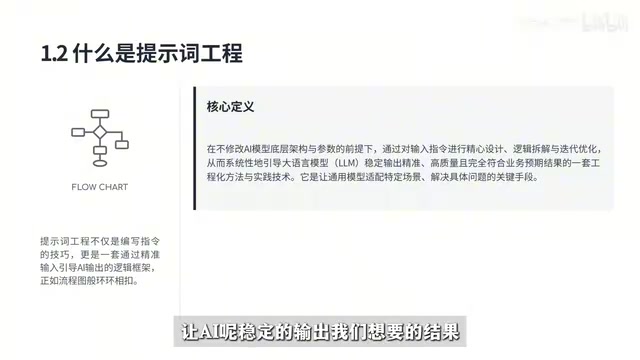
The tutorial breaks this process into six steps:
- Requirement decomposition: Break complex big problems into small problems AI can handle.
- Solution design: Design prompts and roles for the decomposed problems.
- Execution and testing: Actually run it and see the results.
- Evaluation: Judge result quality using specific criteria.
- Strategy iteration: Continuously optimize weak points.
- Codification and reuse: Save effective solutions for direct reuse on similar problems.
This is very similar to software development processes—except you're writing natural language. According to the Bilibili tutorial and analyses from multiple AI creators, this six-step method is a general framework that has been repeatedly validated.
Why Learn Prompt Engineering Now?
The tutorial offers a simple judgment: AI capabilities are already strong, but most people don't know how to use them. It cites data claiming over 90% of users only use AI for basic Q&A—like buying a sports car but only driving in first gear.
The barrier to learning prompt engineering is extremely low: no programming required, no need to understand algorithms—if you can speak and explain things clearly, you can learn it. The direct benefit is efficiency: what used to take a day might now take an hour. There's also commercial value: helping businesses or media optimize prompts, using AI-generated content for side income, one person doing the work of a whole team, and batch-producing content to quickly build an audience.

The tutorial's position: prompt engineering isn't just a skill—it's an opportunity in the AI era.
Token billing is the mainstream business model for large model APIs: charging by total input and output tokens. Unit prices vary widely across models, but the common point is that longer prompts and more frequent calls mean higher costs. In high-frequency scenarios, redundant prompts multiply expenses. Optimization strategies include: streamlining instructions, reusing system prompts, caching fixed content, and summarizing long documents before asking questions. Understanding token billing helps build cost awareness and avoid writing prompts as "mini-essays" that yield only a few useful lines of output.
The Limitations of Prompts: Not a Master Key
This is the part the tutorial spends the most time on and is most easily overlooked. Prompts cannot break through AI's inherent capability ceiling—it doesn't know new events after its training data cutoff, can't solve complex math problems, and no amount of prompt optimization will help. Output is also unstable: changing one word can produce completely different results; too-long prompts make AI "forget." Hallucination can only be reduced, not eliminated; important matters must be verified by humans.
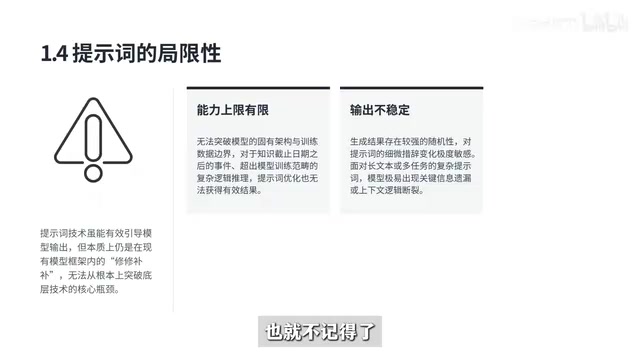
At the technical level, there are three hard constraints:
- Limited context length: Like phone RAM—open too many apps and the system kills background processes; chat too long and AI forgets the original requirements.
- Instability on complex tasks: Single-step tasks are fine, but multi-step calculations or proposal writing tend to skip steps and break logic—you must break them into small tasks.
- No true long-term memory: Each conversation is brand new; it can't remember your preferences and background, which can only be compensated by external databases.
At the implementation level, there are three pitfalls: safety and alignment restrictions may misjudge and block legitimate requests; pure prompts are hard to engineer—when turned into a product for hundreds or thousands of users, there's no version management or issue tracing, so enterprise applications must combine prompts with code; and the cost trap—AI charges by token, so longer prompts cost more, and hidden costs are staggering at high call volumes. Keep prompts concise.
The tutorial's conclusion is clear-eyed: prompts are a useful tool but not a master key—what should be done by humans still must be done by humans.
Hallucination refers to large language models generating content that seems plausible but is factually wrong or fabricated. Its root lies in the model being essentially a probabilistic predictor: it generates text word by word based on statistical patterns in training data rather than retrieving a real knowledge base. When a question falls outside training data coverage, or the model is asked for a definitive answer, it tends to "make things up" rather than admit not knowing. Common manifestations include fabricated citations, invented data, and conflated people and events. Mitigation methods include: asking the model to flag uncertainties, providing reference materials for it to answer based on given materials, and using retrieval-augmented generation (RAG) to introduce external knowledge. But these only reduce probability—they cannot eliminate it—so scenarios requiring high factual accuracy must be verified by humans.
Context window is the maximum text length a model can process in a single conversation, usually measured in tokens (a token is the smallest unit of text a model processes, roughly one Chinese character or half an English word). The context window is like working memory: all historical conversation, current input, and model output occupy this space. When a conversation grows too long and exceeds the window, earlier content is truncated or forgotten, causing the model to "forget" initial settings. This is also why long document processing requires segmentation, summarization, or external memory. Context window size is a hard model specification that prompt techniques cannot expand—only streamlined input and segmented processing can work around it.
Final Thoughts
The value of this introductory course is that it pulls "prompt engineering" from mysticism back to engineering: clear definitions, followable processes, and honest limitations. For readers new to AI, building the understanding that "one-off tricks aren't the same as systematic methods" is more important than memorizing a hundred templates. Subsequent tutorials will move into hands-on practice; this article only covers the cognitive framework of the first lesson.
One-line Summary
Prompts are the direct means to control AI, but you need systematic methodology and must recognize its capability boundaries.
Paragraph Summary
Based on a Bilibili prompt engineering tutorial, this article clarifies the difference between prompts and prompt engineering: prompts are one-off instructions with four functions—communication bridge, task navigation, style control, and boundary constraints; prompt engineering is a six-step systematic method of requirement decomposition, design, testing, evaluation, iteration, and codification for reuse. The article notes the low learning barrier and significant efficiency and commercial value, while focusing on limitations: prompts cannot break through model capability ceilings, face hard constraints like context length, instability on complex tasks, and no long-term memory, and pure prompts are hard to engineer—enterprise applications need code integration and must watch token costs. The conclusion: prompts are a tool, not a master key; building systematic understanding matters more than memorizing templates.
Related articles

ChatGPT Plus Subscription Pitfall Guide: Go/Plus/Pro Tier Comparison and Quick Activation
A complete ChatGPT Plus subscription guide based on a Bilibili tutorial: from registering an account, comparing Go/Plus/Pro tiers, to the practical steps for quickly completing your subscription.

GPT-6.2 Sol/Astra Released! A Step-by-Step ChatGPT Plus Subscription Guide and Tier Comparison
GPT-6.2 Sol/Astra is out—here's a ChatGPT Plus subscription guide: register an account, compare Go/Plus/Pro tiers, and subscribe in a minute.

Comparing Three Channels for Subscribing to GPT Plus in China: Is Website Top-Up the Easiest?
How to subscribe to GPT Plus in China? This article compares website top-up, credit card, and mobile top-up channels—process, cost, and risk—with steps and tips to help you choose wisely.