Prompt Puncher: Deconstructing AI Giants Through a Fighting Game

Prompt Puncher turns AI leaders into browser fighting characters, tapping into AI culture through lightweight entertainment.
Prompt Puncher is a free browser fighting game where players control AI industry leaders like Elon Musk, Sam Altman, and Mark Zuckerberg in combat. With no download or registration required, it earned 64 votes and ranked 14th on Product Hunt. Its core value lies not in gameplay depth but in entertainmentizing tech executives, parodying AI power concentration through fighting, and lowering the barrier for the public to engage with AI figures. Technically likely built on an HTML5 game framework, its lightweight design aids distribution but limits visuals and gameplay depth. As an indie developer's work, its long-term popularity depends on whether it can go beyond topicality with continuous content updates and community building.
When AI Leaders Become Fighting Characters
On Product Hunt, a free browser-based fighting game called Prompt Puncher has drawn attention. It turns AI industry figures like Elon Musk, Sam Altman, and Mark Zuckerberg into playable fighting characters, letting players battle it out in a virtual arena. The game requires no download or registration—just open your browser and start fighting. This low-barrier form of entertainment quickly garnered 64 upvotes and 3 comments, ranking 14th for the day.
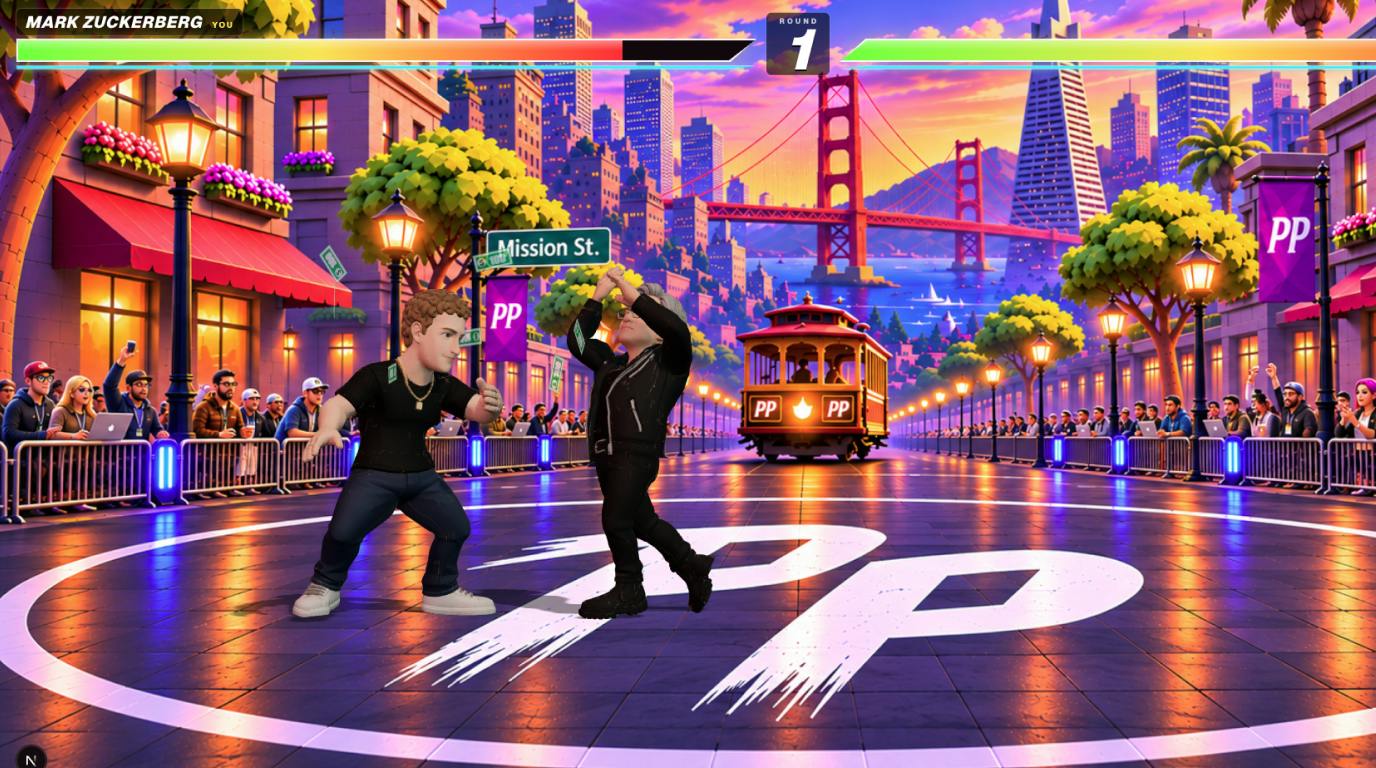
Gameplay and Design: Simple, Straightforward Entertainment
The core gameplay of Prompt Puncher is classic fighting combat. Players can choose different AI CEO characters, each potentially with unique skills or attributes, though the original source material doesn't detail the specific move designs. Being browser-based means it's likely built on HTML5 or WebGL technology to ensure cross-device compatibility. This lightweight design lets players jump in quickly without worrying about hardware specs or storage space.
From a product positioning standpoint, Prompt Puncher is more of a cultural parody casual game than a deep competitive title. It leverages public familiarity with AI industry leaders to transform tech-world talking points into entertainment IP—a cross-boundary fusion that's relatively uncommon among indie games.
Cultural Phenomenon: The Entertainmentization of AI CEOs
Turning tech executives into game characters reflects the growing public attention on the AI industry. Figures like Elon Musk and Sam Altman aren't just business leaders—they've become cultural symbols. Through the fighting game format, Prompt Puncher lets players interact with these symbols in a relaxed way, which is to some extent a humorous deconstruction of AI power concentration.
This entertainment-oriented treatment also raises questions: as AI companies' decisions affect more and more people's lives, public awareness of these decision-makers often remains superficial. The game could perhaps serve as an unconventional entry point for education, letting more people engage with AI figures and stories in an entertaining way.
Market Reception and Positioning
Securing 64 votes and ranking 14th on Product Hunt shows that Prompt Puncher attracted some early attention. The low comment count of 3 may indicate limited user discussion, or that the product was just released and hasn't yet built a community. As a free game, it doesn't directly generate revenue, but it can serve as a portfolio project or traffic funnel for creator Matthew Hefferon.
From an SEO perspective, Prompt Puncher captures the intersection of two keywords—"AI CEO" and "fighting game"—giving it uniqueness in a niche market. However, the game's lifecycle may depend on content updates and community management; otherwise, it could easily become a one-time experience.
Product Hunt's ranking mechanism isn't based solely on total votes but calculates daily popularity by combining vote count, comment activity, posting time, and user engagement quality. Ranking 14th means Prompt Puncher sits in the upper-middle range among all new products that day but still has a clear gap from top-tier products. 64 votes is typical data for an early exposure phase—enough to prove the concept is appealing but not yet viral. The low interaction rate of 3 comments further suggests most voters may have simply been drawn by the title or thumbnail and casually supported it without deeply experiencing it or feeling compelled to discuss. For a free browser game, Product Hunt plays more of a cold-start traffic funnel role; real user retention and word-of-mouth diffusion depend on social media sharing or secondary spread through gaming communities.
Lightweight Technical Implementation Choices
The advantage of browser games is instant play, and Prompt Puncher clearly makes full use of this. No download or registration process lowers the psychological barrier for users to try it. For indie developers, this model also facilitates rapid iteration and distribution. Although the original source doesn't reveal the specific tech stack, it's reasonable to infer it may use popular HTML5 game frameworks like Phaser or PixiJS, or a custom engine built on Canvas/WebGL.
Lightweight also brings limitations: visual presentation and gameplay depth may not match client-based games. But for a small-scale game that wins on creativity and topicality, this may not be a problem.
Phaser and PixiJS are currently the two most mainstream open-source HTML5 game frameworks, though their positioning differs slightly. Phaser provides a complete game development suite with built-in physics engine, animation system, input handling, and scene management—ideal for quickly building 2D game prototypes. PixiJS focuses more on high-performance 2D rendering and doesn't include physics or game logic modules itself, requiring developers to combine other libraries. Both render via Canvas or WebGL and can automatically switch between the two rendering modes to accommodate different devices. For a fighting game like Prompt Puncher with a limited roster and relatively simple gameplay, Phaser's built-in features are sufficient to cover collision detection and frame animation needs, while choosing PixiJS would imply the developer has higher pursuit of rendering performance or already has a custom game logic layer.
Conclusion: An AI Culture Slice Wrapped in Entertainment
Prompt Puncher packages hot figures from the AI industry in the simplest fighting gameplay—both a parody of tech culture and an indie developer's capture of the zeitgeist. It reminds us that AI isn't just about technology and business; it's also becoming part of popular culture. How far this game can go depends on whether it can sustain interesting experiences beyond its topical buzz.
Related articles

Unkernel: Compiling the Linux Kernel to WebAssembly
The Unkernel project compiles a real Linux kernel to WebAssembly, making it possible to run a complete kernel in the browser. This article covers its technical principles, challenges, and prospects.

New Claude Sonnet Model Tested: Performance Approaches Opus with Less Thinking
Anthropic quietly tests a new Sonnet model in Claude Code—performance approaches Opus 5.5 with far fewer thinking tokens, plus Codex transfer optimization, xAI's low-level rewrite, Google Antigravity updates, and the AI science understanding gap.

Building a Reasoning Model from Scratch: Making Complex AI Algorithms Accessible
Mike Finley, author of Build a Reasoning Model from Scratch, shows how a few hundred lines of code, single-sample training, and code reuse make complex AI algorithms like RL and verifiers accessible to all.