Protesters Breach Microsoft Data Center Construction Site in Amsterdam
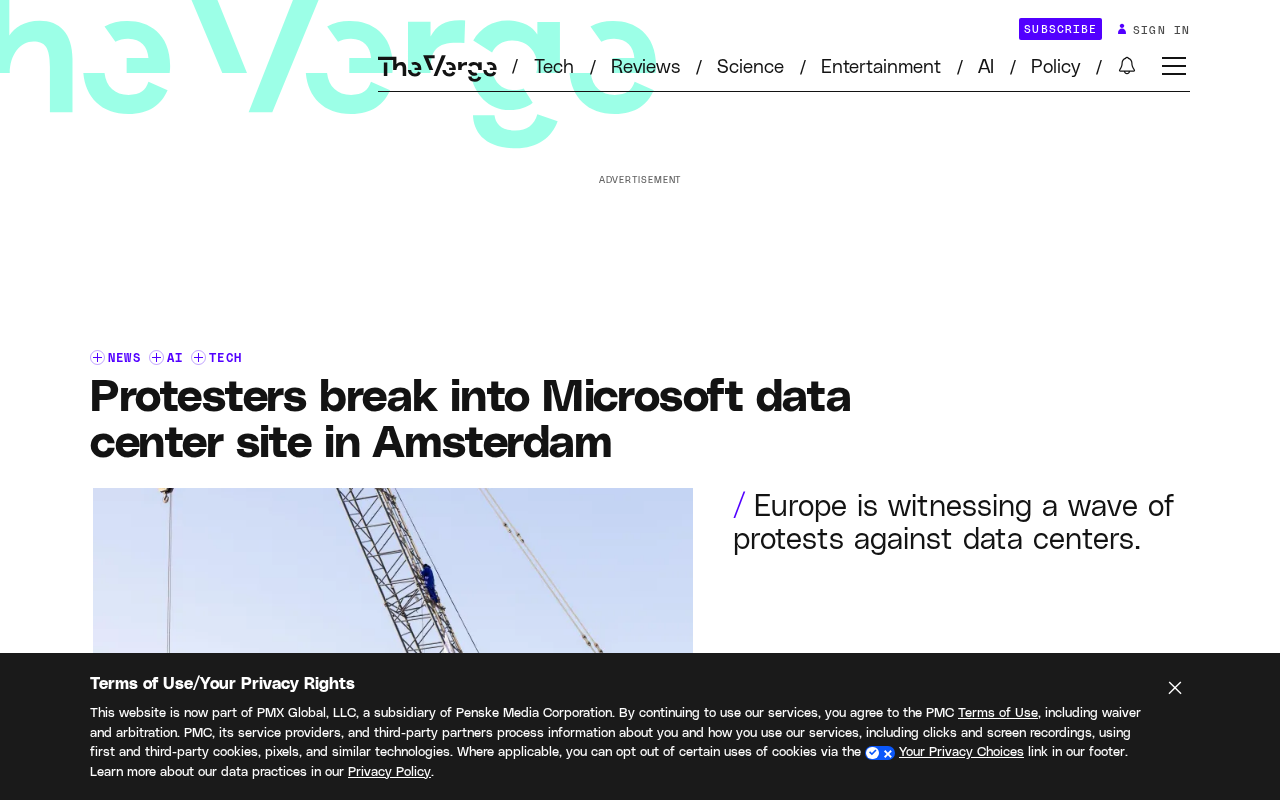
About 100 protesters breached Microsoft's Amsterdam data center site, highlighting social license pressure on data center expansion.
Reuters reports that approximately 100 protesters, aided by activist group Geef Tegengas, breached the construction site of Microsoft's new data center in the outskirts of Amsterdam to oppose the construction of three 85-meter towers. The incident exposed weak site security and reflects the controversies over energy consumption, land use, and community impact that data centers face amid global expansion. The article notes that data centers are the physical backbone of the digital economy and AI computing power, but also major resource consumers, and multiple European countries have begun discussing stricter energy efficiency and siting requirements. For Microsoft, this is both a PR challenge and an operational risk; for the industry, escalating social license pressure could raise data center construction costs and timelines, in turn affecting the cost and accessibility of AI services. Transparent disclosure, early consultation, and substantive investment in renewable energy are seen as key pathways to mitigating tensions.
Event Overview
According to Reuters, a group of protesters breached the construction site of Microsoft's new data center in the outskirts of Amsterdam this morning. The activist group "Geef Tegengas" helped organize the protest, which targeted three data center towers currently under construction, each standing 85 meters tall. The report noted that approximately 100 people successfully entered the construction area, and some individuals may have taken further action.
This incident is not isolated. As data centers expand on a massive scale worldwide, controversies surrounding their energy consumption, land use, and community impact are intensifying. The Amsterdam protest has pushed this tension to the level of physical confrontation.
Why Data Centers Are the Target of Protest
Data centers are the physical backbone of the digital economy, but they are also major resource consumers. Three 85-meter towers mean a massive building footprint and continuous operational demands—electricity, water, and land. For surrounding communities, the noise, landscape changes, and infrastructure strain these facilities bring are tangible concerns.
"Geef Tegengas" organizing this protest reflects some residents' dissatisfaction with the unchecked expansion of data centers. Their concerns extend beyond construction-phase disruptions to long-term environmental burdens. In Europe, data center electricity consumption has already drawn policy-level attention, with multiple countries beginning to discuss stricter energy efficiency and siting requirements for data centers.
Social License to Operate is a key concept for understanding such conflicts. It refers to the implicit acceptance and trust a company or project must earn from local communities and the public, beyond formal legal permits. Social license is not a certificate but a continuously evolving dynamic relationship: once a community perceives that the burdens of a project (noise, landscape destruction, resource competition) outweigh the benefits they perceive, social license erodes—escalating into protests, litigation, or policy resistance. The data center industry is particularly dependent on social license because its land and electricity footprints are large while direct local job creation is limited, making residents prone to a sense of imbalance—"benefits flow out, costs stay local." The Amsterdam protest is a textbook example of missing social license, and explains why compliance approvals alone are insufficient to ensure smooth project progress.
Microsoft's Expansion and Community Relations
Microsoft has accelerated its global data center deployment in recent years to meet demand for cloud computing and AI services. The Amsterdam project is part of its European infrastructure network. However, big tech expansion often brings friction with local communities.
The fact that protesters were able to enter the construction site exposed weak security at the site. For Microsoft, this is not only a PR challenge but also an operational risk management issue. Tech companies need to engage with communities more proactively, incorporating local concerns during project planning and construction phases rather than reacting passively after conflicts erupt.
Broader Industry Signals
The Amsterdam incident is a microcosm. The data center industry is facing increasing social license pressure. From Ireland to the Netherlands, from the United States to Singapore, data centers frequently become focal points of controversy over grid load and carbon emissions.
For the AI industry, this trend warrants vigilance. Large model training and inference depend on massive computing power, which is backed by dense data center clusters. If community resistance and policy restrictions continue to escalate, data center construction costs and timelines could rise, in turn affecting the cost and accessibility of AI services.
The industry needs to consider how to win social trust while expanding. Transparent environmental impact disclosure, early consultation with communities, and substantive investment in renewable energy may be key pathways to mitigating tensions. The Amsterdam protest may be just the beginning of a larger-scale social dialogue.
PUE (Power Usage Effectiveness) is a core metric for measuring data center energy efficiency, equal to total data center power consumption divided by IT equipment power consumption, with an ideal value of 1.0. The closer PUE is to 1, the less energy is consumed by auxiliary systems such as cooling and power distribution. When discussing data center policy, many European countries often use PUE as an entry threshold or disclosure requirement—for example, requiring new data centers to have PUE below a certain threshold. However, PUE only reflects energy efficiency and does not measure absolute power consumption or carbon emissions. Therefore, even a large data center with excellent PUE may still place stress on the local grid due to its total load. This is precisely one of the focal points of concern for communities and regulators: efficiency improvements may not offset the rise in total resource demand brought by scale expansion.
One-line Summary
About 100 protesters breached Microsoft's Amsterdam data center site, highlighting social license pressure on data center expansion.
Paragraph Summary
Reuters reports that approximately 100 protesters, with the help of activist group Geef Tegengas, breached the construction site of Microsoft's new data center in the outskirts of Amsterdam to oppose the construction of three 85-meter towers. The incident exposed weak site security and reflects the controversies over energy consumption, land use, and community impact that data centers face amid global expansion. The article notes that data centers are the physical backbone of the digital economy and AI computing power, but also major resource consumers, and multiple European countries have begun discussing stricter energy efficiency and siting requirements. For Microsoft, this is both a PR challenge and an operational risk; for the industry, escalating social license pressure could raise data center construction costs and timelines, in turn affecting the cost and accessibility of AI services. Transparent disclosure, early consultation, and substantive investment in renewable energy are seen as key pathways to mitigating tensions.
Related articles
 Tech Frontiers
Stylome Bot Slammed as Useless Junk: Why Do AI Detection Tools Keep Failing?
Reddit users test the Stylome AI detection bot: Gemini-rewritten text judged human-written, consistently low confidence. An analysis of AI text detection's technical dilemmas, privacy concerns, and credibility crisis in community governance.
 Tech Frontiers
When AI Becomes a Productivity Divide: Clarity or "AI Psychosis"?
A civil engineer's deep use of agentic AI boosted efficiency but bred contempt for peers who refuse to learn. Is this clarity or AI psychosis? An analysis of the cognitive and psychological challenges behind the AI productivity divide.
 Tech Frontiers
Opus 5.5 Benchmark Scores Climb, Community Says Its "Weights Are Blessed"
Reddit community discusses Opus 5.5's rising scores on the Benchmaxxing Bench, with users describing its performance as "weights are blessed." This article interprets the community reaction and cautions against conflating benchmark scores with real capability.