Proton CEO Halts AI Interviews: When Privacy Culture Collides with Tech Enthusiasm

Proton CEO halts internal AI re-interview process, sparking tech community debate on the boundaries of AI evaluating individuals.
Proton's CEO halted the company's internal AI "re-interview" process, which after 404 Media reporting received 276 points and 232 comments on Hacker News. The article outlines the full story, noting public information confirms only that the process existed and was halted, with no process details disclosed. As a privacy company known for end-to-end encrypted email, Proton's internal use of AI to evaluate employees invites double-standard scrutiny, and the CEO's decision is viewed as a timely correction. The core community debate is not whether AI can evaluate people, but whether evaluation is transparent and explainable and whether the evaluated have informed consent and appeal paths. The article further notes this case offers a general warning for companies embedding AI into recruitment and performance: preset circuit breakers are needed, and internal practices should be examined by externally promoted standards.
Title
Proton CEO Halts AI Interviews: When Privacy Culture Collides with Tech Enthusiasm
Meta Description
Proton CEO halts the company's internal AI re-interview process, sparking heated debate on Hacker News. This article outlines the full story, analyzes the sensitivity of a privacy company deploying AI to evaluate employees, and highlights the importance of transparency and boundaries when AI enters organizational decision-making.
Article Content
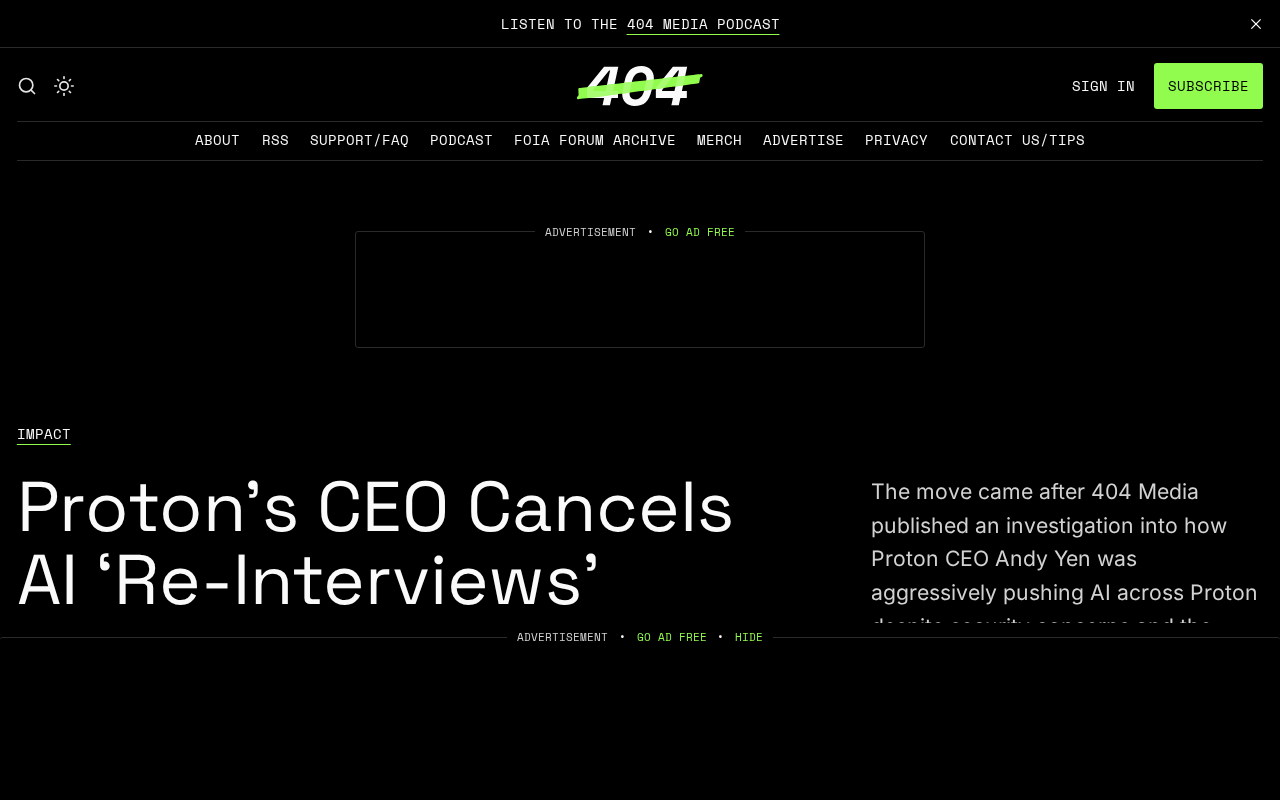
A tech company that built its identity on privacy protection nearly used AI to rewrite its own cultural DNA. Proton's CEO recently halted the company's internal "AI Re-Interviews" process—a move that ignited 276 points and 232 comments on Hacker News, with the discussion quickly moving beyond one company's HR decision to a sharper question: when AI enters the organizational decision-making chain, who guarantees the experience of being "evaluated by an algorithm"?
The Full Picture: An Internal Experiment Publicly Shut Down
According to 404 Media, Proton had designed an AI-driven "re-interview" mechanism whose logic was to use AI to re-evaluate information about employees or candidates. As controversy grew, Proton's CEO publicly announced the cancellation of the process. Judging by the buzz on Hacker News, 232 comments indicate a strong desire in the community to weigh in, while 276 upvotes show the story touched a shared anxiety among tech workers.
Strictly speaking, the publicly available information confirms only two things: that this AI re-interview process existed, and that the CEO has halted it. Specific process details, number of participants, evaluation dimensions, and technology vendors are not disclosed in the reporting or community discussion, and this article does not speculate on these gaps.
404 Media is an independent English-language outlet focused on technology and digital rights, known for investigative reporting and coverage of platform power, privacy, and automated governance. Information about Proton's "AI re-interview" process was first disclosed by this outlet, which subsequently triggered large-scale discussion in tech communities such as Hacker News. Understanding this source helps grasp the nature of the information: it is media investigation rather than an official company announcement, so the reporting confirms the existence of the process and the result of its cancellation, but says little about its technical implementation, evaluation metrics, or scale of participation. This is also why this article remains restrained on the boundaries of fact—readers should distinguish "confirmed facts" from "principled discussion in the community" and not treat speculation in the comments as process details.
Hacker News is a technology and startup community operated by Y Combinator, known for high-quality comments and strong clashes of opinion. Its upvote count (e.g., 276 points) measures a post's visibility, while the comment count (e.g., 232) reflects depth of participation. These two metrics are often cited as a "thermometer of tech-circle sentiment": a high point count means broad reach, and many comments mean the topic is contentious and invites expression. In this case, the combination similarly shows that the discussion has expanded from one company's management action to a general anxiety about AI intervening in organizational decisions.
Why a Privacy Company Is So Sensitive About AI Interviews
Proton's core brand asset is its commitment to user privacy, with its business built around encrypted products such as Pmail. If such a company introduced AI to evaluate employees in its internal governance, it would naturally invite double scrutiny: externally, whether it is practicing the transparency and data minimization it champions; internally, whether employees have the right to refuse being scrutinized by an algorithm.
AI deployment by a privacy company is essentially a test of self-consistency—you cannot sell the idea of "data that never leaves the device" while letting internal evaluation processes bypass human consent. The CEO's decision to halt the process can be understood as a timely correction of this contradiction rather than a mere concession by management.
Pmail refers to Proton Mail, Proton's best-known end-to-end encrypted email service. Its core selling point is that the server cannot read the plaintext of emails, with user keys held locally, so the company cannot hand over readable content even if required to. This "zero-knowledge" architecture is the technical cornerstone of Proton's brand trust, and it means the company publicly commits to an extremely high standard of data minimization and user control. Precisely because of this, when the same company conducts automated evaluations of employees internally, outsiders naturally apply the same yardstick: is employee data collected in a minimized way, are employees informed, and do they have the right to refuse? This expectation of "consistency between internal and external standards" is exactly the risk most easily amplified when a privacy company deploys AI.
Data minimization is a basic principle in privacy protection, advocating that only data directly relevant and necessary for a specific purpose be collected, avoiding excessive collection. Together with informed consent and purpose limitation, it forms a pillar of modern privacy compliance. Applied to the scenario of AI evaluating employees, data minimization asks: what information does the re-interview process actually read, how long is it retained, and is it used for judgments beyond the original purpose? The "transparency and data minimization" emphasized in the article is precisely the extension of this principle into internal organizational governance—the privacy standards proclaimed externally should equally hold in internal processes.
Community Boiling Point: Tech Workers' Collective Discomfort with "Being Judged by AI"
The high activity in the Hacker News comment section reflects a widespread sentiment: the developer community does not reject AI tools, but rejects AI becoming an opaque decision-making subject. Some in the discussion supported the CEO's swift damage control, while others questioned why such a process was designed in the first place. Community consensus tends toward the view that even if AI evaluation can improve efficiency, once it involves redefining individuals and making career judgments, there must be clear paths for informed consent and appeal.
Key points:
- The controversy is not about whether AI can evaluate people, but whether the evaluation process is transparent and explainable
- The relevant discussion did not disclose specific process design details or employee feedback data; the community is mostly debating at the level of principles
- The halt itself is seen as management responding to employee concerns
A Broader Signal: The Boundary Problem of AI in Organizational Decision-Making
This matter's significance is not limited to Proton. More and more companies are inserting AI into recruitment, performance, promotion, and other processes that have a substantive impact on people, while regulators have yet to give a unified answer. The Proton case offers a lesson: internal AI applications need a pre-set "circuit breaker"—when employee resistance and external public opinion heat up simultaneously, management must be able to halt quickly.
For companies that position themselves around privacy, this lesson is even harsher—your internal AI practices will be examined by the standards you promote externally. Any automated process, as long as it involves re-evaluating people, should be treated as a high-risk operation.
Conclusion
The CEO's cancellation of the AI re-interviews is essentially an act of organizational self-correction and a public discussion about the boundaries of technology. For teams currently pushing AI into internal governance, it suggests a not-so-easy judgment: between efficiency and trust, the top priority is always to let the people being evaluated know—and to give them the right to say no.
One-line Summary
Proton CEO halts internal AI re-interview process, sparking tech community discussion about the boundaries of AI evaluating individuals.
Paragraph Summary
Proton's CEO halted the company's internal AI "re-interview" process, which after reporting by 404 Media received 276 points and 232 comments on Hacker News. The article outlines the full story, noting that public information confirms only two points: the process existed and was halted, while process details were not disclosed. As a privacy company known for end-to-end encrypted email, Proton's internal introduction of AI to evaluate employees invites double-standard scrutiny, and the CEO's decision is seen as a timely correction. The core of the community discussion is not whether AI can evaluate people, but whether the evaluation is transparent and explainable and whether the evaluated have paths for informed consent and appeal. The article further notes that this case offers a general warning for companies embedding AI into recruitment, performance, and other processes: pre-set circuit breakers are needed, and internal practices should be examined by the standards promoted externally.
Related articles

AI Can Read Neural Network Weights Directly: Do Models Already Exceed Expectations?
A Reddit developer experiment shows language models can directly read neural network weights and infer their function. Astra, Opus 5.5, and Muse Spark 1.3 all passed the test, sparking discussion on model generalization and training sources.

India's Microdrama Market Explodes: EloElo Secures $80M Investment from NBCUniversal
EloElo secures $80M from NBCUniversal to boost StoryTV, its microdrama platform with over 33M monthly active users, as India's microdrama market draws global capital.

Acoustic Detection of Multi-Rotor UAVs: Fusing Handcrafted Features with Pre-Trained Embeddings
Study reveals data leakage from random splits in UAV acoustic detection, proposes source-disjoint protocol with stacked ensemble of handcrafted features and YAMNet embeddings, achieving 95.29% accuracy for low-cost drone detection.