PS2 Security Chip Cracked After 26 Years: A Four-Year Reverse Engineering Journey
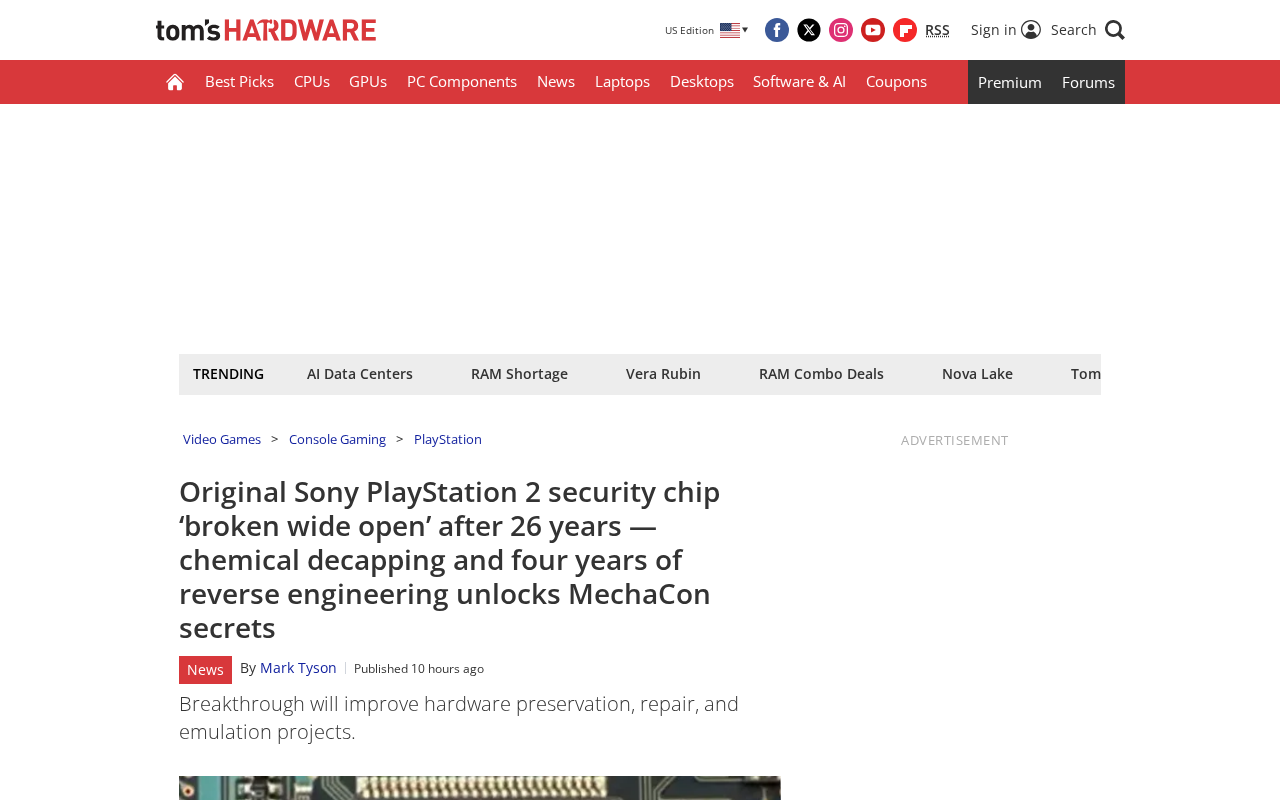
PS2's core security chip MechaCon fully reverse engineered after 26 years and four years of effort.
Sony PlayStation 2's core security chip CXP102064 (MechaCon) has been systematically cracked by a reverse engineer after four years of work — 26 years after the console launched. Long a black-box gatekeeper for PS2 copy protection, MechaCon handled disc authentication and boot security. The breakthrough involved chip decapping, firmware extraction, and state machine reconstruction. For the preservation community, it enables more accurate emulation and archival work; for researchers, it offers a valuable window into early hardware security design evolution.
Sony's PlayStation 2 core security chip has finally been fully reverse engineered — 26 years after its debut. The chip, known as CXP102064 (commonly referred to as MechaCon), has long been a critical component of the PS2's copy protection and hardware security architecture. After four years of sustained effort, the reverse engineer successfully unlocked its internal logic, opening a new chapter in research and preservation of this iconic console.
A Chip Dormant for 26 Years, Finally Awakened
The MechaCon chip is the key component inside the PS2 responsible for verifying disc legitimacy and managing the console's security mechanisms. It has long existed as a closed "black box," with its internal logic largely opaque to the outside world. This breakthrough means researchers can now fully understand how the chip works for the first time — and marks a point where the PS2, a console launched at the turn of the millennium, has virtually no more hardware secrets left.
As reported by Tom's Hardware, the work took approximately four years, and the description of the chip being "broken wide open" is no exaggeration — it involved systematic reverse analysis of the chip's physical structure, firmware logic, and security verification processes. This kind of work typically requires microscope-level chip delayering, signal acquisition, and enormous patience.
MechaCon served as the "gatekeeper" within the PS2's entire security system. Specifically, it communicated with the optical drive to verify whether a disc carried a valid region code and copy protection markers (such as Sony's proprietary disc authentication technology), while also managing the console's boot sequence and partial power control. Historically, every major PS2 modification method — from early analog signal injection (modchips) to later software exploits — required bypassing or fooling MechaCon's verification logic in some way. Understanding the chip's complete internal state machine is therefore essential for accurately reconstructing the PS2's true boot and security flow, and explains why emulators like PCSX2 have exhibited subtle discrepancies in certain edge-case behaviors.
Why Cracking an Old Chip Still Matters
One might ask: the PS2 has been discontinued for years — what's the point of cracking its security chip now? The answer lies in the long-term value of digital preservation and hardware research.
For the game preservation community, understanding a console's underlying security mechanisms is a prerequisite for achieving complete emulation, data backup, and archival-grade preservation. Many classic games and hardware artifacts risk being lost forever as physical devices age, if not properly studied. Cracking MechaCon means the community can more thoroughly understand the PS2's boot and verification flow, enabling the development of more accurate emulators and hardware repair solutions.
This kind of reverse engineering also carries educational and technical research significance. The security designs of older consoles are often crystallizations of the engineering ingenuity of their era. Analyzing them helps future researchers understand the evolutionary history of hardware security and the thinking — and limitations — behind early copy protection technologies.
The Technical Difficulty Behind Four Years of Work
From publicly available information, this was no accidental vulnerability discovery — it was a systematic engineering effort spanning four years. Reverse engineering a dedicated security chip typically requires clearing multiple technical hurdles: at the physical level, decapsulating the chip and photographing its internal circuit structure; at the logic level, reconstructing its firmware and state machines; and at the verification level, repeated experimentation to confirm that the understanding of the chip's behavior is correct.
This kind of work is especially challenging for individual hobbyists, as it demands both specialized equipment and extraordinary patience combined with cross-disciplinary knowledge. Four years of investment alone speaks to the complexity of this chip's security design, and to the care Sony put into hardware protection at the time.
Physically reverse engineering a dedicated security chip typically employs "decapping" techniques: chemical etchants (such as fuming nitric acid) or mechanical polishing are used to remove the chip's packaging and expose the silicon die, which is then photographed layer by layer using optical or electron microscopes to reconstruct the circuit netlist. For chips containing read-only memory (ROM), firmware content can be extracted by visually identifying individual storage cells in the imagery. Non-invasive methods such as differential power analysis (DPA) and fault injection are also commonly used to help reconstruct logical behavior. The entire process spans materials science, analog circuits, digital logic, and software reverse engineering — completing such work solo represents an extremely high barrier in terms of both tooling costs and breadth of knowledge required.
Strong Community Response
The news received 239 upvotes and 66 comments on Hacker News, reflecting the technical community's enduring interest in classic hardware reverse engineering. Discussions around console modding, digital preservation, and the ethics of reverse engineering have always been popular topics in hardcore technical circles.
For retro gaming and hardware preservation enthusiasts, this achievement is a milestone worth celebrating. It not only extends the exploration of classic hardware, but once again proves that given enough time and determination, virtually no chip can keep its secrets forever.
Conclusion
As one of the best-selling consoles in history, the PS2's technical legacy continues to be cherished by countless enthusiasts. The cracking of the MechaCon chip is yet another testament to the reverse engineering community's sustained investment in classic hardware. It reminds us that hardware security is never a permanent solution — and that the preservation of digital culture depends precisely on these quietly dedicated technical explorers.
Related articles
Automattic Executives Signed Reciprocal Severance Agreements During Mullenweg's Brief Ouster
Automattic's CFO and General Counsel signed reciprocal severance agreements during Matt Mullenweg's brief ouster, covering one year's salary and accelerated equity vesting, raising corporate governance concerns.

H3 Singularity Optimization: 40% Speed Boost With Better Image Quality
A Reddit user's Minimax Singularity workflow tip: insert an RTX upsampler before H3 Latent for 40%+ speed gains and better quality. Covers parameters, 12-bit output, and more.
Glyph: A Multi-Strategy Agent System for Automated Enterprise Data Catalog Annotation
Glyph is a multi-strategy LLM agent system for enterprise data catalogs that automates column description generation and sensitivity ontology tagging, grounding outputs in pipeline source code to improve accuracy.