Pure C, Zero-Dependency Colibri: Disk-Streaming MoE Loading Lets You Run Frontier Models on Personal Hardware

Pure C, zero-dependency engine Colibri uses disk-streaming to load MoE experts, letting personal hardware run frontier models.
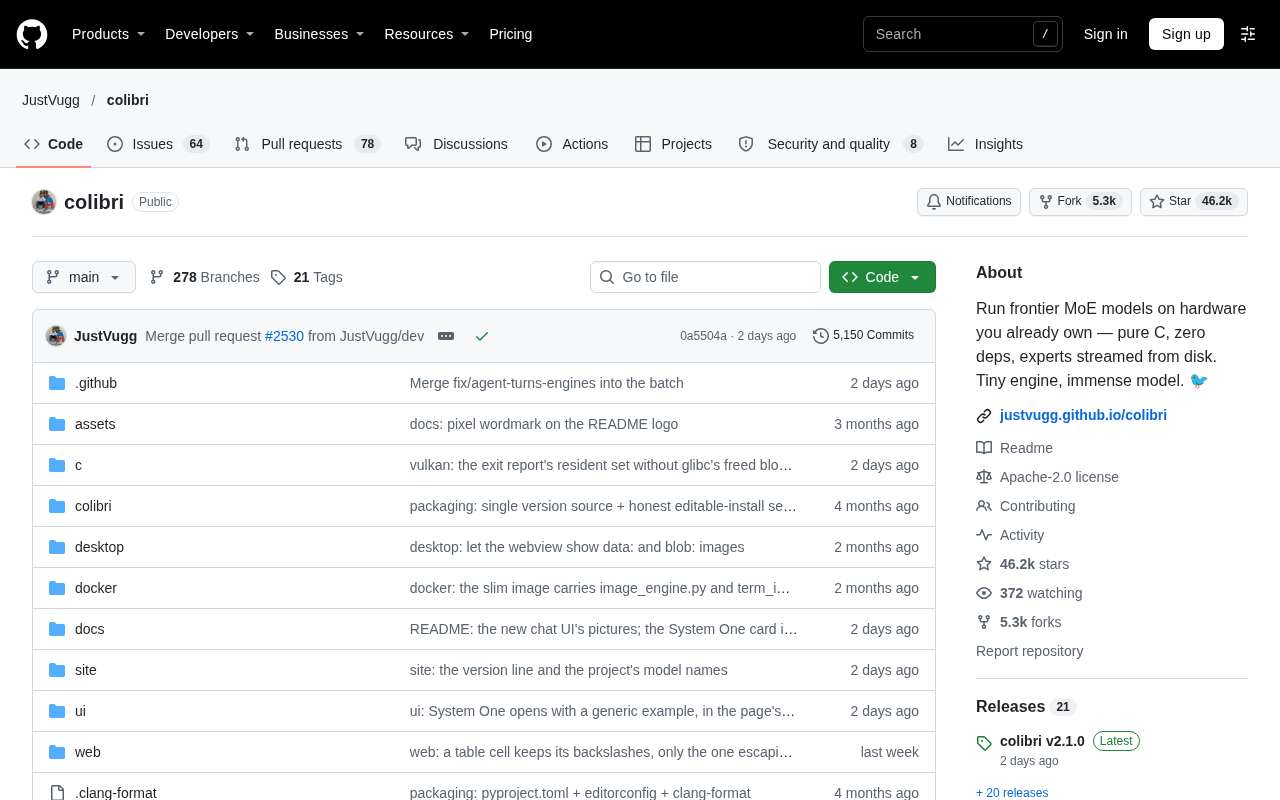
JustVugg/colibri is a tiny inference engine written in pure C with zero external dependencies, aiming to run frontier-scale MoE models on personal hardware. It exploits MoE's sparse activation: expert weights stay on disk, and only the few experts routed to by the current token are loaded on demand, so memory usage no longer grows linearly with total parameter count but only with a single activation's scale. The zero-dependency design further reduces deployment complexity and it runs once compiled. The project has 46,127 stars, 5,319 forks, and 655 new stars in one day. Its limits: disk I/O can bottleneck frequent expert switching, and users need some C compilation and debugging skill.
Pure C, Zero-Dependency Colibri: Disk-Streaming MoE Loading Lets You Run Frontier Models on Personal Hardware
Running frontier-scale Mixture-of-Experts (MoE) models on personal devices usually means grappling with massive memory footprints and complex dependency stacks. The open-source GitHub project JustVugg/colibri offers a different path: a tiny engine written in pure C with zero external dependencies that uses "expert streaming" to load MoE models from disk on demand, letting ordinary hardware drive models whose parameter counts far exceed local VRAM. The project's tagline, "Tiny engine, immense model," captures this design goal directly.
Core Mechanism: Expert Streaming and Zero-Dependency Design
The key idea behind Colibri is to exploit the sparse activation characteristics of MoE architectures. Conventional inference requires all expert weights to reside in memory, whereas colibri keeps expert weights on disk and, during inference, loads only the few experts that the current token is routed to. As a result, memory usage no longer grows linearly with the model's total parameter count but instead correlates with the scale of experts activated at any one time. For MoE models that have many experts but only activate a small fraction of them at once, this strategy can dramatically lower hard memory requirements.
"Pure C, zero dependencies" further reduces deployment complexity. The engine does not rely on a Python runtime, deep learning frameworks, or hardware-specific acceleration libraries, and it runs on existing hardware once compiled. This lowers the barrier to entry and keeps the engine itself extremely small—consistent with its positioning as a "tiny engine."
The sparse activation of Mixture-of-Experts (MoE) is the premise for understanding colibri's design. In the feed-forward layers of a Transformer, MoE replaces a single feed-forward network with multiple parallel "expert" subnetworks plus a routing gating network: for each token, the gate selects only the top-k experts (commonly k=1 or 2) to participate in computation, leaving the rest inactive. The model's total parameter count can therefore be very large, while only a small fraction of the weights actually participate in any single forward pass. This "many parameters, little computation" property is precisely why disk streaming is feasible—as long as experts that aren't routed to stay on disk, they won't slow down that particular inference.
Expert swapping and memory mapping are the engineering essentials of streaming loading. During inference, the engine must read the expert weights hit by the current token from disk into memory, and after use they may be evicted to free up space—a process similar to the operating system's page replacement. Common approaches include using mmap to map weight files as virtual memory and letting the OS page them in on demand, or maintaining custom expert caches with LRU eviction. Either way, the hit rate and prefetching strategy directly determine actual throughput, which is also why this approach's performance is highly dependent on the storage medium.
Project Popularity and Community Signals
The repository currently has 46,127 stars and 5,319 forks, with 655 new stars in a single day. This popularity shows a strong resonance between the demand for running large models locally and the direction of "lightweight inference engines." For developers, a highly starred C-language inference project often means lower risk from external dependencies and a more transparent implementation path.
Use Cases and Boundaries
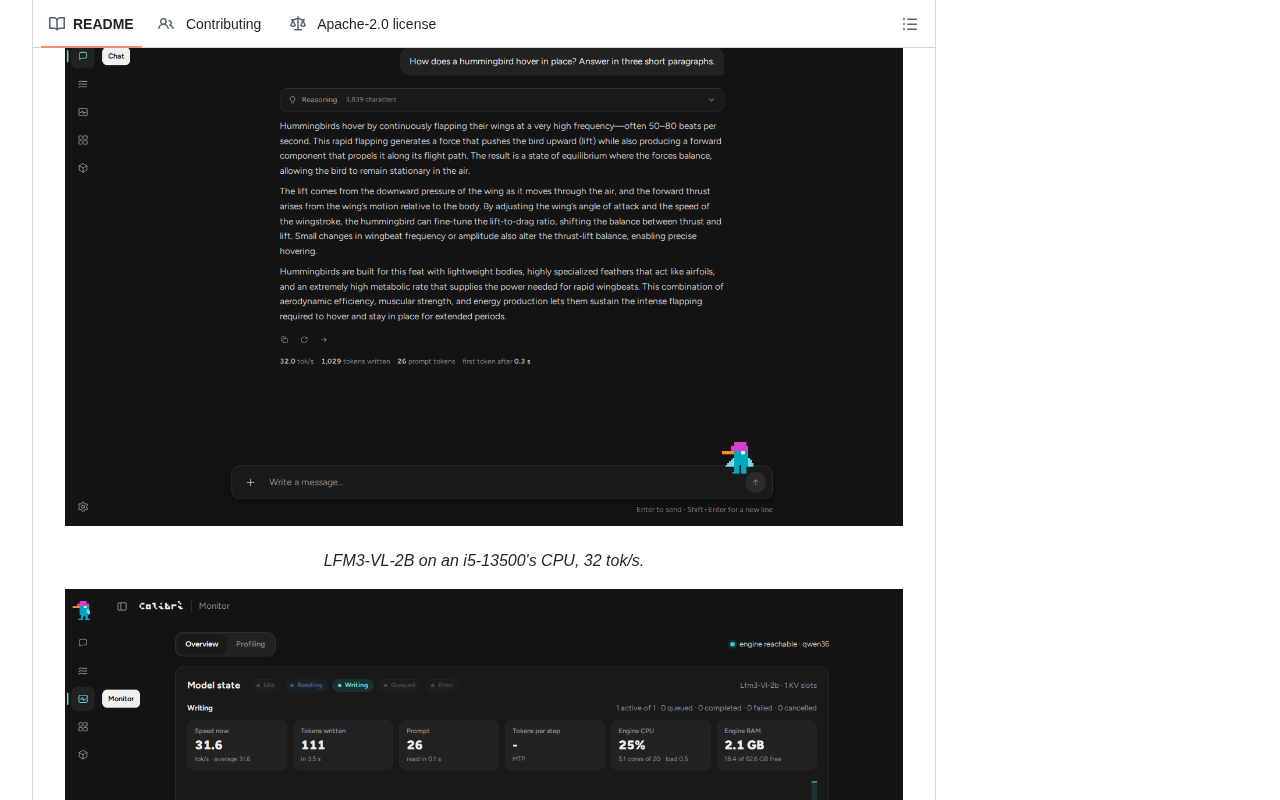
Colibri is positioned not as a general-purpose inference framework but as an optimization for running MoE models on constrained hardware. It suits developers and researchers who want to experiment with frontier MoE models without upgrading their hardware. It's worth noting that the performance of disk streaming is affected by storage media speed; when experts are switched frequently, I/O can become a bottleneck. In addition, because the project is implemented in C, users need some ability to compile and debug at a low level, rather than relying on an out-of-the-box graphical tool.
Zero-dependency here means the engine links no third-party libraries beyond the C standard library and requires no Python interpreter, frameworks like PyTorch, or acceleration libraries like CUDA/cuBLAS. The benefits are a small binary, a simple build chain, and portability to resource-constrained or non-mainstream platforms; the cost is that matrix operations, quantization/dequantization, memory management, and more must all be implemented in-house, which typically also means it's hard to leverage GPU acceleration directly, with performance depending more on CPU and memory bandwidth.
Summary
With a minimalist C engine and disk-streamed expert loading, Colibri narrows the gap between "frontier MoE models" and "existing hardware" by a step. Its high attention reflects the local inference community's sustained interest in lightweight, controllable solutions. For developers willing to get their hands dirty compiling and who understand MoE routing characteristics, this is an experimental project worth watching.
One-line Summary
Pure C, zero-dependency engine Colibri uses disk-streaming to load MoE experts, letting personal hardware run frontier models.
Paragraph Summary
JustVugg/colibri is a tiny inference engine written in pure C with zero external dependencies, aiming to run frontier-scale Mixture-of-Experts (MoE) models on personal hardware. Its core mechanism exploits MoE's sparse activation: expert weights are stored on disk, and during inference only the few experts that the current token is routed to are loaded on demand, so memory usage no longer grows linearly with total parameter count but only correlates with the scale of a single activation. The zero-dependency design further reduces deployment complexity—it runs once compiled. The project has 46,127 stars, 5,319 forks, and 655 new stars in a single day. Its limits are that disk I/O can become a bottleneck when experts are switched frequently, and users need some C compilation and debugging ability.
Related articles

DSH + Ollama Local LLM Deployment in Practice: Free Chat with Da Fei Yu
Bilibili creator tests DSH + Ollama local LLM deployment end to end: Ollama install, Xunlei-accelerated downloads, ModelScope GGUF model import, DSH custom API address setup, and a comparison of Qwen 3.5 4B, 8B, Gemma, and other models on 8GB VRAM, with advice on choosing local deployment vs. API calls.

Tested: A $899 Mac Mini vs. a $200/Month AI Subscription
Real-world test of whether an M4 Mac mini can replace a $200 AI subscription: 16GB can't fit large models, and both speed and quality fall short—but privacy, no caps, and near-zero running costs make it an ideal host for an always-on agent. Includes buying advice per configuration and money-saving strategies.

RSTGameTranslation: Real-Time OCR Localization + Offline Translation with Local LLMs
RSTGameTranslation is an open-source real-time Windows game translation tool: OCR for English, Japanese, and Korean with Chinese overlays in place, plus Ollama or LM Studio local LLM offline translation and Whisper speech transcription for games, manga, and visual novels.