Putting an AI Agent on a Nokia 110: An Experiment in Making Retro Feature Phones Smart

A developer ran an AI Agent on a Nokia 110 using cloud inference, proving intelligence doesn't require high-end hardware.
A developer successfully deployed an AI Agent on the Nokia 110 entry-level feature phone, sharing the project on Hacker News as a Show HN post. The core architecture separates interaction (handled on-device via SMS, USSD, or voice) from inference (handled by a remote server running the actual LLM). Beyond being a fun technical challenge, the experiment raises real questions about AI accessibility: with millions of users worldwide still relying on feature phones, enabling AI through basic communication channels could dramatically expand the reach of large language models. Note that specific implementation details, the model used, and performance metrics remain unclear from available sources.
When an AI Agent Meets the Nokia 110
A developer posted a rather playful Show HN project on Hacker News — deploying an AI Agent onto the Nokia 110, a classic feature phone. The project quickly picked up 16 upvotes and a handful of comments. While it didn't exactly go viral, it touched on a genuinely interesting question: what can AI actually do on a retro device with no touchscreen, no app ecosystem, and virtually zero computing power?
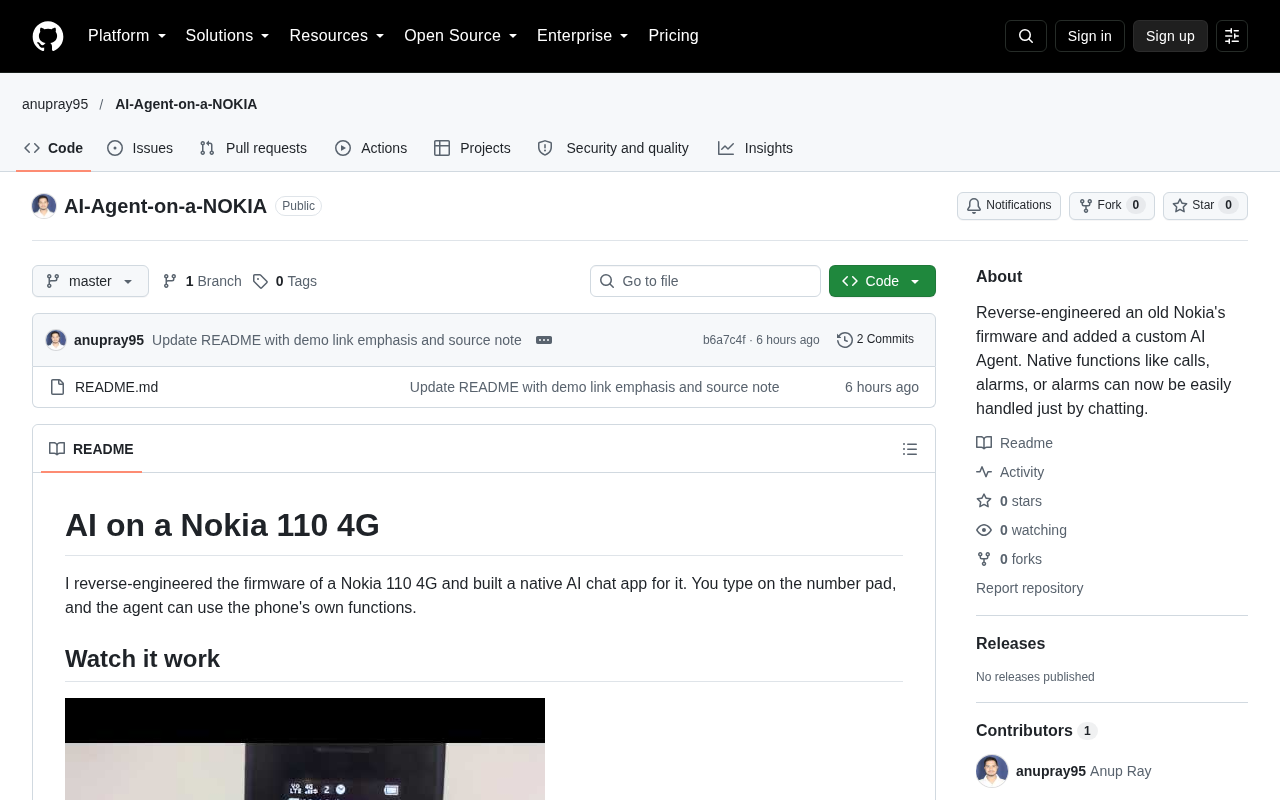
The Nokia 110 is a quintessential entry-level feature phone — small screen, physical numeric keypad, running a closed and highly constrained embedded OS. It has neither the processing capability of a modern smartphone nor the open platform that developers typically need to freely deploy software. That's precisely what makes putting an AI Agent on it — one that requires networked inference and depends on large language model capabilities — such an interesting challenge to device boundaries.
The Technical Significance of This Project
Separating Compute from Inference
Since a feature phone can't run a large language model locally, this type of project almost inevitably follows a single core architecture: the device handles interaction, the cloud handles inference. The device captures input (via the numeric keypad, SMS, or voice channels) and displays results, while the actual AI reasoning happens on a remote server. This architecture reveals a key truth about deploying AI Agents in the real world: the vessel carrying the intelligence can be extremely lightweight — as long as there's a channel reaching computational power.
This "thin client + cloud inference" architecture echoes the thin client philosophy from the early cloud computing era, but takes on new meaning in the age of AI. Traditional thin clients simply moved computation from local machines to servers. Offloading an AI Agent to the cloud, however, also involves cognitive-layer tasks like semantic understanding, intent recognition, and multi-step planning. The edge device only needs to send requests and receive text responses — even an SMS over a 2G signal is enough to serve as the interaction medium. The implicit cost of this architecture is latency and network dependency: if the signal is weak or the server is slow, the user experience degrades significantly. Compressing the data volume of requests and responses under extremely low bandwidth is therefore one of the core engineering challenges for projects like this.
Creative Reuse of Interaction Channels
On a feature phone, the available interaction methods are extremely limited — SMS, USSD, voice calls, or a bare-bones menu interface. Grafting AI conversation capabilities onto these traditional channels means that even a phone costing just a few dollars can become a terminal for interacting with a large language model. This opens up real possibilities for low-bandwidth, low-cost, aging-device scenarios.
USSD (Unstructured Supplementary Service Data) is a real-time, bidirectional communication protocol based on GSM networks, commonly seen in feature phone menu services — like dialing *100# to check your balance. Unlike SMS, USSD is a session-based protocol with extremely low latency (typically responding within one second) and requires no data traffic, operating purely over the signaling channel. Because of this, USSD has already been widely adopted in Africa, Southeast Asia, and similar regions for mobile payments (such as Kenya's M-Pesa) and information query services. Mapping an AI Agent's conversational interface onto a USSD session is essentially upgrading a stateless short-code interaction into a context-aware, multi-turn reasoning terminal — which has considerable practical value for users without smartphones.
Where's the Value in Retro Hardware + Modern AI?
Surface-level, this kind of "cramming new tech into old hardware" geek project looks like showing off. But underneath, it raises a question worth taking seriously: does AI accessibility have to be tied to high-end hardware?
A large portion of the global population still uses feature phones, particularly in regions with limited network infrastructure and lower purchasing power. If AI Agents can reach these devices through the most basic channels — SMS or voice — then the service boundary of large language models could be dramatically expanded. The Nokia 110 functions here more as a symbol: proof that intelligent services can exist independently of the smartphone as a prerequisite.
From an engineering perspective, this project is also an exploration of "minimum viable interaction." When the screen shows only a few lines of text and input is limited to a nine-key numeric pad, designing the AI's output format, compressing information density, and handling multi-turn conversation all become real and valuable design challenges.
Community Response and Discussion
As a Show HN post, the project received 16 points and 4 comments — modest but squarely within the focused attention of niche tech enthusiasts. Hacker News audiences have historically had a soft spot for experiments that combine hardware hacking with AI, since they typically aren't chasing commercialization but rather capturing the moment when technical boundaries get redefined.
It's worth noting that, given the limited information available in the original materials, specifics about the Agent's implementation stack, the language model used, latency characteristics, and the actual range of tasks it can complete remain unclear. These details are precisely what matters when evaluating the project's practical value — readers who are interested are encouraged to check the original post and the author's technical notes directly.
Takeaways
Putting an AI Agent on a Nokia 110 is an engineering experiment that's equal parts fun and thought-provoking. It reminds us that the bottleneck for deploying AI doesn't have to be on-device compute power — it can just as easily come down to ingenuity in interaction channel design and system architecture. When intelligence can reach users through the most unassuming hardware imaginable, the story of democratizing AI might have far more surprising chapters ahead.
Related articles

How Big Can Stars Really Get? The Physical Limits of the Largest Stars
Red supergiants are the largest stars by volume, with radii up to 2,000 times the Sun, engulfing the inner solar system. But there is no precise upper limit on stellar size—models predict up to 15,000 solar radii. The most massive blue stars are far smaller than red supergiants—biggest and heaviest are two different things.

Apple HomeView Smart Display Full Feature Breakdown: Wall-Mount or Desktop, $299
Apple launches HomeView, a $299 smart display with wall-mount and desktop options, 12MP camera for facial recognition, smart home control, music playback, and recipe step-by-step cooking. Full breakdown of watch faces, apps, privacy, and cooking integration.

Where Did the Promised New Studio Go? Craft Computing Answers After Five Years
Craft Computing's host responds to viewer questions: the new studio promised five years ago was shelved as construction costs soared from $30,000 to $75,000, and was replaced by a 168-square-foot garage conversion.