pwn.watch: Real-Time Monitoring of Hacked Targets Across the Internet

pwn.watch offers lightweight security situational awareness via a real-time attack feed, trending on HN and sparking debate on data quality and ethics.
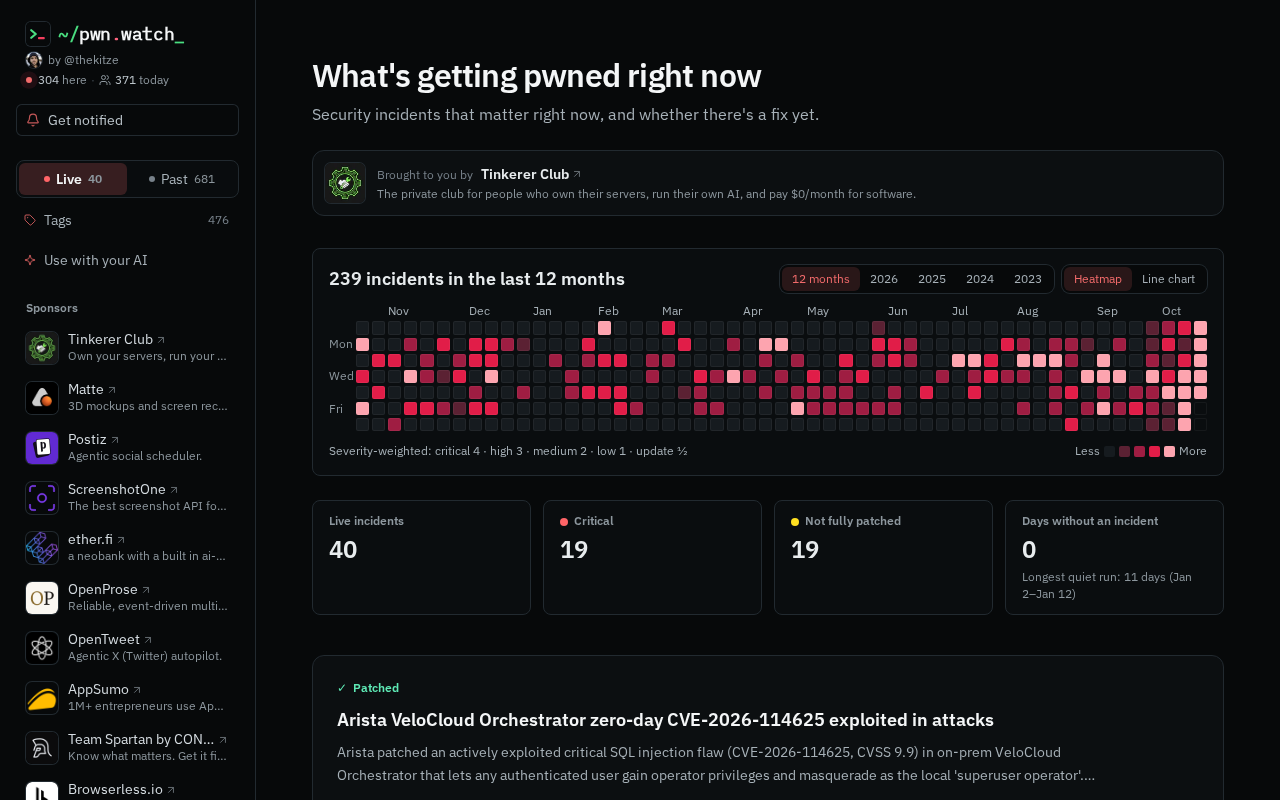
pwn.watch is a real-time attack event feed positioned as "what's getting pwned right now," drawing security community attention with 305 points and 143 comments on Hacker News. It aims to solve the coarse data, high latency, and inaccessibility of traditional enterprise threat intelligence platforms by showing currently attacked targets and methods like a monitoring dashboard. The article analyzes community concerns about data reliability, coverage, and pricing, noting that data freshness and accuracy are core challenges, while publicly displaying attacked targets raises privacy and ethical issues. For SecOps and red teams, it works as an external early-warning signal but must be cross-validated with internal asset inventories and vulnerability management—not treated as an authoritative conclusion.
The security community has recently been buzzing about a website called pwn.watch, whose self-description is just one line: "What's getting pwned right now." This blunt positioning, combined with the discussion heat it generated on Hacker News—305 points and 143 comments—shows that it hits a real need for many security practitioners and operations staff: real-time awareness of what's happening on the external attack surface.
What problem is this tool trying to solve
Traditional threat intelligence platforms are mostly built for enterprise procurement, with coarse data granularity and high update latency, making them hard for ordinary developers to use. pwn.watch takes a different path: it turns "getting pwned" into a real-time information feed akin to a monitoring dashboard, letting users see at a glance which targets are currently under attack and how they're being breached.
For security operations (SecOps) teams, the value of this perspective lies in shortening the gap between "hearing about an attack" and "confirming whether you're affected." Red teams and penetration testers can also use it to understand currently popular attack techniques and the distribution of exposed surfaces.
Attack Surface refers to the sum of all exposure points an organization has that could be exploited by attackers, including public IPs, open ports, web applications, APIs, cloud storage buckets, third-party components, and employee accounts. The core work of Attack Surface Management (ASM) is to continuously discover, inventory, and assess the risk of these exposure points, rather than responding passively only after a vulnerability scan report comes out. In recent years, ASM has evolved from one-off mapping to continuous monitoring, emphasizing an "external perspective"—examining one's own assets from the viewpoint visible to attackers, which often differs from internal asset inventories. Real-time attack feeds like pwn.watch essentially provide a dynamic slice of the attack surface "being exploited," helping teams judge which exposure points have entered the scope of real-world attacks.
User concerns seen from the HN discussion
Information from the original source is limited, but from the discussion volume of 143 comments, it can be inferred that the community's focus centers on several directions: whether the data sources are reliable, how broad the coverage is, free or paid, and whether there's a gap between "spectating" and "actually usable." The biggest challenge for real-time attack monitoring products of this kind has never been presentation, but data freshness and accuracy—there is an inherent delay between when an attack event occurs and when it is observed. How this delay is labeled and how false positives are avoided directly determine the tool's credibility.
Another unavoidable topic is compliance and ethics. Publicly displaying targets that are currently under attack may involve victim privacy and even indirectly provide attackers with a target list. How the product handles this boundary in its design is an important dimension for evaluating it.
Threat Intelligence is usually divided by consumption level into strategic, operational, and tactical categories. Tactical intelligence focuses on specific IOCs (IPs, domains, file hashes) and TTPs (attacker tactics, techniques, and procedures), which can be used directly in detection rules; operational intelligence focuses on whether attack campaigns are relevant to the organization; strategic intelligence is aimed at decision-makers. Real-time attack feeds belong to the "situational awareness" layer between tactical and operational; their value is not in replacing IOC subscriptions but in providing context that attacks are happening. Key metrics for measuring such intelligence sources include timeliness (latency from event occurrence to visibility), coverage (geographic and industry distribution), confidence labeling, and machine-readability. Intelligence sources lacking latency labeling and false-positive control will instead increase alert fatigue for security teams.
Practical value for developers and operations
Even without direct procurement, tools like this are worth adding to the bookmarks for daily security inspections. It can serve as a supplement to the external perspective: when internal monitoring raises no alarms, check whether there are already attack campaigns against similar assets externally, so you can harden in advance. For services exposed to the public internet, continuously paying attention to the types of targets "being pwned" often creates more urgency than reading vulnerability advisories after the fact.
It should be noted that real-time attack feeds are better suited as early-warning signals rather than authoritative conclusions. Attack data from any single source needs cross-validation; it only has practical meaning when combined with your own asset inventory and vulnerability management processes.
False Positives and Alert Fatigue are classic problems in security monitoring: when a system generates a large number of low-quality alerts, analysts gradually ignore all alerts, causing real incidents to be drowned out. Real-time attack display platforms face the same risk—an event marked as "being pwned" may just be scanner probing, honeypot luring, or an illusion caused by misconfiguration. Therefore, mature products label each event with its data source, observation method, and confidence level, and allow users to filter by asset type or attack technique. For users, treating real-time attack feeds as "clues" rather than "conclusions" and validating them with their own logs and traffic analysis is the way to avoid being misled by noise.
Conclusion
The popularity of pwn.watch reflects a trend: security visualization is moving down from enterprise-grade platforms to lighter-weight real-time tools. Whether it can retain users long-term depends on data quality, coverage breadth, and how it handles ethical boundaries. For teams focused on attack surface management, adding it to their list of information sources is a very low-cost starting point.
One-line Summary
pwn.watch provides lightweight security situational awareness through a real-time attack feed, trending on HN and sparking discussion about data quality and ethical boundaries.
Paragraph Summary
pwn.watch is a real-time attack event feed website positioned as "what's getting pwned right now," which drew attention in the security community after earning 305 points and 143 comments on Hacker News. It attempts to solve the problems of traditional enterprise threat intelligence platforms—coarse data granularity, high update latency, and difficulty of use for ordinary developers—by displaying currently attacked targets and attack methods in a way similar to a monitoring dashboard. The article analyzes community focus areas such as data reliability, coverage, and pricing models, pointing out that data freshness and accuracy are the core challenges for such products, while publicly displaying attacked targets involves victim privacy and ethical boundaries. For SecOps and red teams, it is suitable as an external early-warning signal, but it must be cross-validated with internal asset inventories and vulnerability management processes and cannot be treated as an authoritative conclusion.
Related articles
uGAP: An AI Platform Unifying 100+ African Geospatial Datasets
uGAP is an African geospatial AI platform by a University of Cape Town team, unifying 120+ African datasets with a Python SDK for discovery, processing, and model training, already used in cyclone flood mapping.

Cursor Can Now Control Your Computer: AI Agents Can Drive Desktop Apps for Testing
Cursor adds desktop control: AI agents can drive desktop apps like the iOS Simulator to test their own features. We analyze the impact on dev workflows, possible technical approaches, and reliability concerns.

Vibecoding a Custom Inference Engine: High Hopes, Harsh Reality
A Reddit developer shares the real experience of vibecoding a custom inference engine: running GGUF Q4 models in the browser with WebGL2 and GLSL, only to fall into tokenizer debugging hell. This article analyzes the engineering challenges of browser-side LLM inference and why cloning llama.cpp is the more rational choice.