Python + AI for Beginners: A Complete Roadmap from Basic Syntax to Large Model API Development

A four-stage Python + AI roadmap for beginners, from core syntax to DeepSeek API development.
Using the rise of low-cost models like DeepSeek as a starting point, this article explains why Python — powering over 80% of AI applications — is the ideal entry point for everyday people entering AI development. It outlines a four-stage roadmap: environment setup → core syntax → AI application development (focusing on DeepSeek API calls) → web scraping, covering AI apps, data analysis, and backend web development. The key insight is about timing: beginners should hand-code during the syntax stages to build genuine understanding, then adopt AI tools in project work to amplify efficiency. The article also notes that the source material has a marketing slant — real enterprise-level delivery still demands substantial hands-on practice.
Why Ordinary People Should Start with Python in the Age of AI
Millions of people use AI every day, yet most treat it as nothing more than a tool for chatting, writing copy, or generating images — overlooking the massive industrial shift happening beneath the surface. Since GPT ignited the global AI wave, a wave of Chinese large models followed: Wenxin Yiyan, Tongyi Qianwen, Xunfei Xinghuo, Doubao, and others. The AI ecosystem took shape quickly. Now, with the emergence of high-performance, low-cost models like DeepSeekAd, the barrier to AI development has dropped even further — handing ordinary people a real ticket into this space.
Deploying AI in a business context isn't just about building a simple chat interface. It's about using large models to replace repetitive work, cutting costs and boosting efficiency. While major tech companies focus on training foundational models, a vast number of small and medium-sized enterprises urgently need developers who can call APIs and build practical business AI tools — and that's exactly where the opportunity lies for everyday people.
According to statistics cited in the source video, over 80% of AI applications and projects are built on Python, making it the dominant language in the artificial intelligence field by a wide margin.
Three Core Reasons Python Dominates AI Development
Python's rise as the go-to language for AI isn't accidental. It comes down to three fundamental advantages.
Clean syntax with a low learning curve. Compared to languages like C++ or Java, Python doesn't require beginners to wrestle with complex syntax rules. This lets learners focus on logic rather than language mechanics.
An incredibly rich AI ecosystem. Nearly every major AI tool and framework prioritizes Python support. From data processing to model inference, mature libraries are available off the shelf, dramatically lowering the cost of building AI applications.
A massive community with abundant resources. When you hit a wall, there are countless tutorials and open-source projects to reference online — making Python ideal for rapid AI prototyping. For beginners, this means it's much easier to find solutions when things go wrong.
A few names appear in virtually every Python AI project: NumPy and Pandas handle numerical computation and data processing; Matplotlib covers data visualization; Scikit-learn addresses classical machine learning algorithms; and PyTorch and TensorFlow are the two dominant frameworks for deep learning. At the large model application layer, LangChain and LlamaIndex provide the scaffolding that connects model capabilities to business logic, while Requests and FastAPI handle HTTP requests and backend API development respectively. This highly specialized, tightly integrated ecosystem means developers don't need to build from scratch — a few lines of code can call a large model, process data, and deploy an endpoint. This is the core competitive moat that other languages struggle to match in the AI space.
A Clear Four-Stage Learning Roadmap
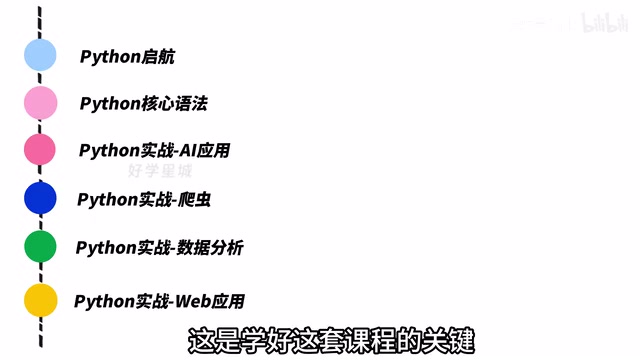
The source video structures the entire curriculum into four progressive chapters — a framework that's equally useful for self-learners.

Stage 1: Python Foundations
This stage starts with setting up your development environment and getting familiar with your editor. The focus is on avoiding the common installation errors that trip up beginners, writing your first line of code, and officially entering the world of programming. Environment setup is often the first dropout point — getting past it early keeps the learning momentum alive.
Stage 2: Core Syntax
This stage covers variables, data types, operators, control flow, functions, and object-oriented programming. This is the foundation for every project that follows. By the end, learners should be able to independently read and write basic code.
Stage 3: AI Application Development (The Core Focus)
This is the centerpiece of the entire roadmap. It begins with the fundamentals of artificial intelligence and large models, moves into network protocols, and then dives into calling the DeepSeek large model API. Through hands-on practice, learners gain the ability to build foundational enterprise-grade AI applications. For anyone looking to break into AI development, this stage is the real turning point.
API (Application Programming Interface) calls are the core skill of this stage. Large model providers package their model capabilities into API services — developers simply send HTTP requests with a prompt according to the documentation, and receive text, code, or structured data in return, with no need to self-host model weights that can run into hundreds of gigabytes. DeepSeek's API uses an interface format compatible with OpenAI's, meaning that once you learn to call one provider's API, switching to another costs very little effort. Typical enterprise AI applications include auto-generated reports, intelligent customer service bots, contract review assistants, and code audit tools — all of which are essentially combinations of business logic, prompt engineering, and API calls, rather than complex engineering projects that require training models from scratch.
Stage 4: Web Scraping in Practice
This stage covers the principles of network requests, with a strong emphasis on scraping compliance — understanding which data can be collected and what is strictly off-limits. Learners then work through practical projects like scraping Douban movie rankings and wallpaper collection sites, mastering the complete workflow of data extraction, cleaning, and storage.
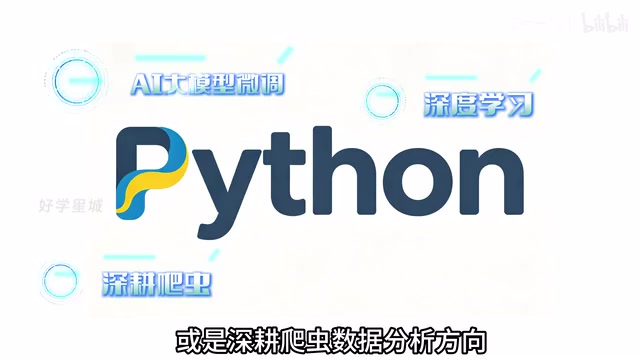
The full roadmap covers nearly all mainstream Python application domains, including AI applications, web scraping, data analysis, and backend web development. After completing it, those who want to go deeper into large model fine-tuning, deep learning, or scraping-based data analysis will have a solid foundation from which to chart their next steps.
In China, scraping compliance has clear legal references: the Cybersecurity Law (effective 2017), the Data Security Law (2021), and the Personal Information Protection Law (2021) together form the basic framework. In practice, a few red lines deserve attention. First, the robots.txt protocol — this file in a website's root directory declares which paths are off-limits to crawlers; violating it isn't directly illegal, but it's often treated as evidence of malicious access. Second, collecting user personal data (names, phone numbers, ID numbers, etc.) requires explicit authorization. Third, bombarding a server with high-frequency requests to the point of disrupting service may violate Article 285 of the Criminal Law on illegal intrusion into computer information systems. Douban movie rankings and publicly available wallpapers are typical compliant practice scenarios, while social platform user data and financial transaction records fall into high-risk territory that beginners should actively avoid.
The Key Learning Method: When to Use AI, and When Not To
One of the most important pieces of advice in this roadmap — especially for complete beginners — concerns when to use AI coding tools.
During the first two stages focused on basic syntax, the recommendation is to avoid relying on AI coding tools as much as possible and to type out all examples and exercises by hand. The core goal at this stage is to understand the logic behind the syntax and develop a programming mindset. If you copy-paste AI-generated code during the foundations stage, you might feel like you're moving fast, but without internalizing the underlying logic, you'll be stuck the moment a project requires any modification.
Once you move into practical project work, you can reasonably lean on AI tools to boost efficiency — learning to develop, debug, and optimize code with AI assistance. The source video specifically notes: the curriculum teaches how to use AI to assist with coding, interpret code, and track down and fix bugs — but it does not encourage directly copying finished code generated by AI.
The logic behind this guidance is straightforward: the developers who will thrive in the future are those who know how to leverage AI tools to ship projects quickly — not those who use AI as a homework machine. Build independent capability first, then use AI to amplify your efficiency. The order matters.
Who This Is For, and What to Realistically Expect
As described in the source video, this type of learning roadmap is primarily aimed at four groups: complete beginners hoping to enter the IT industry and ride the AI wave; tech enthusiasts who want to use AI as a side income source or to improve workplace productivity; working professionals looking to pivot into AI application development; and university students who want to strengthen their graduation projects, competition portfolios, or job-hunting résumés.
It's worth keeping a realistic perspective: this is a course introduction with a recruitment-oriented slant, and the descriptions of career prospects and side income carry some degree of marketing language. Ordinary people can absolutely use Python to enter AI development — but going from beginner to genuinely delivering enterprise-grade AI applications still requires substantial hands-on experience. There are no shortcuts.
The advice genuinely worth taking to heart is simple but correct: don't just watch tutorial videos — write the code yourself. Understanding something doesn't mean you can do it. Only by typing it out yourself, and making your own mistakes, can you truly make the skill your own.
Related articles

How Big Can Stars Really Get? The Physical Limits of the Largest Stars
Red supergiants are the largest stars by volume, with radii up to 2,000 times the Sun, engulfing the inner solar system. But there is no precise upper limit on stellar size—models predict up to 15,000 solar radii. The most massive blue stars are far smaller than red supergiants—biggest and heaviest are two different things.

Apple HomeView Smart Display Full Feature Breakdown: Wall-Mount or Desktop, $299
Apple launches HomeView, a $299 smart display with wall-mount and desktop options, 12MP camera for facial recognition, smart home control, music playback, and recipe step-by-step cooking. Full breakdown of watch faces, apps, privacy, and cooking integration.

Where Did the Promised New Studio Go? Craft Computing Answers After Five Years
Craft Computing's host responds to viewer questions: the new studio promised five years ago was shelved as construction costs soared from $30,000 to $75,000, and was replaced by a 168-square-foot garage conversion.