PyTorch Runs Natively on AWS Trainium: What Zero Code Changes Really Means

AWS claims PyTorch runs natively on Trainium with zero code changes, challenging CUDA lock-in.
AWS engineer Marcus Aduyogo announced at the PyTorch Conference that PyTorch now runs natively on AWS Trainium with zero code changes, under the slogan "If you know PyTorch, you know Trainium." Eager mode, Torch.compile, and standard distributed APIs all work out of the box. The foundation is the open-source Torch Neuron backend. Six conference sessions cover training, Hugging Face integration, VLLM inference, profiling, and RL. If the promise holds, hardware selection shifts from code-rewrite concerns to cost-performance trade-offs — though third-party operator and CUDA migration remain unverified.
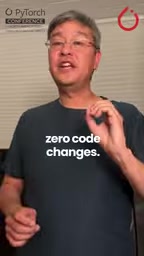
At the PyTorch Conference, AWS engineer Marcus Aduyogo delivered a claim with real impact for deep learning developers: PyTorch can now run natively on AWS Trainium chips with zero code changes. He summed it up with a simple slogan — If you know PyTorch, you know Trainium.

This isn't just a simple porting announcement. For PyTorch developers who have long been tightly bound to the CUDA ecosystem, it touches on a more fundamental question: is hardware substitutability for AI training finally becoming realistic?
What Problem Is Trainium Trying to Solve?
AWS Trainium is Amazon's in-house AI chip, with a very clear positioning: designed for next-generation deep learning AI training and inference — not general-purpose computing.
Behind this positioning is a shared compute anxiety among cloud providers. GPU supply has been tight for a long time and costs remain high, while the vast majority of model training code is deeply dependent on NVIDIA's software stack. If in-house chips only offer an advantage on paper in terms of raw compute, yet require developers to rewrite their training scripts, the migration cost alone is enough to deter most teams.
So Trainium's real challenge was never the hardware itself — it's whether the software ecosystem can let developers switch painlessly.
CUDA is a parallel computing platform and programming model that NVIDIA has built since 2006. Together with libraries like cuDNN, NCCL, and TensorRT, it has formed the de facto software standard for deep learning training. The vast majority of PyTorch's GPU acceleration paths, custom operators, and the underlying implementations of third-party libraries are built on CUDA by default. This deep coupling between software and hardware creates an extremely high migration barrier: even if other hardware has an advantage on paper in raw compute or cost-per-unit, teams are often unwilling to switch because of the high cost of rewriting training code, retuning performance, and rebuilding debugging pipelines. The real difficulty for cloud providers building in-house AI chips, therefore, isn't chip design itself — it's whether they can provide a software stack that lets existing CUDA-ecosystem code migrate with low friction.
Zero Code Changes: The Weight of That Phrase
The core selling point Marcus repeatedly emphasized in his talk was "zero code changes."

Broken down, it means several things developers are familiar with work out of the box:
- Eager mode: PyTorch's most basic immediate execution mode, the workhorse for debugging and prototyping
- Torch.compile: PyTorch 2.x's compilation acceleration path for improving training performance
- Standard distributed APIs: multi-GPU, multi-node parallel training interfaces
In other words, developers don't need to learn a new programming model, nor do they need to insert hardware-related branch logic into their code. Existing PyTorch code should, in theory, run directly on Trainium.
If this holds up in practice, its significance is greater than raw performance numbers. Ecosystem lock-in often isn't because hardware is irreplaceable, but because software migration is too expensive. Lowering migration costs is the first step to breaking that lock-in.
Torch.compile is the compilation acceleration mechanism introduced in PyTorch 2.0. It captures Python bytecode via TorchDynamo to generate a computation graph, then uses a backend compiler to perform operator fusion, memory planning, and other optimizations — improving training and inference performance with almost no source code changes. Its key characteristic is a layered design: the frontend handles graph capture, the backend handles compilation, so in theory it can connect to different hardware. For non-NVIDIA chips like Trainium, whether it can become a usable Torch.compile backend directly determines whether developers can enjoy compilation acceleration transparently. Eager mode, meanwhile, is the immediate execution mode without graph compilation — the foundation for debugging and prototyping. That it can run natively on new hardware means the compatibility bar for new backends has already been lowered significantly.
Torch Neuron: The Open-Source Native Backend
The technical foundation supporting all of this is Torch Neuron — the open-source native PyTorch backend AWS built for Trainium.
Its role is to translate, compile, and schedule PyTorch computation graphs onto Trainium hardware for execution, while remaining transparent to the upper layers. Marcus specifically mentioned that there would be dedicated deep-dive sessions during the conference explaining how Torch Neuron works.
Choosing open source is noteworthy. If a hardware vendor's in-house backend is closed source, developers struggle to troubleshoot issues and have difficulty building trust; open source means the community can inspect the implementation, submit improvements, and better aligns with the PyTorch ecosystem's long-standing open ethos.
In PyTorch's layered architecture, the backend is responsible for translating upper-level computation graphs into executable instructions for specific hardware. Accelerators from different vendors typically need their own backend implementations to handle operator mapping, memory management, communication scheduling, and other low-level details. Torch Neuron is AWS's implementation of this layer for Trainium and Inferentia chips. It shields hardware differences from upper layers, allowing the same PyTorch code to be scheduled onto Trainium. Whether a backend is open source matters enormously for ecosystem trust: with a closed-source backend, once precision deviations, performance anomalies, or missing operators appear, external developers can hardly pinpoint the cause and can only wait passively for the vendor to fix it. Open source allows the community to review compilation logic, reproduce issues, and submit patches — and it better fits the open, collaborative model the PyTorch community has built over the long term.
Six Hands-On Sessions at the Conference
AWS arranged six sessions at this PyTorch Conference, covering a complete path from beginner to advanced:

- Keynote and live demos: a direct demonstration of PyTorch code running on Trainium
- Torch Neuron deep dive: a clear explanation of how the backend works
- Model training with Hugging Face and Torch Titan: closely aligned with mainstream training workflows
- VLLM inference serving: covering inference deployment and aggregated serving
- Performance profiling
- Reinforcement learning (RL)
This session list sends a signal: what AWS wants to show isn't a single demo, but a complete chain from training, fine-tuning, and inference to performance tuning. Naming VLLM on the inference side shows that Trainium's target scenarios include both training and inference, not just training.
What Developers Should Pay Attention To
If this zero-code-change promise holds, the most direct impact is this: the decision about which training hardware to choose shifts from "do we need to rewrite the code" to "are the cost and performance worthwhile."
But there's usually a gap between announcements and reality. PyTorch API compatibility is one thing; whether common third-party operators, custom CUDA kernels, and projects that depend on CUDA-specific features can migrate smoothly is another. Such details often determine whether a backend is actually usable in real projects.
For teams with PyTorch experience, what's worth watching is Torch Neuron's operator coverage, the actual scaling efficiency of distributed training, and the out-of-the-box experience under mainstream workflows like Hugging Face. These are the keys to turning "zero code changes" from a slogan into productivity.
Marcus was direct at the end: if you know PyTorch, you know Trainium. Whether that line can be delivered depends on the six sessions that follow and developers' real feedback afterward — not on the slogan itself.
A custom CUDA kernel refers to a parallel function that developers write directly in CUDA C/C++ to run on GPUs, often used to implement specialized computations that PyTorch's native operators don't cover or don't handle fast enough. This kind of code is tightly bound to NVIDIA hardware and cannot be migrated directly to other accelerators like Trainium — it usually needs to be rewritten as the corresponding low-level implementation for the target hardware. In addition, many third-party libraries and models embed CUDA code via methods like torch.utils.cpp_extension, and these paths often require dedicated alternatives on non-CUDA backends. So when evaluating "zero code changes," beyond the compatibility of standard PyTorch APIs, it's also important to confirm whether such hardware-related code exists in a project and whether the corresponding operators are already covered by the target backend.
One-line Summary
AWS claims PyTorch can run natively on Trainium with zero code changes, aiming to break CUDA ecosystem lock-in.
Paragraph Summary
AWS engineer Marcus Aduyogo announced at the PyTorch Conference that PyTorch can now run natively on its in-house AI chip Trainium with zero code changes, with the slogan "If you know PyTorch, you know Trainium." This means eager mode, Torch.compile, and standard distributed APIs all work out of the box, with no need to learn a new programming model or insert hardware branches. The technical foundation is the open-source native backend Torch Neuron, which handles computation graph compilation and hardware scheduling. The conference features six sessions covering training, Hugging Face integration, VLLM inference, profiling, and reinforcement learning. If the promise holds, hardware selection logic shifts from "do we need to rewrite code" to "are cost and performance worthwhile" — but the migration feasibility of third-party operators and CUDA-dependent projects still needs verification.
Related articles

From Photons to Production: An Open-Source Computer Vision Engineering Reading Path
Reddit user open-sources a computer vision engineering reading path with 16 chapters from image formation to production deployment, emphasizing primary sources, dependency order, and reproducible benchmarks to help engineers understand why models fail and build reliable vision systems.

Prompt Failures? The Truth About Why AI Agents Struggle in Production—and How to Fix It
A Reddit developer built Agents with Copilot and Gemini but faced unstable behavior. This article analyzes three gaps in prompt engineering for Agent scenarios and offers three practical paths to reliable Agent deployment, including structured prompts, workflow-first approaches, and building an evaluation loop.

Tesla Robotaxi to Open Private Vehicle Access Next Year: Promise or Pipe Dream?
At its Q3 earnings call, Tesla said owners can add their cars to the Robotaxi fleet next year. We analyze the technical basis, Musk's missed deadlines, business logic, and competition.