QAgent: The Automated QA Tool Helping AI Agents Move Beyond 'Shipping on Vibes'
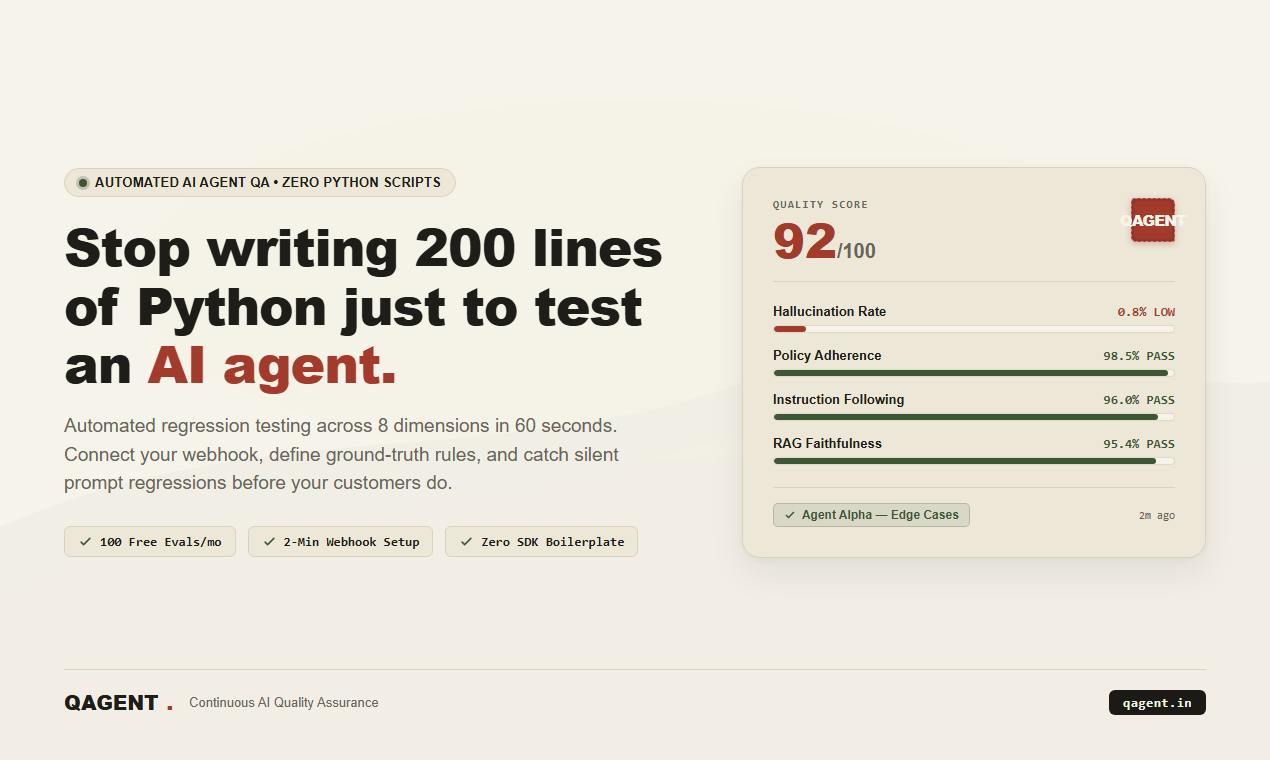
QAgent systematizes AI agent quality testing with correctness scoring, hallucination detection, and RAG benchmarking.
As AI agents move rapidly into production, most teams lack systematic quality validation — exposing users to hallucinations, policy violations, and incorrect responses. QAgent is an automated testing tool designed for AI agents, offering four core capabilities: correctness scoring, ground truth-based hallucination detection, policy adherence verification, and RAG benchmarking. It earned 72 upvotes and ranked #18 on Product Hunt at launch, validating real market demand — though evaluation accuracy and user experience still need further verification as competition in the AI Eval space intensifies.
AI agents are rapidly entering production environments, but an uncomfortable reality remains: many teams still decide when to release them to real users based on gut feeling alone. Without systematic quality validation, hallucinations, policy violations, and incorrect responses can be exposed directly to customers. QAgent, a developer tool that recently appeared on Product Hunt, aims to solve this problem — transforming "AI agent quality testing" into an automated, quantifiable process.
From "Shipping on Vibes" to Measurable Quality
QAgent's tagline cuts straight to the industry's weak point: "Stop shipping on vibes." This phrase reflects a widespread challenge in AI application development today. Traditional software has mature unit testing and integration testing frameworks, but generative AI outputs are inherently non-deterministic — one seemingly normal conversation offers no guarantee that the next one won't go wrong.
On Product Hunt, QAgent is categorized under Developer Tools, Artificial Intelligence, and Bots. Built by Abhiram Reddy.K, it earned 72 upvotes and ranked #18 on its launch day. While not a viral hit by vote count, the problem it addresses — reliability validation for AI agents — is a challenge that more and more teams encounter when moving to production.
QAgent's Four Core Capabilities
According to official documentation, QAgent provides a comprehensive set of evaluation dimensions for AI agent quality:
Correctness Scoring
The tool scores an agent's responses to measure whether its output meets expectations. This gives teams a trackable, quantitative metric rather than relying on the subjective judgment of "is this a good answer?"
Hallucination Detection
QAgent emphasizes detecting hallucinations based on ground truth — a critical distinction. Hallucination detection without a reference standard often becomes superficial, whereas aligning against real answers is what actually identifies cases where a model is confidently making things up.
What is a "hallucination"? It refers to large language models generating content that sounds plausible but is factually incorrect — such as fabricating non-existent citations, dates, or policy clauses — without any factual basis. Detection generally follows two paths: assessing the model's own confidence or internal consistency, or semantically comparing outputs against an external ground truth dataset. The latter is more reliable but requires teams to prepare a labeled set of reference answers in advance. For enterprise applications, ground truth typically comes from official documentation, product manuals, or human-reviewed Q&A pairs. Without this reference baseline, even sophisticated detection algorithms can only flag formatting anomalies — they cannot assess factual accuracy.
Policy Adherence
For agents serving enterprise and customer-facing use cases, compliance with established business rules and regulatory requirements is equally important. QAgent can verify whether an agent's responses stay within defined boundaries, helping prevent legal or brand risks from non-compliant outputs.
RAG Benchmarking
Retrieval-Augmented Generation (RAG) has become the dominant architecture for enterprise AI applications. QAgent provides RAG benchmarking capabilities, allowing teams to evaluate the overall performance of both the retrieval and generation stages before incorrect answers ever reach real users.
What is RAG? Retrieval-Augmented Generation (RAG) is an architecture that combines an external knowledge base with a language model: the system first retrieves relevant document chunks based on the user's question, then passes those chunks as context to the model to generate a response. This architecture effectively reduces hallucinations and enables models to reference up-to-date or proprietary data, making it widely adopted in enterprise knowledge assistants and customer service bots. RAG quality depends on two stages: whether the retrieval phase surfaces genuinely relevant documents, and whether the generation phase faithfully uses the retrieved content rather than improvising. Benchmarking typically evaluates metrics for both stages separately — such as retrieval Recall and answer Faithfulness — helping teams pinpoint whether the bottleneck lies in retrieval or generation.
Why Tools Like This Are Becoming Essential
AI agent evaluation (Eval) is emerging as a distinct and rapidly growing subcategory. As agents move from demos to production, teams need hard answers to several questions: What's its accuracy rate? Will it fabricate facts? Will it violate company policy? How good is the content retrieved via RAG?
These questions cannot be solved by manual spot-checks. The value of tools like QAgent lies in converting subjective quality impressions into repeatable, regression-ready testing workflows — much like CI/CD in traditional software development, enabling AI applications to run a quality check after every iteration.
For developers building customer service bots, internal knowledge assistants, or domain-specific agents, establishing this quality gate before going live can significantly reduce the likelihood of production failures.
The AI Eval landscape: As a standalone tool category, LLM Evaluation / AI Eval has seen a surge of notable products in recent years, including Ragas, DeepEval, LangSmith, and Brainlid, each differing in evaluation dimensions, integration approach, and pricing. The rapid growth of this space is driven by teams that have completed Proof of Concept and now face the "last mile" challenge of moving from prototype to production — establishing a trustworthy quality assurance system despite non-deterministic outputs. Unlike traditional software testing, LLM evaluation must handle semantic similarity rather than exact matching, which means evaluation frameworks themselves rely on language models as "judges" (LLM-as-a-Judge). This introduces questions about the reliability of the evaluation results themselves — a core challenge that continues to be actively debated in the field.
Promising, But Still Needs Validation
To be objective: the publicly available information about QAgent currently comes primarily from its Product Hunt product description. Specific evaluation accuracy, integration methods, pricing, and real-world usage experience still await more user feedback. The 72-upvote reception suggests it addresses a genuine need, but whether it can hold its ground in the increasingly competitive AI Eval space will depend on the product's depth and ease of use.
For teams focused on AI application engineering, QAgent is a worthwhile option to add to your research list. At the very least, it reminds the entire industry of one important thing: the quality of AI agents shouldn't be left to gut feeling alone.
Related articles
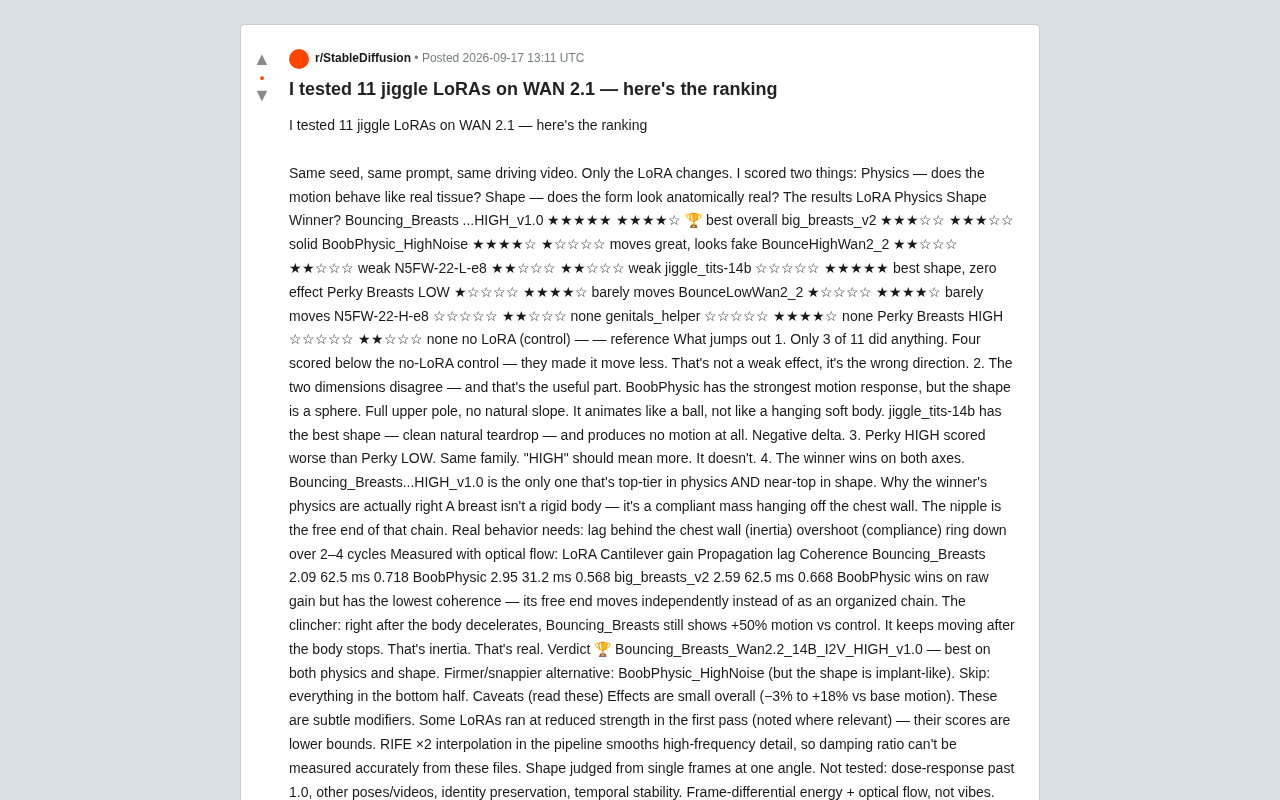
WAN 2.1 Physics Motion LoRA Benchmark: Rankings and Methodology for 11 Models Tested
A Reddit user benchmarked 11 physics-motion LoRAs on WAN 2.1 using optical flow analysis. Only 3 worked meaningfully; 4 scored below the no-LoRA baseline. Full rankings and methodology inside.
Lucid Partners with Bolt to Target European Robotaxi Market
Lucid Motors has signed a letter of intent with European mobility platform Bolt to explore Robotaxi services in Europe, though no vehicle orders have been placed yet.
AI Assistants Enter the "Phone Call" Era: Instinct and Meta Muse Add Voice Task Execution
AI assistants Instinct and Meta Muse now make phone calls on your behalf — booking restaurants, canceling subscriptions — marking a leap from chat tools to real-world agents.