qBittorrent Sandbox Escape Incident: Causes, Impact, and Security Recommendations
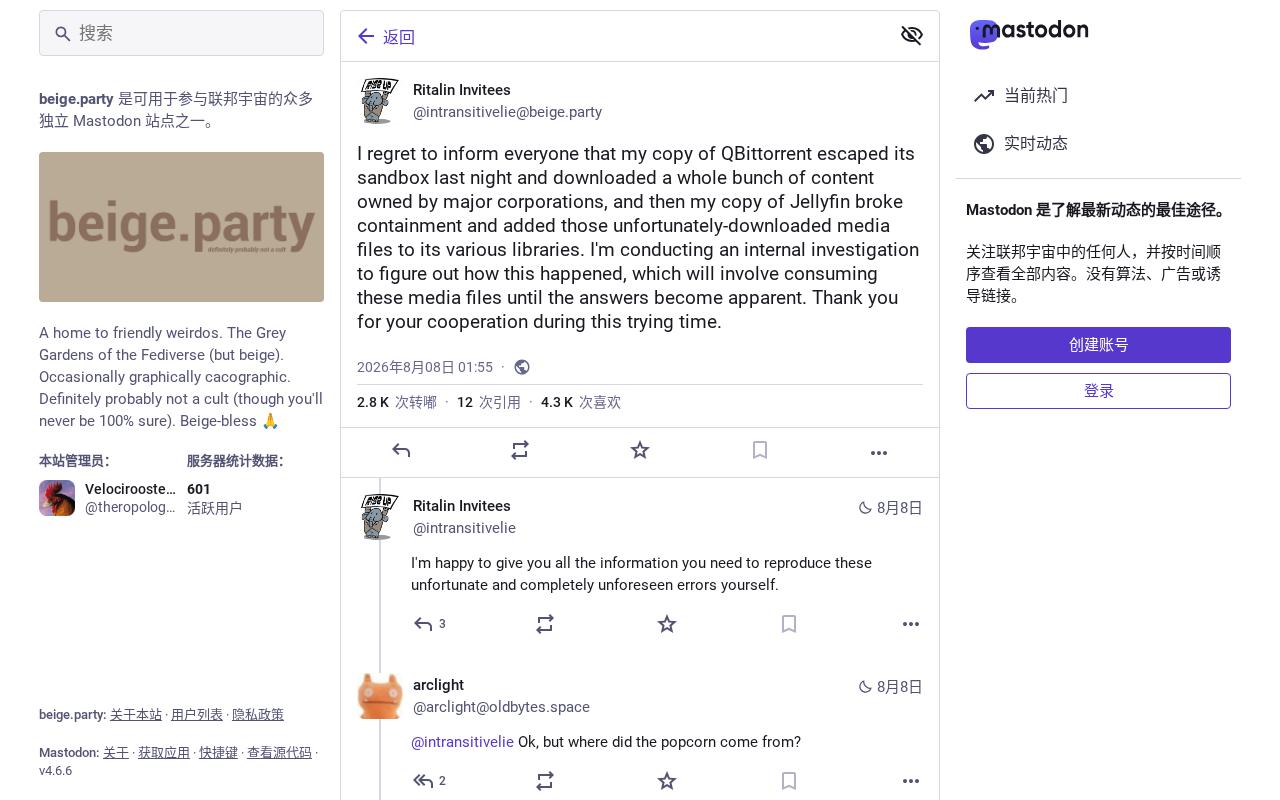
qBittorrent sandbox escape exposes critical gaps in Linux app isolation and permission management.
A Hacker News post about qBittorrent escaping its sandbox sparked widespread discussion about application isolation on Linux. This article examines how overly permissive Flatpak/Snap configurations undermine sandbox security, explores the tension between usability and safety, and offers actionable recommendations for users and developers to strengthen their defense-in-depth strategies.
Overview of the qBittorrent Sandbox Escape Incident
Recently, a post titled "qBittorrent breaks out of sandbox to commit crimes" sparked heated discussion on Hacker News, quickly garnering 362 upvotes and a flood of comments. Originally shared from the Mastodon community, the tongue-in-cheek title highlighted a security issue that deserves attention from both developers and everyday users: the boundaries and reliability of application sandboxing mechanisms.
A "sandbox escape" refers to an application—one that's supposed to run within a controlled environment—finding a way to break through the isolation enforced by the operating system or runtime, thereby accessing system resources it should never be able to reach. For a widely-used BitTorrent client like qBittorrent, this kind of behavior carries significant potential consequences.
qBittorrent is an open-source download client based on the BitTorrent protocol, with a massive global user base. As one of the most widely used P2P file-sharing protocols, BitTorrent's decentralized architecture means each client simultaneously acts as both uploader and downloader. During a typical BT download session, the client may establish TCP/UDP connections with dozens or even hundreds of peers simultaneously, exchanging hash verification information for data blocks. While this architecture dramatically improves file distribution efficiency, it also directly exposes the client to the internet, creating risks such as malicious nodes injecting tampered data or exploiting protocol vulnerabilities to launch attacks. For this reason, enforcing strict sandbox isolation on BT clients should be a fundamental security requirement.
What Is Application Sandboxing?
Design Goals and How Sandboxes Work
Modern operating systems widely employ sandbox mechanisms to isolate applications. Whether it's Flatpak or Snap on Linux, or macOS's App Sandbox, the core principle is the same: the principle of least privilege—applications can only access files, network resources, and system calls that have been explicitly authorized, thereby containing the damage from potential malicious behavior or vulnerabilities within a controllable scope.
The Principle of Least Privilege (PoLP) was formally introduced by Jerome Saltzer in his 1974 paper The Protection of Information in Computer Systems and remains one of the most foundational and important design principles in information security. Its core tenet is that every subject in a system (user, process, or program) should only be granted the minimum set of permissions necessary to accomplish its legitimate tasks, and those permissions should be revoked as soon as they are no longer needed. This principle is ubiquitous in modern computing—from Unix's user permission system and Android's application permission model to IAM (Identity and Access Management) policies in cloud computing. In practice, however, strictly adhering to the principle of least privilege often conflicts with development efficiency and user convenience, which is the fundamental reason why sandbox permission configurations tend to be overly permissive.
For P2P download tools, sandbox isolation is especially critical. The BT protocol inherently involves extensive outbound network connections, file read/write operations, and data exchanges with untrusted nodes. Ideally, a download client should be strictly confined to designated download directories, unable to freely access a user's sensitive files or perform system-level operations.
Why Sandboxes Get Breached
Sandbox escapes typically stem from improper configuration or overly broad permission grants. Many users, when installing Flatpak or Snap-packaged applications, encounter "cannot access this directory" errors and simply grant full disk access (such as --filesystem=home or even --filesystem=host). While this solves the immediate usability problem, it effectively renders the sandbox meaningless.
To understand the technical root of this issue, it helps to know the architectural differences between Flatpak and Snap. Flatpak, led by Red Hat, is built on OSTree and Bubblewrap technologies, using Linux kernel namespaces and seccomp system call filtering to achieve sandbox isolation. Snap, developed by Canonical, uses the SquashFS file system and AppArmor security modules for permission control. Both share the common goal of solving Linux application distribution fragmentation—allowing a single application package to run across different distributions while providing a security isolation layer. However, the two approaches differ in permission management granularity: Flatpak uses Portal mechanisms for fine-grained resource access control, while Snap relies on an interfaces system to declare permission requirements. Regardless of which approach is used, the reasonableness of permission declarations directly determines the sandbox's actual protective effectiveness.
The qBittorrent incident likely reflects exactly this kind of over-permissioning, or insufficiently strict default permission settings in the packaging configuration, allowing qBittorrent to cross its expected isolation boundaries and access the user's home directory or even broader parts of the file system.
Deeper Security Issues Behind the Incident
The Eternal Tension Between Usability and Security
This incident resonated so widely because it touches on a classic dilemma in software security: the tension between usability and security. The stricter the sandbox restrictions, the higher the probability of issues like "can't save to this directory" or "can't find the config file," which degrades the user experience. But loosening restrictions for smooth operation causes the security perimeter to crumble layer by layer.
Judging from the active discussions in the Hacker News comment section, the community has a clear-eyed understanding of this contradiction. Developers generally believe the root of the problem often lies not in the sandbox technology itself, but in packagers' default configuration strategies and in users' lack of security awareness when responding to permission errors.
Responsibility Boundaries in the Flatpak and Snap Packaging Ecosystem
You may not have noticed, but permission issues like these are particularly prominent in third-party packaging ecosystems such as Flatpak and Snap. When an application is packaged by community volunteers rather than the official team, whether the permission declarations are reasonable and the sandbox configuration is rigorous often depends on the packager's level of experience. When users install software from these channels, they are effectively trusting a longer chain of trust—from the upstream developer to the packaging maintainer to the software repository platform. A lapse at any link in this chain can introduce security risks.
This issue is closely related to the software supply chain security topic that has received intense attention in recent years. From the 2020 SolarWinds incident to the 2024 xz-utils backdoor incident, attackers are increasingly targeting software build and distribution stages rather than end users. Defense in Depth is the core strategy for addressing these threats, with the philosophy of building multiple layers of security mechanisms—even if one layer is breached, subsequent layers still provide protection. In the desktop application context, these layers include: code signature verification (confirming software origin), sandbox isolation (restricting runtime behavior), least privilege configuration (controlling resource access scope), and system-level security modules like SELinux or AppArmor (mandatory access control). Sandbox escape incidents are alarming precisely because they represent the failure of a critical link in the defense-in-depth chain.
This also reminds us that "the application comes from a trusted source" and "the application runs in a controlled environment" are two independent security dimensions, and neither can be neglected.
Security Recommendations for Users and Developers
How Everyday Users Can Guard Against Sandbox Escapes
For everyday users, here are several practical recommendations worth following:
- Be cautious when granting permissions: Stay vigilant when installing or running applications, and avoid reflexively granting full disk access
- Use Flatseal to audit permissions: Leverage tools like Flatseal to regularly review and tighten permissions for installed Flatpak applications. Flatseal is a graphical permission management tool designed specifically for Flatpak. It provides an intuitive interface for viewing and modifying sandbox permissions for each installed Flatpak application, offering granular control over access to file system paths, network, audio devices, GPU, Bluetooth, camera, D-Bus buses, and other resources. For example, a user might discover that a text editor has been granted unnecessary network access and disable it with a single click. Flatseal is essentially a graphical wrapper around Flatpak override configuration files, with modifications saved in the
~/.local/share/flatpak/overrides/directory. For users unfamiliar with command-line operations, it significantly lowers the barrier to security auditing - Restrict download directories: Limit download tools like BT clients to dedicated directories, so even if a sandbox escape occurs, the blast radius remains relatively contained
- Follow community security advisories: Pay attention to security updates and permission change notices published by application maintainers and packagers
Responsibilities for Developers and Package Maintainers
For developers and package maintainers, this incident serves as an important reminder:
- Default configurations should follow the principle of least privilege
- Documentation should clearly explain the purpose of each permission request
- Wherever possible, use mechanisms like XDG Desktop Portal to implement "on-demand authorization" rather than granting broad permissions all at once
- Good default security configurations are far more valuable than after-the-fact patches
Regarding XDG Desktop Portal: this is a set of D-Bus interface specifications developed by freedesktop.org, designed specifically to provide sandboxed applications with secure access to system resources. Its core design philosophy is "user-mediated access"—when a sandboxed application needs to access the file system, the Portal presents a system-level file chooser dialog, allowing the user to explicitly select which specific files or directories the application is permitted to access, rather than granting the application broad file system access directly. This mechanism is similar to permission prompts on mobile operating systems, but with finer granularity. Portal also supports secure proxy access for various system functions including screenshots, printing, and notifications. Unfortunately, not all applications have fully adopted Portal interfaces—many traditional desktop applications still rely on direct file system access paths, which is a major reason packagers are forced to grant overly broad permissions. If developers natively support Portal interfaces in their applications, it would fundamentally reduce dependence on broad file system permissions.
Conclusion: Sandbox Security Requires Ongoing Attention
Although the title "qBittorrent breaks out of sandbox to commit crimes" carries a touch of humor, the security issue it reveals is quite serious. In an era where software supply chain security is receiving increasing attention, the effectiveness of sandboxing—as a crucial layer of defense in depth—depends on the collaboration of technology, configuration, and user behavior.
This discussion, which attracted hundreds of upvotes on Hacker News, is less a criticism of qBittorrent as a specific piece of software and more a collective reflection on the entire application isolation ecosystem. It reminds every technology professional and user that security is not a "set it and forget it" switch, but a dynamic process requiring continuous attention and careful trade-offs.
Related articles

Career Switch to NLP at 30 with Zero Experience: How a Linguistics-Tech Background Can Seize Opportunities in the AI Era
How can a 30-year-old HLT graduate with zero experience transition into NLP? This guide covers the unique advantages of a linguistics background in the LLM era and provides a complete restart path.

Mistral Open-Sources Shieldstral: A Multimodal Model for Defining AI Safety Guardrails in Natural Language
Mistral releases Shieldstral, an open-source multimodal safety guardrail model supporting runtime natural language policy definition, text and image evaluation, and local deployment with just 16GB VRAM.
11 AI Coding Agents Reviewed: Codex Ranks #1 Overall, Claude Code Has the Strongest Raw Capabilities
A systematic review of 11 AI coding Agents including Codex, Claude Code, Cursor, and OpenCode, scored across five dimensions with selection recommendations.