QGIS Bans AI-Assisted Contributions: A Trust Crisis in the Open Source Community

QGIS bans AI-assisted code contributions, sparking open source debate over quality, trust, and AI boundaries.
QGIS announced that it will no longer accept AI-assisted code contributions, citing reasons such as reducing maintainers' review burden, preventing licensing and security risks, and preserving trust-based open source collaboration. The policy has divided the community, with supporters viewing it as necessary to protect critical infrastructure quality and opponents fearing that a blanket ban will hinder progress and exclude new developers. The core dispute is the inability to distinguish responsible AI assistance from low-quality automated submissions. Long term, it may split the open source ecosystem into AI-friendly and conservative camps and force every project to redefine "real contribution."
Open source geographic information system QGIS recently announced a policy that has sparked widespread discussion: it will no longer accept AI-assisted code contributions. This decision has dropped a stone into the geographic information and open source communities, and the ripples it has stirred extend far beyond the technical level.
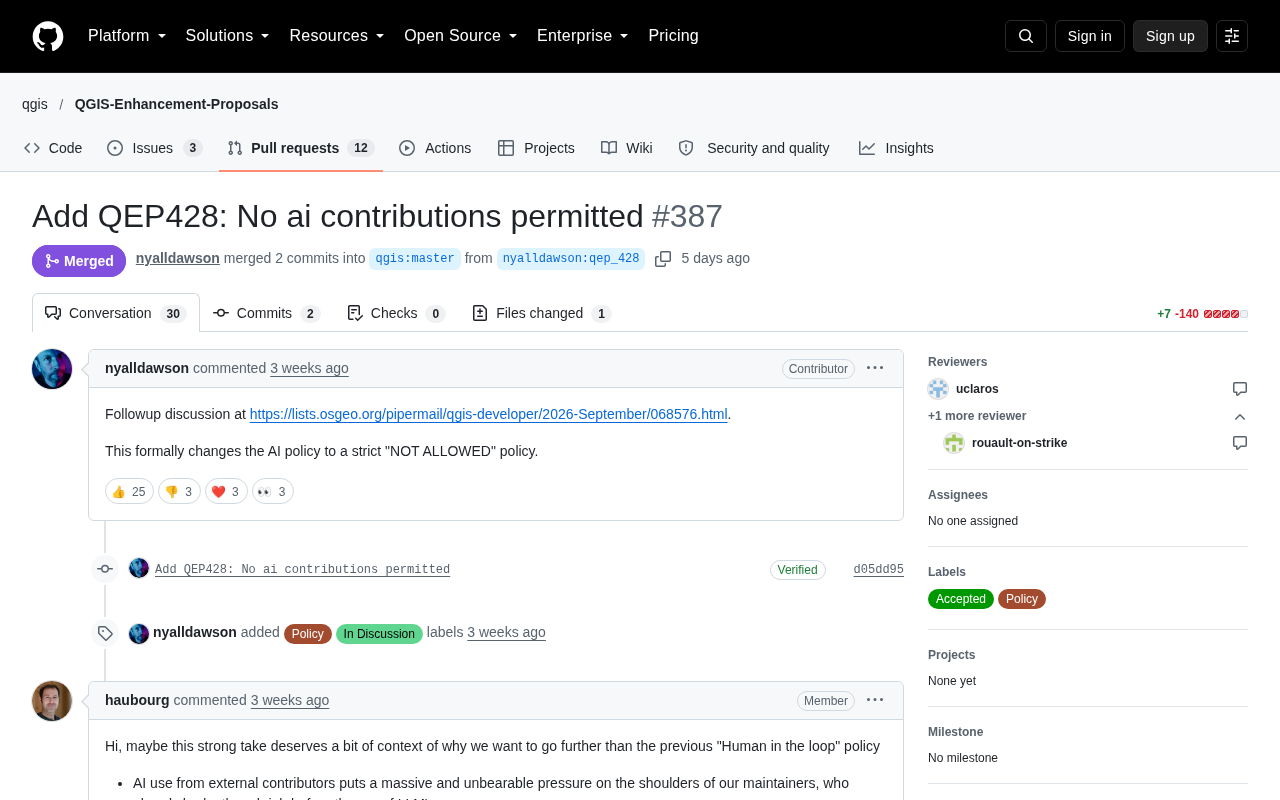
Why Is QGIS Banning AI Code?
According to discussions on Hacker News, QGIS project maintainers have made it clear that they will not accept code submissions generated with AI assistance or written entirely by AI. This policy was not adopted on a whim, but is based on multiple practical considerations.
The most direct concern comes from the burden of code review. When contributors submit AI-generated code, maintainers must spend a great deal of time verifying its correctness, security, and license compliance. If contributors themselves cannot fully understand the logic of the code, how can reviewers ensure that it will not introduce hidden bugs?
The deeper anxiety lies in the erosion of trust mechanisms. Collaboration in open source projects is built on reputation between people. When AI can generate seemingly reasonable code at scale, maintainers lose the basis for judging the true abilities of contributors.
QGIS (Quantum GIS) is a cross-platform open source desktop geographic information system released under the GNU General Public License (GPL). It supports viewing, editing, and analyzing geospatial data, has a plugin architecture and a large user community, and is widely used by government agencies, research institutes, environmental organizations, and others for map production, spatial analysis, and decision support. Because its codebase involves a large number of modules from different contributors and is often integrated downstream into commercial or public projects, license compliance and code quality directly affect the stability of the entire ecosystem. Understanding this position of QGIS helps explain why its contribution policy is seen as a bellwether for open source governance.
Division and Contestation in the Open Source Community
QGIS's decision is not an isolated case, but it marks a tougher stance. Before this, several well-known open source projects had already tried to restrict the influx of AI-generated content.
Some projects require contributors to disclose their use of AI, while others directly state in their contribution guidelines that "AI-generated code will not be accepted." The reason QGIS's policy has provoked a larger reaction is that it comes from a critical infrastructure project with a huge user base that is widely adopted by government agencies and research institutions.
Supporters see this as a necessary step to protect code quality. Opponents worry that a blanket ban may hinder technological progress and even shut out a new generation of contributors who use AI to learn and improve efficiency.
Open source projects' Contributor License Agreements (CLA) or Developer Certificates of Origin (DCO) usually require contributors to declare that the code they submit is original or that they have the right to submit it. AI-generated code may involve open source fragments from training data, leading to license contamination or unclear copyright ownership. Therefore, requiring disclosure of AI use is not merely a matter of transparency, but also part of legal risk management. When a project cannot trace the source of code, downstream adopters may face compliance risks, which is especially sensitive for critical infrastructure such as QGIS.
Where Is the Boundary of AI-Assisted Programming?
At the core of this debate is actually a question on which there is not yet consensus: Where is the reasonable boundary of AI-assisted programming?
Code generated entirely by AI and not substantially reviewed by contributors clearly carries risks. But how fundamentally different is a process of using AI for completion, refactoring, and writing tests, followed by careful human verification, from the traditional approach of "consulting documentation and then writing code by hand"?
QGIS's ban adopts the precautionary principle—when it is impossible to effectively distinguish between "responsible AI assistance" and "hands-off submissions," it is better not to distinguish at all. This conservative strategy sacrifices some efficiency in exchange for certainty in the review process and stability in community trust.
The precautionary principle is often invoked in environmental policy and risk management, referring to taking conservative measures to avoid potentially irreversible consequences when science cannot confirm whether an activity will cause harm. QGIS transfers it to the field of code governance: since existing tools cannot reliably distinguish between "human-led AI assistance" and "AI-led automated submissions," a comprehensive ban becomes the simplest strategy for reducing uncertainty. The cost of this approach is sacrificing some efficiency and inclusiveness, but supporters argue that in open source communities with fragile trust mechanisms, certainty itself is a scarce resource.
Long-Term Impact on the Open Source Ecosystem
In the short term, QGIS's policy may reduce low-quality code submissions and ease the burden on maintainers. But in the long term, it may bring two unexpected consequences.
First, compliance costs shift to contributors. Developers who want to participate in QGIS need to additionally prove that their code was not AI-generated, which may give rise to new review tools and an atmosphere of distrust.
Second, projects may diverge in attractiveness. Projects that are open to AI assistance may attract more young developers, while projects that insist on bans will rely more on contributors taking traditional paths. The open source ecosystem may therefore form two parallel talent pools.
Regardless of one's position, QGIS's decision forces every open source project to answer an urgent question: When AI becomes the default option for programming, how do we define a "real contribution"? The answer to this question will determine the basic shape of open source collaboration over the next decade.
One-line Summary
QGIS bans AI-assisted code contributions, sparking debate in the open source community over quality, trust, and the boundaries of AI.
Paragraph Summary
QGIS announced that it will no longer accept AI-assisted code contributions, citing reasons including reducing maintainers' review burden, preventing licensing and security risks, and preserving open source collaboration mechanisms based on interpersonal trust. The policy has divided the community: supporters see it as a necessary step to protect the quality of critical infrastructure, while opponents worry that a blanket ban will hinder technological progress and exclude a new generation of developers. The core dispute is the inability to effectively distinguish responsible AI assistance from low-quality automated submissions. In the long run, this move may lead to a split in the open source ecosystem, forming two camps of AI-friendly and conservative projects, and forcing every project to redefine "real contribution."
Related articles

Gaussian Process Bandit Optimization: Exploration Strategies and Inference Regret Guarantees
Cumulative regret guarantees in Bayesian optimization fail to reflect final recommendation quality. This article examines a new study that provides inference regret guarantees for Gaussian process bandit optimization through exploration query strategies and fill distance analysis, validated on hyperparameter optimization and control tasks.

The Most Detailed Codex Guide on Bilibili: From Installation to Real-World Practice
The most detailed Codex guide on Bilibili: from app store installation to daily work mode configuration, with a real coffee shop project demonstrating file organization, data extraction, dashboard creation, and other practical tasks. Learn to use Plan Mode and desktop pets to leverage Codex efficiently.

Appearance Compensation in Volume Rendering: Why RGB Accuracy Cannot Guarantee Density Correctness
Volume rendering research reveals that volumetric data perfectly reproducing external RGB views may still contain density errors: appearance compensation can double central density and keep external rays unchanged even when L2 error exceeds 14.52%. Density recovery depends on appearance capacity, spatial resolution, and measurement design.