qorqbot: A Proactive Business Agent That Runs on Your Existing Subscriptions
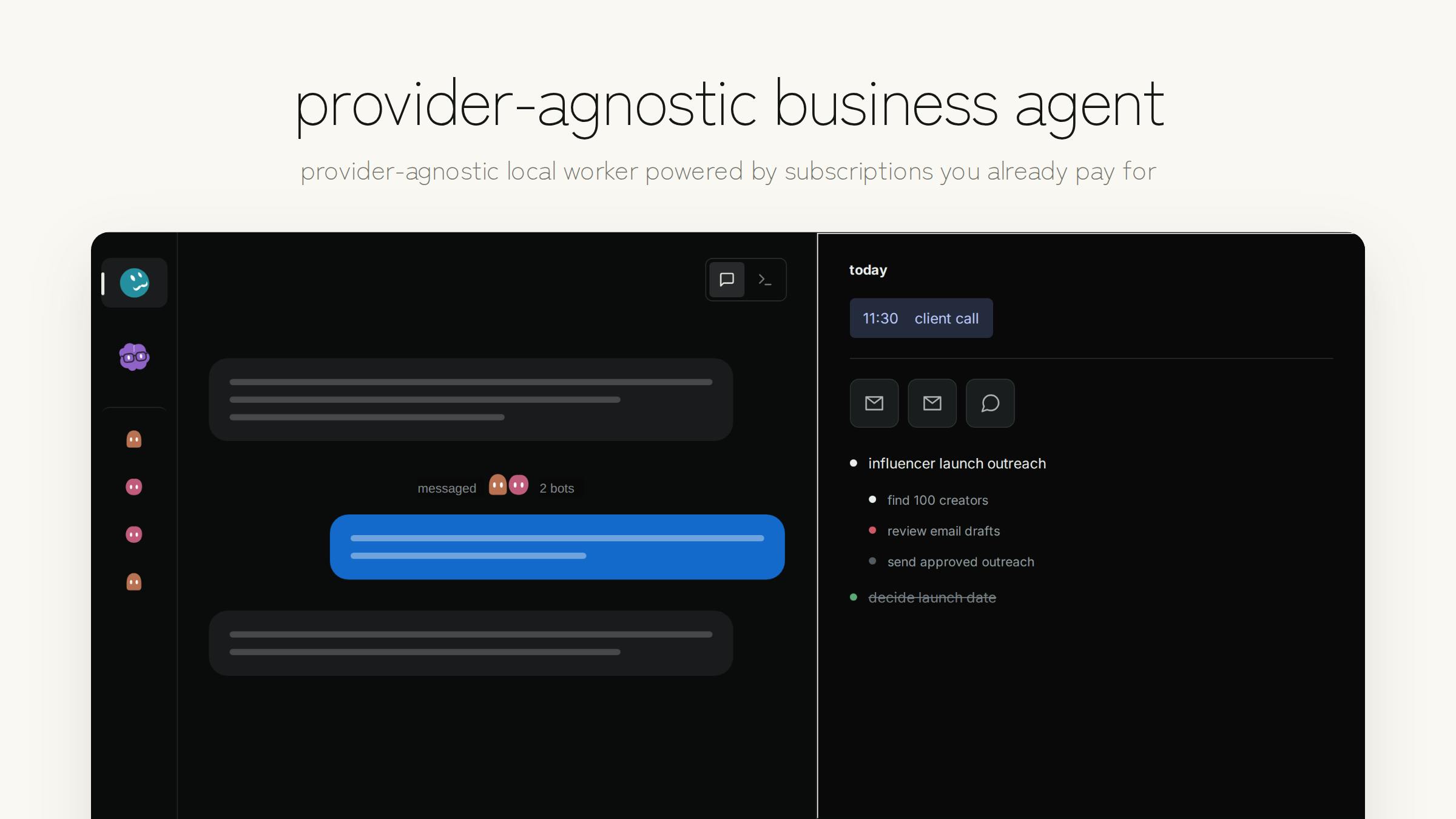
qorqbot doesn't build a harness—it adds a proactive business agent layer around your existing subscriptions and frameworks.
qorqbot is a proactive business agent ranked 8th on Product Hunt with 83 votes. Its core positioning is "not a harness, but something that exists around your harness," adding operations, context, UX, and self-adjustment layers around existing runtime frameworks like Claude and Codex, giving teams already invested in existing workflows near-zero migration cost. It runs on subscriptions users already pay for and is provider-agnostic, lowering marginal costs and model lock-in risk. It emphasizes proactive background execution and attention management for complex, long-running business tasks, and learns user preferences without active teaching. The article notes that preference transparency, correctability, and quota handling remain undisclosed; it suits teams with mature AI workflows and offers limited value for short single-turn scenarios.
Ranking 8th on Product Hunt with 83 votes, qorqbot positions itself as a "Proactive Agent" built specifically for business work. What stands out most isn't the length of its feature list, but a rather restrained product philosophy: it is not a harness—it exists around your harness. Behind that statement lies a response to a real pain point in today's AI agent tooling ecosystem.
A Counterintuitive Positioning: Don't Build a Harness, Build the Shell Around It
To understand qorqbot's positioning, you first need to grasp what "harness" means in the AI agent context. Models or coding agents like Claude and Codex provide execution capability, while the harness typically refers to the runtime framework that wraps the model—handling tool invocation, state management, and task orchestration. Many agent products on the market choose to rebuild a harness, pulling users into their own ecosystem.
qorqbot takes the opposite path. According to its official website, it "sits around your harness," providing an operations layer, context layer, UX layer, and self-adjustment layer on the periphery of your harness. This layered approach means it doesn't try to replace the tools you already use, but rather coordinates at the layer above. For teams already deeply invested in Claude or Codex workflows, migration cost is essentially zero—this is its core selling point that distinguishes it from most "all-in-one" agents.
Further Notes on Harness
The term harness is borrowed in the AI agent context from software testing, where it originally referred to the "test fixture" that wraps the code under test and provides the runtime environment and driver logic. In agent scenarios, it refers to the runtime infrastructure outside the model: including tool invocation protocols (such as parsing and routing of function calling), persistence of session state and memory, orchestration and scheduling of multi-step tasks, error retry and timeout control, and permission and sandbox boundaries. A mature harness often determines whether an agent can reliably complete long tasks, not just the quality of a single-turn conversation.
Because the harness carries a great deal of engineering complexity, many teams choose to adopt existing frameworks (such as various agent SDKs or open-source orchestration frameworks) rather than building their own. This also explains why "not building a harness" is a meaningful trade-off: it means qorqbot acknowledges the existing value of the underlying framework and shifts the point of competition to the coordination and operations layer above the framework, thereby avoiding direct conflict with users' existing tech stacks.
Runs Directly on Subscriptions You Already Pay For
qorqbot explicitly claims to run on subscriptions users "already pay for," naming Claude and Codex among others, and emphasizes that it is provider-agnostic.
This choice has two implications in real business contexts. The first is cost structure: users don't need to buy another set of model invocation credits for agent capability—their existing subscriptions are the source of compute, keeping marginal costs very low. The second is lock-in risk: provider-agnostic means that switching on the model side won't cause the agent layer to fail, and teams can change underlying providers based on task type or price changes. At a stage when model capabilities iterate rapidly and vendors adjust prices frequently, this decoupled design is more attractive to business teams that use it long-term.
Interestingly, "running on subscriptions" also implies a constraint—it depends on the availability and quotas of the underlying subscriptions themselves. qorqbot does not elaborate in its public description on how it handles scenarios such as quota exhaustion or subscription policy changes, which may be details that need additional confirmation during actual deployment.
What Provider-Agnostic Means in Practice
Provider-agnostic in engineering usually means the agent layer communicates with models through an abstraction interface, encapsulating specific model calls, authentication methods, context window limits, and differences in tool-calling formats behind adapters. This way, upper-layer business logic doesn't directly depend on any vendor's SDK or API shape, and switching providers only requires replacing the adapter.
But this design also has costs: different models differ in tool-calling formats, adherence to system prompts, and context length, and the abstraction layer can hardly smooth all of this out—actual results may vary by underlying model. In addition, when provider-agnostic is combined with "running on user subscriptions," it also involves how subscription credentials are securely reused by the agent layer, which is an area that requires focused evaluation for compliance and permission management in enterprise environments.
Proactivity and Background Execution: Freeing Up Your Attention from Tasks
qorqbot repeatedly emphasizes two words: proactive and background. It claims to "manage your attention," getting the work done in the background.
This points to a common shortcoming of today's AI agent products: most tools remain passively responsive—the user makes a request, it executes, and the user checks again. True "proactivity" means the agent can perceive task status, advance work at the appropriate time, and filter out the points that require human decisions. qorqbot describes itself as a role that manages attention, rather than yet another dialog box you need to watch.
Combined with its positioning around "complex, long-running tasks," it's clear that it targets not one-off Q&A, but business processes that span multiple steps and continue for hours or longer. Such scenarios place far higher demands on state retention and context coherence than single-turn tasks, and are also key scenarios for testing the quality of agent products.
The Difference Between Proactive and Passively Responsive Agents
Passively responsive agents follow a synchronous "request—execute—return" pattern, where every interaction is explicitly triggered by the user and the agent itself holds no sense of goals across sessions. Proactive agents, by contrast, introduce persistent goal states: they maintain a model of to-dos and progress, can determine what to do next without new instructions, and proactively ask humans for help or push results to them at key decision points.
Such capabilities depend on several prerequisites: reliable state persistence (tasks can be recovered after interruption), event triggering mechanisms (such as timers, external signals, or dependency completion), and management of the human attention budget (avoiding excessive interruptions). Long-cycle tasks especially test these mechanisms, because the more steps there are, the higher the risk of accumulated errors and context drift. This is also the underlying capability that deserves more attention than feature lists when evaluating proactive agent products.
Preference Learning Without Active Teaching
On personalization, qorqbot's claim is that it "learns from you, without you actively teaching it"—it learns from your usage without requiring you to specifically teach it. Furthermore, it naturally synthesizes your preferences, workflows, and context.
This contrasts with the current practice of many products that require users to manually configure memory, write prompt templates, and maintain knowledge bases. Passive learning lowers the barrier to entry, but it also raises a question that needs observation: whether the learned preferences are transparent and correctable. qorqbot's public information does not explain how users can view or modify the preference model it accumulates, and this is precisely the key to building trust in business scenarios—when an agent makes decisions based on implicit preferences, users need the ability to audit and intervene.
Who It's For, and Who It's Not For
Judging from its positioning, qorqbot's target users are teams that already have a mature AI workflow, subscribe to multiple model services, and have a large number of long-cycle tasks in their business. It provides incremental value at the orchestration and operations layer, rather than building agent capability from scratch.
Conversely, if you need a standalone agent product that works out of the box with its own model credits, or if most of your tasks are short, quick single-turn interactions, qorqbot's layered architecture may instead introduce extra comprehension overhead. It is essentially an "enhancement layer," whose value is built on the premise that there is already something at the bottom to enhance.
As a new product ranked 8th on Product Hunt with 83 votes, qorqbot's currently public information remains fairly conceptual. Its product thinking—provider-agnostic, built around existing harnesses, proactive background execution, and frictionless learning—hits several real pain points in current agent tooling, but its actual implementation, especially the transparency of preference learning and the reliability of long tasks, still needs more real-world usage feedback to verify.
One-line Summary
qorqbot doesn't build a harness—it provides a proactive business agent layer around users' existing subscriptions and frameworks.
Paragraph Summary
qorqbot is a proactive business agent product ranked 8th on Product Hunt with 83 votes. Its core positioning is "not a harness, but something that exists around your harness," providing an operations layer, context layer, UX layer, and self-adjustment layer around existing runtime frameworks like Claude and Codex, giving teams already deeply invested in existing workflows near-zero migration cost. It runs on subscriptions users already pay for and is provider-agnostic, both lowering marginal costs and reducing model lock-in risk. The product emphasizes proactive background execution and attention management, targets complex, long-running business tasks, and can learn user preferences without active teaching. The article also notes that details such as preference transparency, correctability, and quota handling have not yet been disclosed; it suits teams with mature AI workflows, while offering limited value for short, quick single-turn scenarios.
Related articles

Anthropic Goes Public: AI Bubble or Buying Opportunity?
Anthropic lists on Nasdaq, opening about a third above its IPO price. We break down the $81.3B raise, $1.5T offering valuation, and $2T market valuation, plus Claude's growth and $567M quarterly operating loss.
Why the FBI's AI Hacker Warning Hinges on a Single Word from Microsoft
FBI says AI tool Artex attacked 2,250+ organizations, but the citation trail leads to Microsoft's wording of "attempted sign-ins." The gap between attempts and breaches reveals the attack's true scale.
Fable 5.2 Powers the Creation of Getsumen Express: A Browser-Based Lunar and Martian Exploration Game
A developer used Fable 5.2 to build Getsumen Express, a browser game where players explore the Moon and Mars, scan real landmarks, shoot aliens, and ride an interstellar train. Built on Three.js and WebGPU for about $730, it showcases AI-assisted development.