Quad9 Exits France: A Wake-Up Call for DNS Privacy
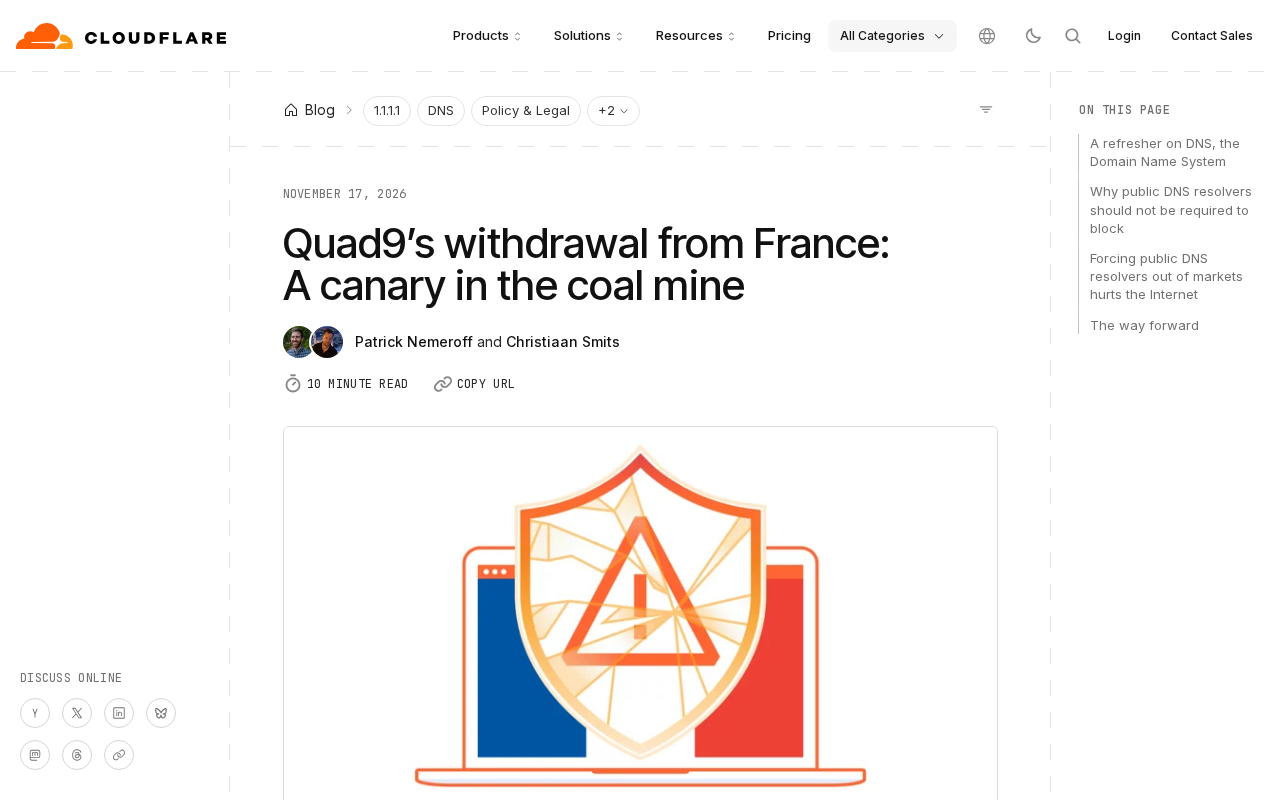
Cloudflare uses Quad9's exit from France to warn that privacy DNS infrastructure faces systemic regulatory pressure.
Cloudflare's blog frames Quad9's withdrawal from the French market as a "canary in the coal mine" event for the internet privacy ecosystem. Quad9, a nonprofit privacy-first public DNS resolver, was forced out under regulatory pressure, highlighting the structural contradiction between privacy sensitivity at the DNS chokepoint and law enforcement demands. The article notes that nonprofit providers lack the legal and commercial resources of large tech companies and are most vulnerable as compliance costs rise, and that their exit narrows users' DNS choices in ways users can barely perceive. The tech community's intense interest reflects concerns about the trend of "compliance costs concentrating among a few giants." The article advises developers to upgrade multi-resolver backups and policy risk monitoring from best practices to necessary actions, and to guard against the industry gradually accepting the narrative that "privacy-friendly infrastructure is unsustainable."
Cloudflare recently published a blog post titled "Quad9's withdrawal from France: A canary in the coal mine," framing Quad9's exit from the French market as a wake-up call for the entire internet privacy ecosystem. This is not an ordinary commercial retreat, but a choice forced upon a nonprofit DNS resolver whose very identity is built on privacy protection, under increasingly stringent regulatory pressure. The story earned 306 points on Hacker News with 90 comments in the discussion thread—the tech community's intense interest in this event is itself a sign that it has struck a shared nerve across the industry.
Who Quad9 Is and Why It Matters
To understand the weight of this event, one must first understand Quad9's special place in the DNS ecosystem. It is a nonprofit public DNS resolution service whose core selling point is putting user privacy and data security first—no logging, no tracking, while filtering malicious domains through threat intelligence. For a large number of ordinary users and small-to-medium businesses, it plays the role of "trusted infrastructure by default."
DNS resolution sits at the chokepoint between users and the internet: whoever can see every domain query holds a fairly complete map of user behavior. Precisely for this reason, privacy-friendly DNS providers are inherently sensitive in the eyes of regulators. Quad9's business model is not based on advertising or data monetization—this is both the source of its credibility and the reason it lacks the commercial buffer to engage in prolonged negotiations with regulators.
A public DNS resolution service refers to domain name resolution servers operated by third parties and made freely available to the public. Users simply point their device or router's DNS address to it, replacing the resolution service provided by default by their ISP. Common public DNS services include Google's 8.8.8.8, Cloudflare's 1.1.1.1, and Quad9's 9.9.9.9. Because DNS queries occur before encrypted web traffic, resolution providers can in theory observe every domain a user visits, so their logging policies directly determine how traceable a user's browsing behavior is. Privacy-first public DNS typically promises not to record IP addresses, not to retain long-term logs, and differentiates itself with additional capabilities such as DNSSEC validation and malicious domain filtering—this is also the foundation on which nonprofit services like Quad9 earn trust in the tech community.
The Deeper Signal Behind the France Exit
Cloudflare's "canary in the coal mine" metaphor is apt because Quad9's exit is not an isolated event but an early indicator of declining tolerance for privacy-oriented infrastructure in the policy environment. When a provider that explicitly operates on the principle of not logging user data can no longer sustain itself in a given jurisdiction, other similarly positioned providers will face not the question of "whether" to reassess their compliance strategies, but "when."
For ordinary users, the direct consequence is a narrowing of DNS service choices. Once privacy-protective public DNS becomes unavailable in a given location, users are passively pushed back to more mainstream resolution services with looser data retention policies—and most people have no awareness of this at all. The loss is silent, yet its impact is extremely broad.
"Canary in the coal mine" originates from the early practice of miners using canaries, which are sensitive to toxic gases such as methane, to warn of danger. It later came to describe an early signal of systemic risk. In the context of internet governance, this metaphor is often used to describe the withdrawal of a small participant or the setback of a technical standard, which often foreshadows broader changes in the regulatory or market environment. By invoking this image, Cloudflare emphasizes that Quad9's departure is not an isolated case but a harbinger of systemic pressure on privacy-oriented infrastructure in a particular jurisdiction. Unlike a canary, however, such signals often do not immediately draw public attention, because changes in DNS service availability are nearly invisible to end users—which makes the value of the warning easier to underestimate.
Regulatory Tightening and the Structural Contradiction of Privacy Infrastructure
Behind this lies a clear structural contradiction: regulators in various countries continue to escalate demands around anti-abuse, law enforcement forensics, and content governance, while privacy-first DNS services are designed to minimize data retention—the two sides' requirements are nearly irreconcilable. Nonprofit providers are especially vulnerable in this tension: they lack the legal and lobbying resources of large tech companies, and they are unwilling to compromise on their core principles.
The heated discussion in the comments section confirms this: what the tech community worries about is not only the plight of one provider like Quad9, but the long-term trend of "compliance costs concentrating among a few giants." As small and medium-sized privacy providers are forced out, the fewer players remain, the weaker users' choices and bargaining power become.
Law enforcement demands at the DNS layer are mainly concentrated in the anti-abuse domain—for example, blocking malware command-and-control domains, combating botnets, and cooperating with child protection or copyright enforcement. To achieve these goals, regulators typically require resolution providers to have the ability to quickly take down specific domains and to retain query logs for a certain period for tracing purposes. Privacy-first DNS services, by design, follow the principle of data minimization, striving not to generate or store query records that can identify individuals—which creates a direct conflict with the needs of law enforcement forensics. In addition, regulations such as the EU's Digital Services Act are still evolving in how they define the boundaries of intermediary liability, and small and medium-sized providers often struggle to bear the costs of compliance assessments and legal responses. This asymmetric pressure is the real-world manifestation of the structural contradiction.
What This Means for the Industry
Zooming out, this event serves as a reminder to all users and developers who rely on public privacy infrastructure: privacy at the DNS layer is not a given default but a public good that must be continuously fought for and maintained. For developers and operations engineers, multi-resolver backups and attention to policy trends in one's jurisdiction will shift from "best practices" to "necessary actions."
The real risk is not the departure of any single provider, but the industry gradually accepting the narrative that "privacy-friendly infrastructure is unsustainable." The value of a canary lies precisely in the fact that it falls early enough for people to still have time to react.
Related articles

Daybreak Red Deployment Guide: A Reference Architecture for Supervised Security Investigation
A breakdown of the Daybreak Red reference architecture: security control design, deployment configuration process, and runtime monitoring for supervised security investigation.

Gemini 4 Neon Tops the Models Engineering Index
Gemini 4 Neon tops the Models Engineering Index, sparking Hacker News debate over ranking credibility and evaluation methods. Here's what it means for developers.

Apple's Self-Developed AI Agent: An Agent That Can Operate Your Mac Is Coming
Apple is reportedly developing an AI agent that can operate a Mac, targeting Meta Muse, Claude, OpenAI Dots, and others. This article analyzes Apple's system-level advantages, the competitive landscape, and likely rollout paths in the agent race.