Quantum Generative Models Synthesize Medical Images: Cancer Detection AUC Improves to 80.2%

Quantum generative models synthesize medical images, and classifiers trained on them surpass the real-data baseline in AUC-ROC.
This study addresses the shortage of malignant samples in breast cancer ultrasound datasets by exploring generative quantum machine learning for data augmentation. Using quantum generative models to synthesize images on the BUSI dataset, researchers compared three training schemes: real data only, synthetic data only, and mixed data. A CNN trained entirely on synthetic images achieved an AUC-ROC of 0.802 on the real test set, exceeding the 0.760 baseline trained only on real data. This counterintuitive finding challenges the assumption that real data always outperforms synthetic data. The paper suggests quantum models capture feature correlations through high-dimensional Hilbert space representations and quantum entanglement, offering a new direction for medical image augmentation. The study takes a pragmatic "quantum as a component" approach, but key details such as synthetic image quality assessment and training cost remain undisclosed.
When Cancer Image Data Falls Short, What Can Quantum Generative Models Do?
Medical AI has a long-standing dilemma: high-quality malignant samples are too few. In breast cancer ultrasound image datasets, benign samples often outnumber malignant ones several times over, and this class imbalance directly undermines a classifier's ability to recognize malignant lesions. What makes it even trickier is that annotating medical images requires professional radiologists to interpret them one by one, making dataset expansion extremely costly.
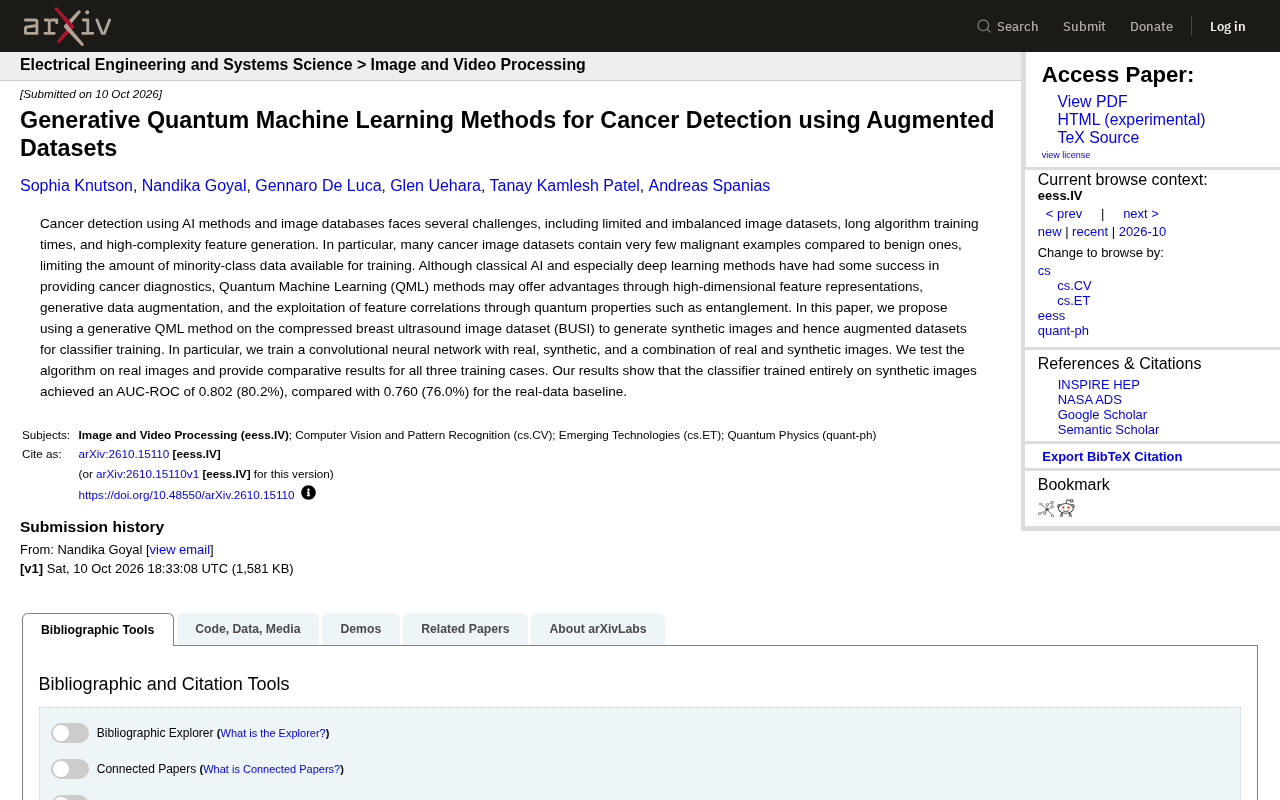
A study on Generative Quantum Machine Learning (Generative QML) applied to cancer detection offers a noteworthy new path. Researchers used quantum generative models to synthesize images from the Breast Ultrasound Image (BUSI) dataset and trained classifiers on this synthetic data, ultimately achieving performance on a real test set that outperformed a pure real-data baseline.
Why Quantum Generative Models?
Bottlenecks of Classical Methods
Deep learning has seen many successes in medical imaging diagnosis, but its appetite for data is equally demanding. Data augmentation (rotation, flipping, cropping) can alleviate sample scarcity, but it cannot create genuinely new feature distributions—a flipped tumor image is still the same tumor image. Traditional generative adversarial networks (GANs) can synthesize images, but issues such as unstable training and mode collapse are especially pronounced in medical imaging scenarios with fine textures.
Potential Advantages of Quantum Properties
The paper points out that QML methods may offer advantages through three mechanisms: high-dimensional feature representation, quantum entanglement's ability to capture feature correlations, and generative data augmentation. Quantum states naturally exist in an exponentially growing Hilbert space, meaning that with the same number of parameters, quantum models can express more complex probability distributions. For medical images where malignant tumor boundaries are blurry and textures are complex, this high-dimensional representational capacity may have practical value.
The essence of this approach is not to replace classical neural networks with quantum computers, but to use quantum generative models as a stronger "data factory" that provides high-quality synthetic training samples for classical classifiers.
Hilbert Space and the High-Dimensional Representation of Quantum States
Hilbert space is the mathematical framework in quantum mechanics for describing quantum states. A system composed of n qubits exists in a 2^n-dimensional complex vector space. This means that each additional qubit doubles the number of representable basis states, growing exponentially. For a classical model to express a probability distribution of equivalent dimensionality, the required number of parameters would grow linearly or even at higher orders with dimension. Leveraging this exponential state space, quantum models can cover a broader range of probability distribution shapes with a similar number of parameters. For medical images where malignant tumor boundaries are blurry and textures are highly complex, this representational redundancy may help the model capture subtle patterns that classical models tend to miss. It should be noted that quantum hardware in the NISQ era has strict limitations on qubit count, coherence time, and gate fidelity, so such advantages currently remain more at the theoretical and small-scale experimental level.
Quantum Entanglement and Feature Correlations
Quantum entanglement refers to the non-classical correlations formed between multiple qubits: measuring one qubit instantaneously affects the state of another, regardless of the distance between them. In the context of generative models, entanglement can be viewed as a built-in mechanism for feature correlation. In medical images, a tumor's boundaries, internal texture, and surrounding tissue often exhibit complex spatial correlations, and classical models must explicitly model these relationships through convolutional kernels or attention layers. Quantum generative models, through entanglement operations, may be able to encode such correlations into quantum states during the state preparation stage, thereby more naturally preserving these structures when generating synthetic samples. However, whether entanglement is truly more efficient than classical correlation modeling remains an open question, depending on the specific task and circuit design.
Experimental Design and Key Results
Training Strategies
The research team designed three training schemes for comparison: training on real images only, training on synthetic images only, and training on a mixture of real and synthetic images. The classifier used a convolutional neural network (CNN), and the test set consisted entirely of real images to ensure that evaluation results reflect the model's performance in real clinical scenarios.
Key Data
The most striking result is that the classifier trained entirely on synthetic images achieved an AUC-ROC of 0.802 on the real test set, while the baseline trained only on real data reached 0.760. The model trained on synthetic data actually performed better than the one trained on real data. This seems counterintuitive, but a possible explanation is that the synthetic samples produced by the quantum generative model alleviated the class imbalance problem to some extent, allowing the classifier to encounter a more representative distribution of malignant samples during training.
AUC-ROC improved from 0.760 to 0.802, an absolute gain of about 4.2 percentage points. In medical imaging diagnosis, an improvement of this magnitude, if reproducible, is practically meaningful—it could mean fewer missed diagnoses.
The Meaning and Clinical Interpretation of the AUC-ROC Metric
AUC-ROC is a commonly used metric for evaluating the overall performance of binary classification models, with values ranging from 0.5 to 1.0. A value of 0.5 represents random guessing, while 1.0 represents perfect discrimination. It measures the probability that the model ranks a randomly chosen positive sample above a randomly chosen negative sample, making it insensitive to class imbalance—which is precisely why it is favored in medical imaging diagnosis. An improvement from 0.760 to 0.802 means that when randomly drawing a pair of malignant and benign samples, the probability that the model ranks them correctly increases from 76% to about 80%. In clinical settings, this improvement could translate into a higher detection rate for malignant lesions or a lower false-negative rate. However, AUC-ROC is a global metric and cannot reflect the trade-off between sensitivity and specificity at a specific threshold. In actual deployment, the operating point still needs to be chosen based on clinical needs.
FID Score and Generated Image Quality Assessment
FID (Fréchet Inception Distance) is a commonly used metric for evaluating the quality of generated images. It measures how realistic synthetic samples are by comparing the distributional distance between real and generated images in the feature space of the Inception network. The lower the FID, the closer the generated distribution is to the real distribution. The paper did not disclose FID scores, meaning readers cannot directly judge how close the synthetic images produced by the quantum generative model are to real ultrasound images at the visual and statistical levels. Without this metric, it is difficult to rule out one possibility for the result that synthetic data outperformed real data: the synthetic samples happened to regularize the classifier in some way rather than genuinely providing high-quality malignant samples. If future research could report metrics such as FID, precision, and recall simultaneously, it would be more helpful for judging the actual value of synthetic data.
What Is Truly Noteworthy About This Research
Synthetic Data Is Not Just a "Substitute"
The most counterintuitive finding of this work is that synthetic data is not merely a fallback when data is insufficient; under certain conditions, it can surpass the training effectiveness of real data. This challenges the default assumption that "real data is always better than synthetic data." Of course, this requires more independent research to verify—the results of a single experiment may be influenced by dataset size, synthetic model quality, or even random seed selection.
A Pragmatic Entry Point for Quantum Machine Learning
Current quantum computing hardware is still in the noisy intermediate-scale quantum (NISQ) stage, and the field of quantum machine learning is not lacking in overpromising. What is valuable about this study is that it chooses a pragmatic problem: not replacing the entire diagnostic pipeline with quantum algorithms, but using a quantum generative model to solve a specific bottleneck—data augmentation. This "quantum as a component" approach is more likely to create value in practice than the narrative of "quantum replacing everything."
Questions Yet to Be Answered
The paper did not disclose specific quality assessment metrics for the synthetic images (such as FID scores), nor did it discuss how the training cost of the quantum generative model compares with that of traditional GANs. In addition, the BUSI dataset is relatively limited in scale, and whether this method can be generalized to larger-scale image datasets covering more cancer types remains unknown.
Implications for the Development of Medical AI
This study sends a signal: in the field of medical AI, data quality issues may be more critical than model architecture choices. While the entire community is chasing larger models and more complex attention mechanisms, approaching from the angle of data generation and using quantum generative models to improve the distribution and quality of training data may be another path worth investing in.
For developers and researchers focused on AI medical applications, the practical takeaway is this: in scenarios with data imbalance, it is worth trying generative methods (whether classical GANs or quantum generative models) as a data preprocessing step, rather than relying solely on loss function weighting or sampling strategies to handle class imbalance. The role of synthetic data in training may be more active than we previously thought.
One-line Summary
Quantum generative models synthesize medical images, and classifiers trained on them surpass the real-data baseline in AUC-ROC.
Paragraph Summary
Aiming at the shortage of malignant samples in breast cancer ultrasound datasets, this study explores the application of generative quantum machine learning to data augmentation. Researchers used quantum generative models to synthesize images on the BUSI dataset and designed three training schemes for comparison: real data only, synthetic data only, and mixed data. Results show that a CNN trained entirely on synthetic images achieved an AUC-ROC of 0.802 on the real test set, exceeding the 0.760 baseline trained only on real data. This counterintuitive finding challenges the default assumption that real data is always better than synthetic data. The paper proposes that quantum models capture feature correlations through high-dimensional Hilbert space representations and quantum entanglement, offering a new idea for medical image augmentation. The study adopts a pragmatic route of quantum as a component, but key information such as synthetic image quality assessment and training cost has not yet been disclosed.
Related articles

5 Practical Ways Real Estate Agents Can Use AI to Boost Efficiency (2026 Edition)
How can real estate agents use AI to boost efficiency? Based on a YouTube walkthrough, this breaks down five methods — ChatGPT for listing descriptions, Canva for marketing materials, forms for open house leads, Zapier for automated follow-up, and seller meeting prep — and flags risk boundaries like fair housing laws, photo authenticity, and price verification.

Grok Bot vs ChatGPT Agent: Which AI Agent Is More Powerful?
How does Grok Bot differ from ChatGPT Agent? This comparison examines how they work: Grok Bot has a cloud computer and runs persistently inside tools to execute multi-step tasks automatically; ChatGPT Agent operates web pages in a browser and is more mature at general tasks. Includes selection advice.

Walmart Agent Gateway: AI Shops for You Automatically—Why Is Amazon Going the Opposite Way?
Walmart's Agent Gateway lets ChatGPT, Gemini and other AI assistants access its product catalog to search, compare and add to cart, with spending limits and per-purchase approval. Amazon blocks external AI agents—two retail giants, opposite paths. Currently US-only, India may follow.