Quantum Support Vector Regression for Imputing Missing Ship Data

A study is the first to apply quantum support vector regression to imputing missing ship performance data, validated on real bulk carrier data.
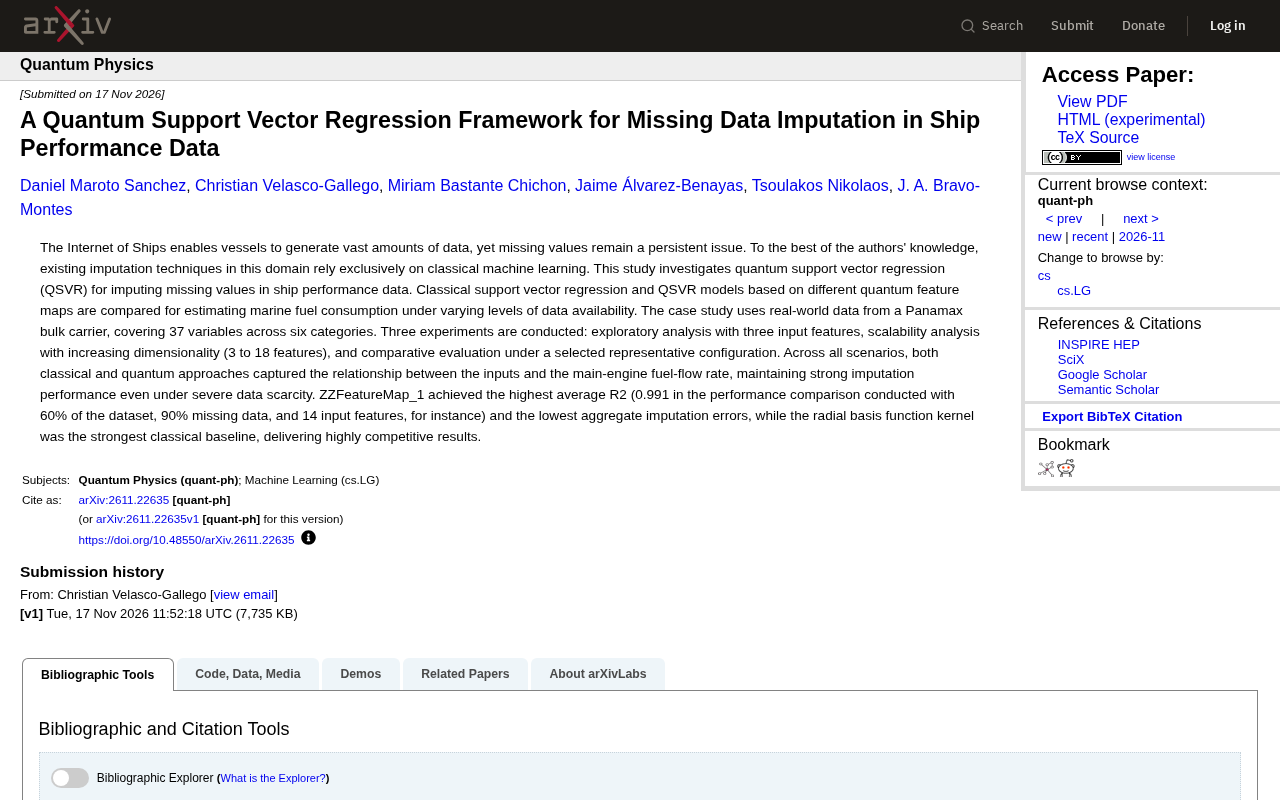
This study addresses missing data in shipboard IoT by being the first to apply quantum support vector regression (QSVR) to imputation. Using real operational data from a Panamax bulk carrier (37 variables), it compares classical SVR with QSVR using different quantum feature maps for estimating main engine fuel consumption. Results show both methods maintain strong imputation performance under severe data scarcity, with ZZFeatureMap_1 achieving the highest average R² (0.991 in a specific configuration) and lowest aggregated error, while the classical RBF kernel was the strongest baseline. The study concludes the quantum method's advantage lies in the accuracy ceiling rather than feasibility; findings are based on a single-vessel case, and universality and deployment still require larger-scale validation.
Shipboard IoT generates massive amounts of operational data from ocean-going vessels every day, but missing values remain a persistent challenge for data analysis. A new study is the first to introduce quantum support vector regression (QSVR) to the task of imputing missing values in ship performance data, validating its feasibility on real bulk carrier data.
Why Ship Data Needs Better Imputation Methods
During voyages, ships collect dozens of variable types—main engine fuel consumption, speed, weather, trim, and more. Sensor failures, communication interruptions, or manual recording omissions all create data gaps. Missing values directly undermine the reliability of fuel consumption modeling, energy efficiency assessment, and emissions accounting.
According to the authors, existing imputation methods in the maritime domain rely almost entirely on classical machine learning. This leaves a gap: can quantum kernel methods provide more robust estimates under data-scarce conditions? The study is built around this question.
Study Design and Data Foundation
The case data comes from real operational records of a Panamax bulk carrier, covering 37 variables across six major categories. The study sets up three progressive experiments:
- Exploratory analysis using only three input features;
- Scalability analysis, gradually increasing input dimensionality from 3 to 18;
- Comparative evaluation under a representative configuration.
The comparison targets include classical support vector regression (SVR) and QSVR models based on different quantum feature maps, with the goal of estimating marine fuel consumption and observing performance under varying degrees of data availability.
QSVR and Quantum Feature Maps
Quantum support vector regression (QSVR) is a quantum extension of classical SVR, whose core idea is to implement feature mapping using quantum circuits. Classical SVR relies on kernel functions (such as RBF) to implicitly map data into a high-dimensional space, whereas QSVR encodes input vectors into quantum states through quantum gate operations, computing inner products in an exponentially larger Hilbert space, potentially expressing more complex nonlinear relationships. The ZZFeatureMap mentioned in the study is a commonly used quantum feature map in Qiskit, which encodes classical features bit by bit through entangling and rotation gates and introduces pairwise interaction terms between features, making it suitable for small-to-medium-scale inputs. Different feature maps (such as PauliFeatureMap, ZFeatureMap) have different expressive power and noise sensitivity for the same data, which explains why merely swapping the feature map leads to accuracy differences.
Performance Comparison of Quantum and Classical Kernels
Across all experimental scenarios, both classical and quantum methods were able to capture the relationship between input variables and main engine fuel flow, maintaining strong imputation performance even under severe data scarcity. This in itself suggests that the signal structure of the task is relatively clear, and that method choice affects the upper bound of accuracy rather than feasibility.
The differences appear in accuracy ranking. ZZFeatureMap_1 achieved the highest average R²—for example, reaching 0.991 in a performance comparison using only 60% of the dataset, 90% missing data, and 14 input features—while also having the lowest aggregated imputation error. Among classical baselines, the radial basis function (RBF) kernel performed strongest, with highly competitive results.
This result warrants a measured interpretation: quantum feature maps did not outperform classical methods across all metrics, but their optimal configuration still held an advantage under extreme missing-data conditions. For scenarios like maritime data, where acquisition costs are high and missing patterns are complex, having an additional high-accuracy alternative has practical value.
R² and Aggregated Imputation Error
R² (coefficient of determination) measures the proportion of variance in the target variable explained by a regression model; values closer to 1 indicate better fit. In this study, the target variable is main engine fuel flow, and R²=0.991 means the model explains 99.1% of the variation in fuel flow with very small residuals. Aggregated imputation error is a metric that summarizes the estimation errors of individual missing values to reflect overall imputation quality. Note that a high R² does not necessarily mean imputed values are physically reasonable, especially under extreme missing-data conditions where the model may over-rely on local patterns in the remaining samples. Therefore, the study reports both R² and error metrics to evaluate imputation performance more comprehensively.
Implications and Limitations for Maritime Digitalization
The study's contribution lies in moving quantum machine learning from theoretical benchmarks to real industrial data, and choosing the link with the least ideal data quality—missing value imputation. If QSVR can reproduce this accuracy across more ship types and routes, shipping companies could maintain reliable fuel consumption and emissions models even when sensor data is incomplete.
One caveat: the study is based on a single-vessel case, the choice of quantum feature map clearly affects results, and practical deployment of quantum computing remains constrained by hardware conditions. Whether ZZFeatureMap_1's advantage is universal still requires validation with larger fleet data. The authors also explicitly state that this is the first attempt in the field to use quantum regression for imputation, and the conclusions should be regarded as directional evidence rather than final verdict.
The Realistic Position of Quantum Machine Learning in Industrial Data
Current quantum machine learning (QML) on noisy intermediate-scale quantum (NISQ) hardware is still limited by qubit count, gate fidelity, and coherence time. Most QML research uses quantum simulators or small-scale real devices, with data dimensionality typically not exceeding a few dozen dimensions. This study's 37 variables and 18 input features are already near the boundary of what current simulators can handle efficiently. Practical deployment of QSVR would need to address quantum circuit compilation, batch inference latency, and compatibility with shipboard edge computing platforms. In the short term, QSVR is more likely to serve as a supplementary tool for shore-side offline analysis rather than a real-time shipboard system.
Frequently Asked Questions
What is the core difference between QSVR and traditional SVR? Both are based on the support vector regression framework, but QSVR maps input data into quantum state space through quantum feature mapping, potentially capturing nonlinear relationships that classical kernels struggle to express.
What does achieving R² of 0.991 with 90% missing data mean? It means that in this ship dataset, the remaining 10% of samples still contain sufficient information and the selected features are closely related to fuel flow. This value comes from a specific configuration and cannot be directly extrapolated to other datasets.
Can this technology be deployed on ships now? It is still at the research stage. Integration of quantum computing hardware with shipboard systems is not yet mature; in the short term, the more realistic approach is offline imputation and model validation in shore-side data centers.
One-line Summary
A study is the first to apply quantum support vector regression to imputing missing values in ship performance data, validating feasibility on real bulk carrier data.
Paragraph Summary
Addressing missing data in shipboard IoT, this study is the first to introduce quantum support vector regression (QSVR) to imputation tasks. Using real operational data from a Panamax bulk carrier (37 variables), it sets up exploratory, scalability, and comparative experiments, comparing classical SVR with QSVR using different quantum feature maps for estimating main engine fuel consumption. Results show that both classical and quantum methods maintain strong imputation performance under severe data scarcity, but ZZFeatureMap_1 achieved the highest average R² (0.991 in a specific configuration) and lowest aggregated error, with the classical RBF kernel as the strongest baseline. The study concludes that the quantum method's advantage lies in the accuracy ceiling rather than feasibility; findings are based on a single-vessel case, and universality and practical deployment still require larger-scale validation.
Related articles

ChatGPT Plus Subscription Pitfall Guide: Go/Plus/Pro Tier Comparison and Quick Activation
A complete ChatGPT Plus subscription guide based on a Bilibili tutorial: from registering an account, comparing Go/Plus/Pro tiers, to the practical steps for quickly completing your subscription.

GPT-6.2 Sol/Astra Released! A Step-by-Step ChatGPT Plus Subscription Guide and Tier Comparison
GPT-6.2 Sol/Astra is out—here's a ChatGPT Plus subscription guide: register an account, compare Go/Plus/Pro tiers, and subscribe in a minute.

Comparing Three Channels for Subscribing to GPT Plus in China: Is Website Top-Up the Easiest?
How to subscribe to GPT Plus in China? This article compares website top-up, credit card, and mobile top-up channels—process, cost, and risk—with steps and tips to help you choose wisely.