Quantum Uncertainty: Without It, Neither Atoms Nor Life Would Exist

Quantum uncertainty is not a flaw but a cornerstone: it stabilizes atoms and enables chemistry, thereby making life possible.
The article clarifies that the Heisenberg uncertainty principle is often misunderstood as "measurement disturbance," and argues that it is actually a built-in property of the mathematical structure of quantum states, rooted in the nature of waves and Fourier analysis: localizing a wave requires superposing multiple wavelengths, which introduces momentum broadening. Through quantum confinement, this principle prevents electrons from falling into protons and gives the hydrogen atom a finite-sized ground state—the root of matter's stable size. The Pauli exclusion principle then prevents electrons from crowding into the same quantum state, forming atomic shells and determining the periodic table and chemical diversity. Without quantum mechanics, there would be no stable atoms or chemistry, and chemistry-based life like ours could not exist; still, other forms of life should not be ruled out.
Quantum Uncertainty: Without It, Neither Atoms Nor Life Would Exist
Imagine if tomorrow morning one of nature's strangest rules suddenly vanished—every electron would simultaneously possess a precise position and a precise momentum, particles could in principle be completely pinned down, and quantum fuzziness would no longer exist. This sounds like a more orderly, more predictable universe, but the truth is: in such a universe, you simply would not exist.
Why would a more intuitive universe be unable to harbor life? The answer lies hidden in the deepest corners of quantum mechanics. This article will walk you through how the Heisenberg uncertainty principle and the Pauli exclusion principle together underpin the stability of atoms, the diversity of chemistry, and even the possibility of life.
Uncertainty Is Not Just "Measurement Disturbance"
The biggest misunderstanding people have about quantum uncertainty is equating it with "uncertainty" in everyday language—for example, you don't know which corner of the room the baseball is in, but the baseball itself has a definite position. Quantum uncertainty is completely different.
In 1927, Heisenberg proposed the uncertainty principle: certain paired physical properties cannot simultaneously have arbitrarily precise values. The most famous example is position and momentum. Mathematically it is written as Δx · Δp ≥ ℏ/2, where Δx is the statistical width of the position distribution, Δp is the statistical width of the momentum distribution, and ℏ is the Planck constant. The narrower one variable is squeezed, the wider the distribution of the other must become.
A common misconception is that the act of measurement disturbs the electron, which is why we cannot measure precisely. Measurement does indeed disturb quantum systems, but even without any measurement, a quantum state itself cannot simultaneously assign precise values to both position and momentum. Uncertainty is not a flaw in measurement technology but a built-in property of the mathematical structure of reality.

The Nature of Waves: Why Position and Momentum Cannot Coexist
To intuitively understand this, first remember that quantum particles have wave properties. A perfectly regular wave has a completely definite wavelength, and according to the de Broglie relation λ = h/p, wavelength corresponds to momentum—so its momentum is extremely precise. But here is the problem: this wave extends across infinite space. Where is it? The answer: everywhere.
If you try to "truncate" this wave into a small segment, confining it to some region, it is no longer a pure wave of a single wavelength. The amplitude must rise from zero, oscillate, and fall back to zero, and this process requires superposing a large number of waves of different wavelengths.

Fourier analysis tells us: the more tightly you want to localize a wave, the broader the range of wavelengths you need to mix; and different wavelengths correspond to different momenta, so the momentum distribution broadens accordingly. This is not a mysterious quantum rule but a fundamental mathematical property of waves. Since electrons and photons are described by quantum wave functions, this trade-off becomes part of the laws of nature.

The de Broglie relation λ = h/p was proposed by Louis de Broglie in 1924 and is the core quantitative expression of wave-particle duality: any particle with momentum p corresponds to a wavelength λ, where h is the Planck constant. This relation directly links the "particle-like" parameter of a particle (momentum) with its "wave-like" parameter (wavelength), and is the foundation for understanding the trade-off between quantum localization and momentum broadening. It was later confirmed by the Davisson–Germer experiment (electron diffraction) and also became the physical basis for technologies such as electron microscopy.
Fourier analysis is a mathematical tool for decomposing waves: any sufficiently regular function can be represented as a superposition of sine waves of different frequencies (i.e., different wavelengths). A wave packet that is highly localized in space necessarily has a broad Fourier spectrum; conversely, a wave with a narrower spectrum extends more widely in space. This property—that conjugate variables cannot both be narrow—is a purely mathematical conclusion unrelated to quantum mechanics, but once combined with the de Broglie relation (wavelength ↔ momentum), it directly yields the position-momentum uncertainty relation.
How Uncertainty Prevents Atoms from Collapsing
Consider the simplest atom—hydrogen: one positively charged proton and one negatively charged electron. Opposite charges attract, so why doesn't the electron simply fall into the proton?
Classical physics once hit a wall here. If you imagine the atom as a miniature solar system, with the electron orbiting the nucleus in a circle, then an accelerating charge would radiate energy, and the electron would spiral into the nucleus. Real atoms are obviously not like this.
Quantum mechanics' solution is: the electron is not a small planet traveling along a definite orbit, but occupies a quantum state, called an "orbital" in chemistry. An orbital is not an orbit line but the spatial distribution corresponding to the electron's quantum state—like a cloud.
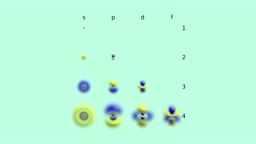
Now try to squeeze the electron into an extremely small region near the proton. Its position becomes increasingly definite, but according to the uncertainty principle, the momentum distribution must become increasingly broad, and a large spread in momentum means enormous kinetic energy. Thus two competing effects emerge: electrical attraction wants to pull the electron closer, but quantum confinement makes compression energetically expensive. The lowest-energy state therefore has a finite size—this is the ground state of hydrogen, where the electron does not land exactly on the proton.
The key conclusion is: the uncertainty principle is not an "annoying fuzziness" superimposed on atoms; it is itself one of the reasons matter has a stable size. Even in the lowest energy state, a quantum system cannot simultaneously have a precise position and zero momentum; this irreducible motion is related to "zero-point energy."
Zero-point energy is the lowest energy a quantum system still possesses at absolute zero. It is not zero, and the root cause is precisely the Heisenberg uncertainty principle: if a particle were completely at rest (zero momentum) and had a precise position, it would violate Δx·Δp ≥ ℏ/2. For a simple harmonic oscillator, the zero-point energy is ½ℏω; for the hydrogen atom, the ground-state energy is -13.6 eV, corresponding to an electron cloud with a finite spatial scale rather than collapsing onto the proton with infinite negative energy. Zero-point energy is not a theoretical fiction; phenomena such as the Casimir effect and the fact that liquid helium does not solidify at normal pressure are related to it.
The term "orbital" is easily confused with classical planetary orbits. It actually refers to the wave function of the electron's quantum state in an atom, whose squared modulus gives the probability density of finding the electron at each point in space. s orbitals are spherically symmetric, p orbitals are dumbbell-shaped, and d orbitals have more complex shapes. It is precisely the shapes and energies of these orbitals that determine the directionality of chemical bonds and the geometry of molecules.
The Pauli Exclusion Principle: Why Matter Occupies Space
Uncertainty explains the stability of hydrogen, but it is not enough to explain all matter. Here another quantum rule enters: electrons are fermions and obey the Pauli exclusion principle—identical electrons cannot all occupy the same quantum state.
In large atoms, electrons cannot all crowd into the lowest energy state; they must occupy different allowed states, thereby forming the shell structure of atoms. The outermost electrons determine the chemical properties of an element, which is why carbon, oxygen, and sodium behave so differently. The periodic table is to a large extent a product of quantum mechanics.
A clarification is needed: the periodic table cannot simply be attributed to the Heisenberg uncertainty principle. The Pauli principle and the uncertainty principle are two different quantum rules, both crucial, but with different roles.
Fermions are particles with half-integer spin (such as electrons, protons, and neutrons). They obey Fermi–Dirac statistics, and their many-particle wave function changes sign when two particles are exchanged. This antisymmetry directly leads to the Pauli exclusion principle. In contrast, bosons (such as photons and the Higgs boson) have integer spin, their wave functions are symmetric under exchange, and any number of them can occupy the same quantum state—this is the basis of lasers and Bose–Einstein condensates.
The specific filling rules for shell structure are given by the Aufbau principle: electrons fill 1s, 2s, 2p, 3s... in order of increasing energy, with each orbital holding at most two electrons of opposite spin. The arrangement of the outermost electrons determines an element's ionization energy, electronegativity, and bonding tendencies, so the rows and columns of the periodic table are essentially a tabular presentation of the electron shell filling order.
Without Quantum Mechanics, There Would Be No Chemistry and No You
Without quantum mechanics, there would be no chemistry as we know it. Everything in your body is chemistry: DNA is chemistry, proteins are chemistry, cells are chemistry, and the signals transmitted in your brain rely on chemistry and electromagnetic interactions. Your ability to read and think at this moment depends on physical interactions among atoms, electrons, and molecules.
In a completely classical universe, particles have precise positions and precise momenta, with no quantum wave functions, no uncertainty principle, and no atomic orbitals. Building atoms from electrons and nuclei using classical electromagnetism would encounter fundamental failure: stable atoms could not form, the periodic table would not exist, chemistry would not exist, and life like ours would have no way to arise.
However, there is an important qualification: saying "matter like ours could not exist" does not logically prove that all conceivable life is impossible. Some completely different form of life, one we cannot even imagine, might still be possible. We should not arrogantly assume that all life must depend on a universe like ours.
So, rather than asking "how can life exist under quantum uncertainty," it is better to ask the reverse: without it, how could life possibly exist?
One-line Summary
Quantum uncertainty is not a flaw but a cornerstone: it stabilizes atoms and enables chemistry, thereby making life possible.
Paragraph Summary
The article clarifies that the Heisenberg uncertainty principle is often misunderstood as "measurement disturbance," and points out that it is actually a built-in property of the mathematical structure of quantum states, arising from the nature of waves and Fourier analysis: a localized wave must superpose multiple wavelengths, thereby introducing momentum broadening. Through quantum confinement, this principle prevents electrons from falling into protons and gives the hydrogen atom a ground state of finite size—the root of matter's stable size. The Pauli exclusion principle, in turn, prevents electrons from crowding into the same quantum state, forming atomic shell structure and determining the periodic table and chemical diversity. The article emphasizes that without quantum mechanics there would be no stable atoms and no chemistry, and life like ours, based on chemistry, could not exist; but other forms of life should not be ruled out.
Related articles
 Tech Frontiers
Google Omni 1.2 Flash: 15-Second AI Video at Just $0.07 per Second
Google DeepMind releases Gemini Omni 1.2 Flash: 15-second video, 720p at $0.07/sec (30% cheaper), multi-turn editing without regeneration, draft upscaling to 4K.
 Tech Frontiers
No AI Ghostwriting: Writer's Quarter Reinvents Novel Writing with a Visual Workbench
The Writer's Quarter is an AI-free novel writing and planning tool that unifies character building, story planning, and manuscript writing in one visual workbench. This article analyzes its positioning, target users, and differentiated value amid the rise of AI writing tools.
 Tech Frontiers
Fleeep: A Unified Inspiration Collection Notes App for Creatives
Fleeep is a notes app for creatives that unifies screenshots, bookmarks, saved posts, and inspiration into one calm, cross-device, offline-capable space. This article analyzes its positioning, differentiation, and target users.