Quello: Unifying All AI Work Context with MCP

Quello builds a work context layer based on MCP, letting multiple AI assistants share your work memory.
Quello is a productivity tool launched on Product Hunt that solves the problem of fragmented context when users switch between AI assistants. Built on Anthropic's MCP protocol, it brings work context scattered across tools, documents, and knowledge bases into mainstream AI assistants like Claude, ChatGPT, Gemini, Grok, and Perplexity, acting as their shared "memory layer." The product emphasizes "understanding work" rather than simple search, builds a coherent work knowledge graph, and ensures all answers come with cited sources. It also offers a voice agent for natural conversational interaction, expanding use in mobile and hands-busy scenarios. Although the MCP ecosystem is still early and cross-platform consistency and data privacy remain challenges, Quello's positioning makes it a promising infrastructure for the AI assistant era.
Introduction: The "Amnesia" of AI Assistants
Every day, we shuttle between different AI assistants like Claude, ChatGPT, and Gemini, only to find that each conversation starts from scratch. They don't know about the document you wrote last week, the meeting you had yesterday, or the project you're currently pushing forward—this "amnesia" greatly diminishes the usefulness of AI. Quello, a new product on Product Hunt, attempts to solve this pain point with MCP (Model Context Protocol): it brings work context scattered across various tools, documents, and knowledge bases uniformly into the AI assistants you commonly use.
Core Features: Not Just Search, But Understanding
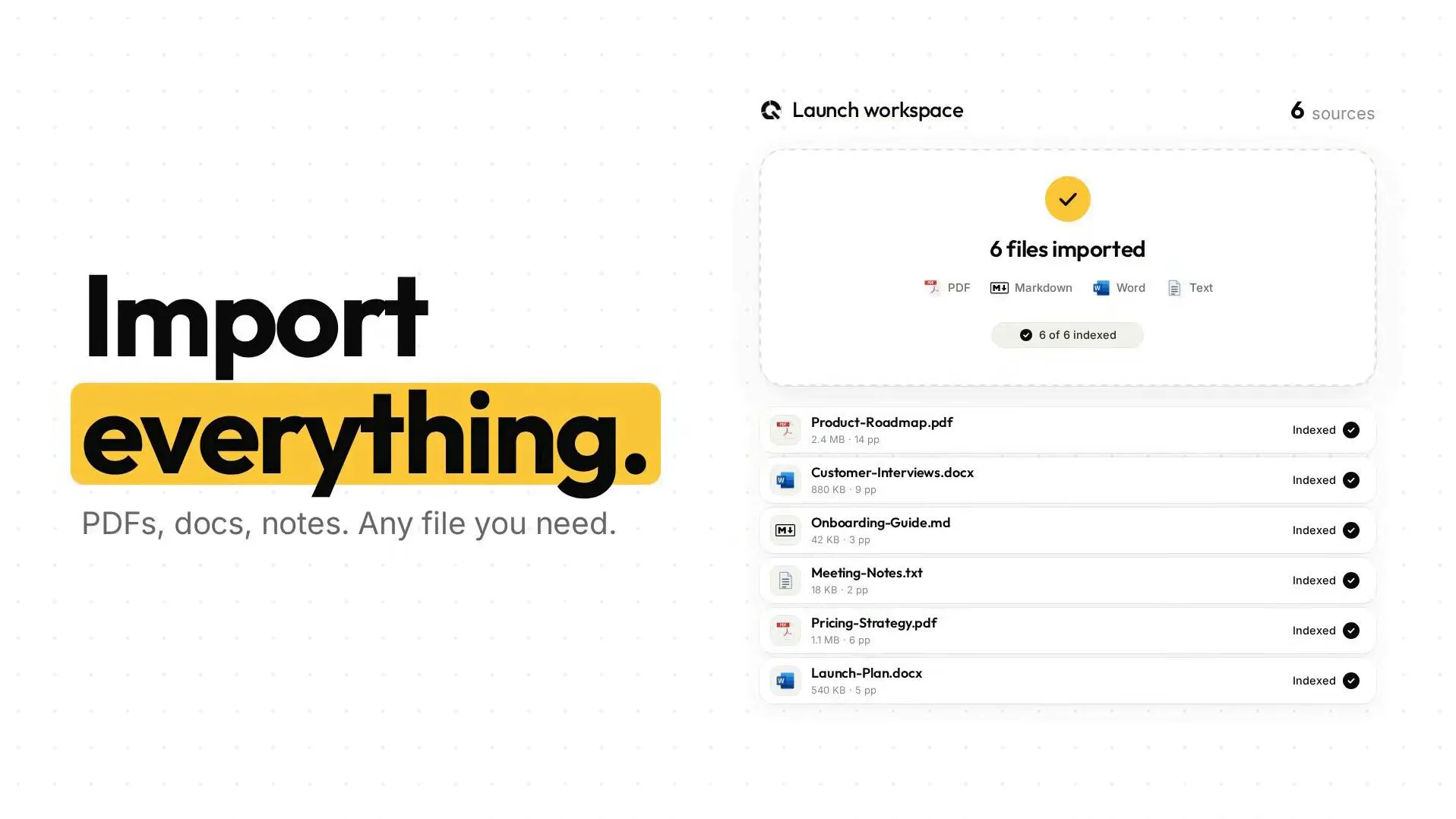
Quello's positioning is clear: Other tools search your files; Quello understands your work. It builds a unified workspace that integrates your tools, documents, and knowledge, and ensures every answer has cited sources. More uniquely, it provides a voice agent that lets you "talk" directly instead of typing.
Unlike traditional enterprise search tools, Quello emphasizes the concept of a "context layer." It doesn't just return document fragments matching keywords; it attempts to build a coherent work knowledge graph. When you ask about project progress in Claude, Quello can automatically provide relevant meeting notes, task lists, and design documents, giving the AI's answers a solid foundation.
"Context layer" is a concept that has emerged in AI engineering in recent years, referring to a service layer between underlying data sources and upper-layer AI applications, responsible for aggregating, cleaning, indexing, and retrieving background information relevant to the current task. Traditional enterprise search only does keyword or semantic matching, returning isolated documents; a context layer emphasizes the relevance and timeliness of information, combining dimensions like projects, people, and time to build a knowledge graph, and injecting information on demand when AI needs it. Its value lies in solving two major pain points of large models: "limited context windows" and "data silos," so that models don't have to rely on users manually pasting background information to give answers that fit actual work. Quello positions itself as this layer, meaning its core asset is a structured context index, not another chat interface.
MCP: The Technical Foundation for Context Flow Across AIs
The core reason Quello can achieve cross-AI platform context sharing is its adoption of the MCP protocol. This open standard proposed by Anthropic allows AI applications to securely connect to external data sources and tools. Built on MCP, Quello means it can bring your complete work context into Claude, ChatGPT, Gemini, Grok, and Perplexity—covering current mainstream large model assistants.
This design approach is worth noting: it doesn't try to replace any AI assistant, but becomes their shared "memory layer." For users who use multiple AI tools simultaneously, this solves the problem of fragmented context. You no longer need to repeatedly paste background information; Quello handles it all automatically.
MCP (Model Context Protocol) is an open protocol proposed by Anthropic in November 2024, aimed at establishing a standardized connection between AI applications and external data sources and tools. It can be understood as the "USB-C interface of the AI world": developers only need to implement a server once according to the MCP specification, and any AI client that supports the protocol (such as Claude Desktop, IDE plugins, etc.) can securely read data or call tools. MCP uses a client-server architecture, communicates via JSON-RPC, and has built-in permission control mechanisms, allowing users to explicitly authorize which resources AI can access. Compared to traditional API integration, MCP reduces the cost of repetitive development, enabling context and tool capabilities to be reused across different AI platforms. This is precisely the technical prerequisite that enables Quello to "connect once, share across multiple endpoints."
Citations and Voice: Product Thinking in the Details
Quello demonstrates product depth in two details. First, all answers come with citations. This is crucial in enterprise scenarios—when AI gives suggestions, you can quickly trace the source of information and verify accuracy. Compared to "black box" AI answers, the citation mechanism enhances credibility.
Second, the addition of a voice agent lowers the barrier to use. In mobile scenarios or when hands are busy, speaking directly is more natural than typing. Although voice interaction is not a new concept, combining it with work context makes it possible to "ask about project progress while walking," expanding the use cases of AI assistants.
In AI products, the "citation" mechanism refers to annotating information sources when generating answers, usually presented as footnotes, links, or highlighted fragments. It is part of "grounded generation": the model first retrieves relevant documents, then answers based on the retrieval results, indicating which material each sentence is based on. The value of the citation mechanism lies in three aspects: first, reducing hallucination risk and allowing users to verify facts; second, meeting enterprise compliance and audit requirements; third, helping users quickly jump to the original document. Compared to simple approaches that only show "reference links," mature citation systems also annotate paragraph positions and confidence levels. For knowledge work scenarios, citation is a key design for building trust and an important selling point that distinguishes Quello from "black box" AI answers.
Market Positioning and Potential Challenges
Quello received 76 votes on Product Hunt, ranking 10th—a good start for a productivity tool. It targets knowledge workers—those who use multiple AI assistants simultaneously and need to frequently switch work scenarios.
However, the challenges are also obvious. The MCP ecosystem is still in its early stages, and user awareness of the "context layer" needs to be cultivated. In addition, how to ensure consistent MCP support across different AI platforms, and how to implement data privacy and permission management, are questions Quello needs to continuously answer. But if it can deliver on its promises, Quello could become the infrastructure of the AI assistant era—just as browsers were to the internet, giving every AI a complete picture of you.
One-line Summary
Quello builds a work context layer based on the MCP protocol, letting multiple AI assistants share your work memory.
Paragraph Summary
Quello is a productivity tool launched on Product Hunt, designed to solve the problem of fragmented context when users switch between different AI assistants. Based on the MCP protocol proposed by Anthropic, it brings work context scattered across various tools, documents, and knowledge bases uniformly into mainstream AI assistants like Claude, ChatGPT, Gemini, Grok, and Perplexity, acting as their shared "memory layer." The product emphasizes "understanding work" rather than simple search, can build a coherent work knowledge graph, and ensures all answers come with cited sources to enhance credibility. Additionally, Quello provides a voice agent to support natural conversational interaction, expanding usage possibilities in mobile and hands-busy scenarios. Although the MCP ecosystem is still early and cross-platform consistency and data privacy remain challenges, Quello's positioning makes it promising as infrastructure for the AI assistant era.
Related articles

Chain of Thought Isn't Just for AI: How Humans Can Use CoT to Improve Thinking Quality
Chain of Thought isn't just a prompt trick for large models. Starting from a Hacker News discussion, this article analyzes why CoT works for human thinking too, breaks down actionable ways to transfer it, and highlights the key differences between human CoT and machine CoT.
Cloudflare Teams Up with OpenAI: Closi…
Cloudflare Teams Up with OpenAI: Closing the Loop from Vulnerability Discovery to Defense with AI
Cloudflare uses OpenAI Daybreak to investigate security vulnerabilities and generate reviewable remediation plans, while developers use Codex to boost coding efficiency and quality.

Orca Multi-Agent Orchestration in Practice: A Guide to Parallel Collaboration with Claude and Codex
Orca is Stable AI's free open-source agent workbench supporting 34 agents like Claude Code and Codex in parallel. Learn its Git worktree isolation, multi-model orchestration, and mobile management.