Querit Search API: Real-Time Search and Scheduled Monitoring for AI Agents
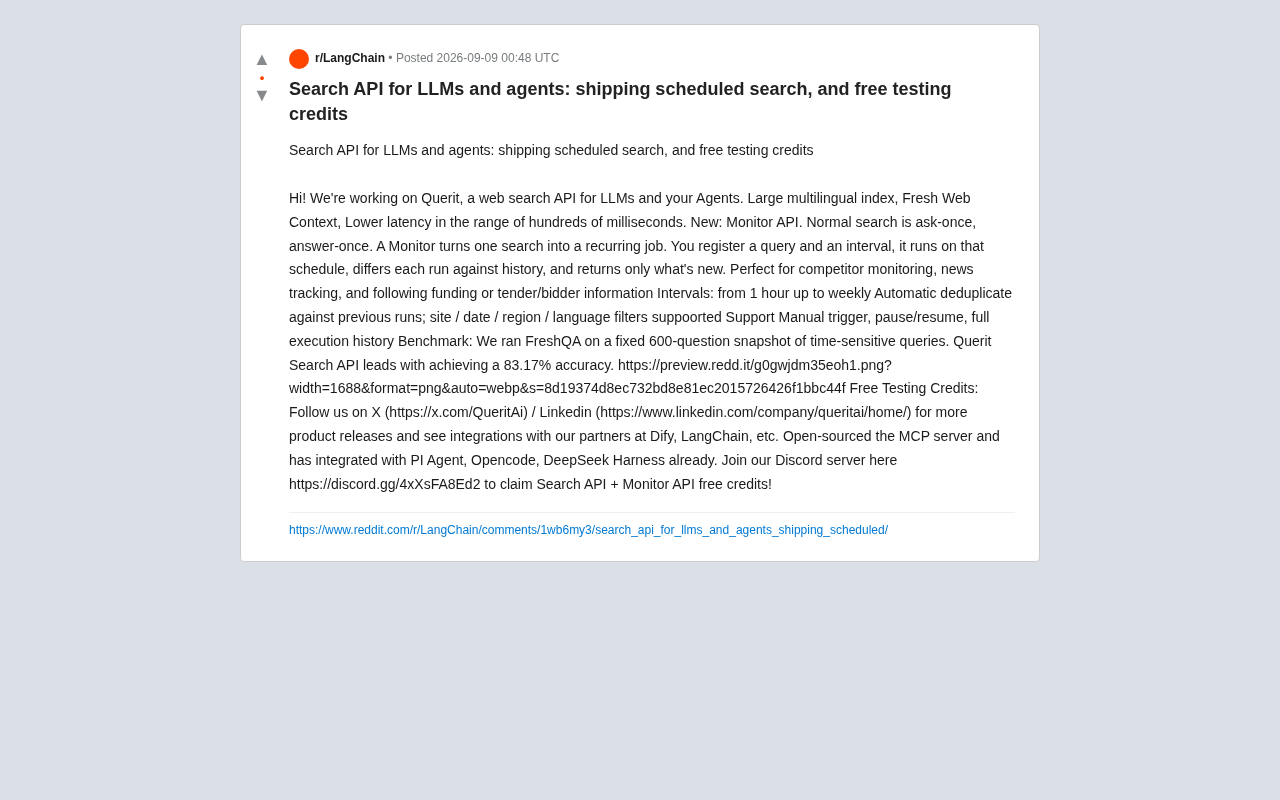
Querit offers a real-time search API and scheduled monitoring service built for AI Agents and LLMs.
Querit is a web search API designed for LLMs and AI Agents, featuring millisecond-level response times and a Monitor API for scheduled, deduplicated information tracking. Achieving 83.17% accuracy on the FreshQA benchmark, it integrates with Dify, LangChain, and the MCP protocol, making it ideal for competitive monitoring, news tracking, and enterprise-grade AI applications.
A Search API Designed Specifically for AI Agents
Querit is a web search API service built for large language models and AI Agents. Through multilingual indexing and real-time web data retrieval capabilities, it provides low-latency search support for AI applications. With response times in the hundreds of milliseconds, it meets the real-time requirements of conversational AI and automated tasks.
AI Agents are AI systems capable of autonomously perceiving their environment, making decisions, and executing tasks. Unlike simple chatbots, Agents typically need to call external tools to complete complex tasks. Web search is one of the most critical tools for Agents, since LLM training data has a knowledge cutoff date and cannot access the latest information. Through search APIs, Agents can retrieve the most up-to-date data from the web in real time, filling knowledge gaps — an approach that can be viewed as an online variant of Retrieval-Augmented Generation (RAG). Querit is designed as the infrastructure service for precisely this use case.
Unlike the traditional "one query, one response" model of search APIs, Querit introduces a Monitor API feature that transforms one-time searches into sustainable scheduled tasks. Users simply set query keywords and execution intervals, and the system automatically runs searches on schedule, comparing results against historical records to return only new or changed content. This mechanism is particularly well-suited for competitive monitoring, news tracking, funding information collection, and bid/tender tracking scenarios.
Core Capabilities of Monitor API: From Passive Search to Active Monitoring
The Monitor API offers flexible execution intervals ranging from 1 hour to weekly. The system automatically handles deduplication to avoid redundant information. Users can set multi-dimensional filtering conditions based on site, date, region, and language to achieve precise information capture.
From a technical architecture perspective, the design pattern employed by the Monitor API is essentially a hybrid of publish-subscribe (Pub/Sub) and polling architectures. In the traditional approach, developers need to build their own scheduled task systems (such as Cron Jobs), write deduplication logic, and maintain result state databases. This workflow involves task scheduling, differential comparison, state persistence, and multiple other engineering components, resulting in high development and operational costs. Monitor API encapsulates all these capabilities into a single API call, essentially shifting infrastructure complexity from the client side to the server side.
The feature also supports manual triggering, pause/resume operations, and maintains complete historical records of each execution. This design allows AI Agents to continuously track changes in specific topics without requiring developers to repeatedly call APIs or maintain complex state management logic. For enterprise applications that need long-term monitoring of market dynamics or industry information, Monitor API significantly reduces development and operational costs.
FreshQA Performance Benchmark: 83.17% Accuracy
The Querit team conducted performance evaluations using the FreshQA dataset, which contains 600 time-sensitive query questions. Test results show that Querit Search API achieved an accuracy rate of 83.17%, leading among comparable products.
FreshQA is an evaluation benchmark released by Google Research in 2023, specifically designed to test the ability of language models and search systems to handle time-sensitive questions. The dataset categorizes questions into four types: facts that never change, slowly changing information, rapidly changing information, and false-premise questions based on outdated information. Traditional search evaluation benchmarks tend to focus on static knowledge coverage, while FreshQA's unique value lies in requiring systems not only to retrieve information but to retrieve the "most current" correct information. An accuracy rate of 83.17% means that out of 600 time-sensitive questions, Querit was able to provide accurate real-time search results for approximately 500 of them.
High accuracy means that when LLMs call the Querit API, they receive more reliable contextual information, enabling them to generate more accurate and timely responses. This is particularly critical for application scenarios with extremely high freshness requirements, such as financial news, journalism, and legal and regulatory updates.
Ecosystem Integration: Support for Dify, LangChain, and MCP Protocol
Querit has established integrations with multiple mainstream AI development frameworks, including Dify and LangChain. Dify is an open-source LLM application development platform that provides a visual workflow orchestration interface, allowing developers to build AI Agents and RAG applications without writing extensive code. LangChain is one of the most popular LLM application development frameworks, simplifying the process of integrating external APIs into LLM workflows through abstractions like chain calls and tool use. These two frameworks represent two mainstream paradigms in current AI application development: low-code visual orchestration and code-first framework-based development. By supporting both platforms, Querit covers developer groups with different technical backgrounds and simplifies the process of embedding search capabilities into AI workflows without writing extensive adapter code.
On the open-source front, Querit has released an open-source implementation of an MCP (Model Context Protocol) server and has completed integrations with projects including PI Agent, Opencode, and DeepSeek Harness. MCP was originally proposed and open-sourced by Anthropic in late 2024, aiming to solve the lack of a unified interface standard between AI models and external tools and data sources. Before MCP, every AI application needed custom adapter layers to connect with different tools, creating a massive "M×N integration problem" — M AI clients and N tools each requiring independent integration. MCP unifies tool capability descriptions, invocation methods, and return formats through a standardized communication protocol, enabling any MCP-compatible AI client to directly call any MCP-compatible tool server. This protocol is rapidly becoming the de facto standard for the AI tool ecosystem. By open-sourcing its MCP server, Querit lowers the barrier to entry for community developers and lays the foundation for broader application of its search API across more scenarios.
Free Testing Credits and Community Resources
Querit is currently offering free testing credits. Developers can follow its official social media accounts (on X and LinkedIn) for product updates and join the Discord community to claim free usage credits for both the Search API and Monitor API.
This strategy helps rapidly accumulate user feedback and validate the product's performance in real-world scenarios. For teams developing AI Agents or looking to enhance search capabilities for LLM applications, this is a low-cost opportunity to try it out. As AI Agent applications become more widespread, API services with real-time search and information monitoring capabilities will become essential infrastructure components. In the current AI toolchain, search APIs are gradually evolving from optional add-ons to standard capabilities for Agent systems — their role is analogous to databases in traditional software architecture: an indispensable foundational layer.
Key Takeaways
Related articles
Deep Dive into vLLM's Scheduling Mechanism: The Complete CPU-to-GPU Mapping Pipeline
An in-depth analysis of how vLLM converts scheduler output to GPU-executable inputs, covering request state management, batch construction, token sequence flattening, and KV Cache physical address mapping.
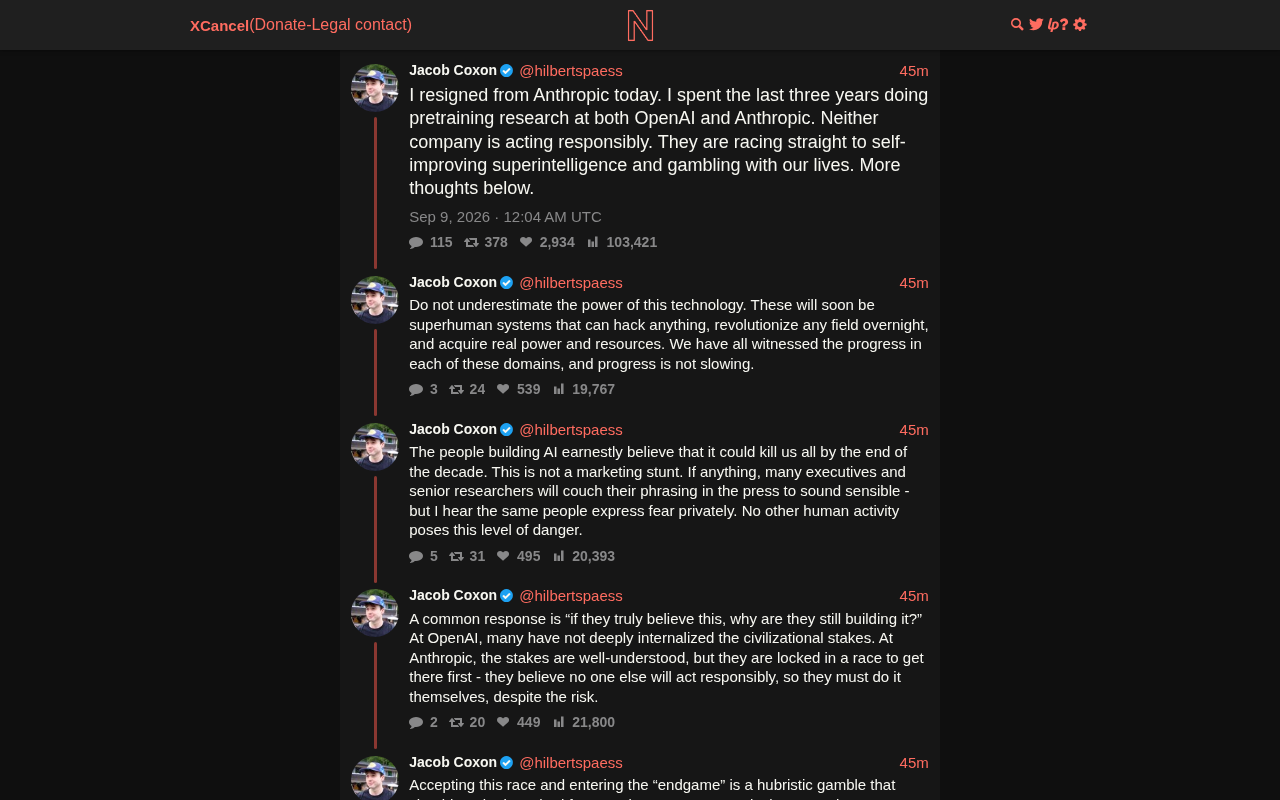
Anthropic Employee Departure: An In-Depth Analysis of Talent Mobility in AI Safety
An Anthropic employee departure sparks industry attention. This article analyzes talent challenges, ideological divides, and knowledge diffusion in AI safety.
The Evolution of AI Workflows: A Three-Stage Leap from Automation to Intelligent Agents
Three real-world examples reveal the core differences between AI workflows and Agents: traditional automation follows rules, AI workflows add intelligent decisions, and Agents achieve autonomous planning.