Qwen 27B Local Deployment Test: Can Open-Source LLMs Replace GPT-4?
Qwen 27B runs locally via Ollama in minutes, beats GPT-4 speed on code audits, and saves ~$1,300 over three years.
This article reviews a video demo of deploying the Qwen 27B open-source LLM locally. Ollama reduces setup to a single command with a 5.6GB download; power users can build from llama.cpp source for full control. Q4 quantization makes 27B models viable on RTX 3090/4090 GPUs. Hybrid attention cuts ~75% of compute overhead, enabling 262K-token context. In one code security audit task, the local model responded in 8.1s vs. GPT-4's 12.3s and produced CVSS/OWASP-mapped analysis. Over three years of heavy use, local deployment saves roughly $1,300 — though it requires ~$1,616 upfront in hardware.
Why Consider Local Deployment of Open-Source LLMs
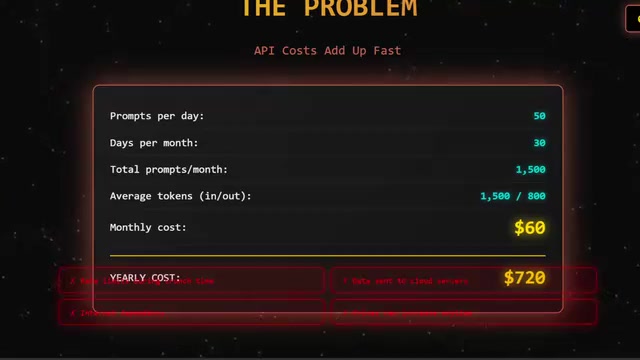
Relying on cloud-based API calls to commercial LLMs adds up to a significant expense over time. Take the use case from the video as an example: 50 prompts per day, 1,500 queries per month, at a subscription cost of roughly $60/month. Over three years, that's nearly $720 in API spend alone (figures are from the video and will vary based on actual usage).
Beyond cost, cloud-based calls introduce a range of hidden pain points: rate limiting, privacy concerns from uploading data to the cloud, dependence on network stability, and the risk of price hikes at any time. For developers making high-frequency API calls, these issues stack up quickly — which is exactly where the appeal of local deployment shines.
This is why a 27-billion-parameter (27B) open-source model released under the Apache 2.0 license has been attracting attention — it lets you run everything entirely on your own hardware, sidestepping most of the problems above.
Note: The repeated references to "Queens / Meet Queens" in the video appear to be a speech or transcription error. Based on the technical details (27B parameters, Apache 2.0 license, hybrid attention, Ollama pull), this almost certainly refers to Alibaba's Qwen series. This article treats it as Qwen.
How Simple Is the Installation?
One of the video's key selling points is how dramatically the barrier to local deployment has dropped. With Ollama, pulling a model is theoretically a single command — the model downloaded in the demo is about 5.6GB and can be up and running locally within minutes.
For power users who want more control, there's another route: building from source. This involves cloning the llama.cpp repository, configuring CUDA support, compiling it yourself, and then downloading the model weights from Hugging Face. It requires more steps, but gives you complete control over the inference engine and model — making it easier to do quantization, fine-tuning, and other customizations down the line.
Hardware Requirements: What GPU Do You Need?
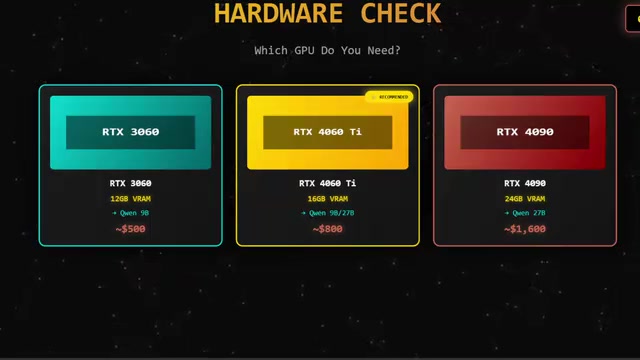
Running a 27B model locally means you can't avoid talking about GPUs. The video offers a few budget tiers as reference:
- Budget-friendly: RTX 3000 series — a good entry point
- Mid-to-high range: RTX 4000 series, 4060 Ti, etc. — a solid balance of performance and price
- Enthusiast level: RTX 4090 and cards with 24GB VRAM — capable of stable, 24/7 inference
VRAM capacity directly determines whether you can load the full model and how large a context window you can support. For a 27B model, quantization (e.g., Q4) can significantly reduce VRAM usage, making consumer-grade GPUs viable. Running at native full precision requires a larger VRAM budget.
Quantization is the key technology that makes large models runnable on consumer GPUs. Model weights are stored by default in FP16 (16-bit floating point) or BF16 format — a 27B parameter model requires roughly 54GB of VRAM, far beyond what a typical GPU can handle. Quantization compresses weight precision to fewer bits: Q4 (4-bit quantization) means each parameter occupies just 4 bits, bringing a 27B model's VRAM footprint down to approximately 14–18GB — well within the 24GB offered by an RTX 3090 or 4090. llama.cpp natively supports multiple quantization levels in GGUF format (Q2 through Q8); lower precision saves more VRAM but may reduce output quality. In practice, Q4_K_M is a common sweet spot, dramatically lowering hardware requirements with acceptable quality trade-offs. When Ollama pulls a model, it defaults to a quantized version — which is why the download is 5.6GB rather than the full-precision weight size.
Head-to-Head: Qwen 27B vs. GPT-4
The video ran a real-world code security audit task as a side-by-side comparison: a flawed JWT validation function with a problematic timestamp comparison.
The results:
- GPT-4: ~12.3 seconds to respond
- Qwen 27B (local): ~8.1 seconds to respond
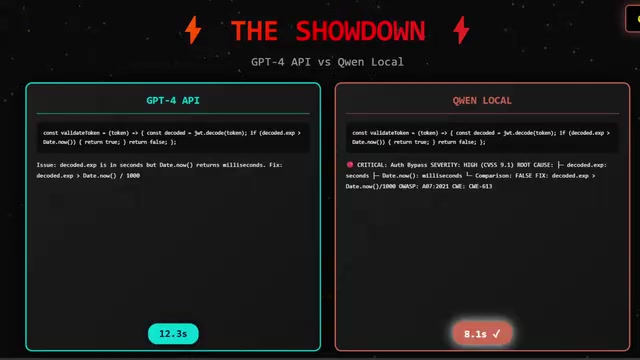
In terms of analysis quality, the local model wasn't just faster — it also delivered a fairly thorough security breakdown, flagging a CVSS score and mapping the issue to OWASP categories. The video's conclusion: the local model was "faster, deeper, and free" on this task.
That said, it's worth being objective: this is a single task, single sample comparison. It doesn't reflect the overall capability gap (or lack thereof) between these two models. Performance on code auditing, reasoning, creative writing, and other tasks can vary dramatically, and a proper evaluation requires systematic benchmarking.
CVSS (Common Vulnerability Scoring System) and OWASP are two standard frameworks in the security industry. CVSS, maintained by FIRST, scores vulnerabilities across dimensions like attack vector, complexity, and impact, producing a severity rating from 0 to 10 — the industry's common language for assessing vulnerability risk. OWASP (Open Web Application Security Project) maintains the "Top 10" list, categorizing common web security issues into classes like A01 Broken Access Control, A02 Cryptographic Failures, and A03 Injection. The fact that the local model could proactively reference both frameworks during a code audit task suggests meaningful training depth in security terminology and classification logic. A JWT timestamp comparison bug is a classic logic flaw, typically mapped to OWASP A07 (Identification and Authentication Failures), with CVSS scores generally ranging from 5 to 8 depending on context. The model's ability to produce this kind of structured output is the concrete basis for the video's claim that its analysis was "deeper."
Technical Highlight: How Hybrid Attention Enables Long Context
The reason a 27B model can support an ultra-long context window on consumer hardware comes down to improvements in the attention mechanism.
Traditional Transformer self-attention has O(N²) complexity — the longer the context, the more VRAM and compute required, growing quadratically. At 262K tokens of context, this cost becomes nearly unbearable.
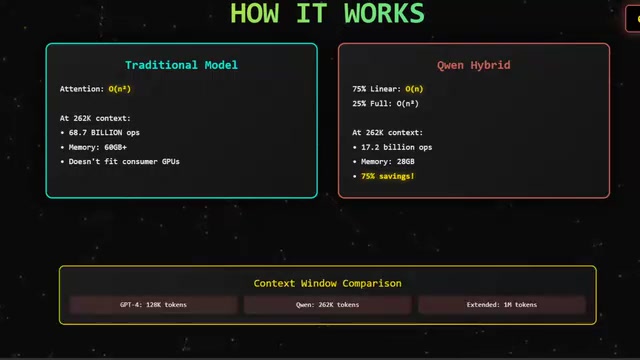
The video notes that this model uses a hybrid attention approach, where roughly 75% of attention layers use linear complexity — dramatically compressing the computational overhead in long-context scenarios (saving approximately 75%). This is the core technical reason it can handle long documents and extended conversations within limited VRAM.
Hybrid Attention typically refers to an architectural design that interleaves standard global self-attention (Softmax Attention) with linear attention or local attention mechanisms. Global self-attention precisely captures dependencies between any two positions, but at O(N²) complexity. Linear attention approximates this with kernel functions, reducing complexity to O(N) — at the cost of some precision. Mixing the two at a defined ratio achieves a balance between accuracy and efficiency: the majority of layers that don't require global awareness use linear attention to save compute, while a few critical layers retain full global attention to preserve expressiveness. The Qwen series applies a similar approach in its long-context variants, combined with memory-saving techniques like GQA (Grouped Query Attention), allowing a single consumer GPU to process hundreds of thousands of tokens with reasonable latency. Understanding this mechanism helps you judge which tasks this model excels at: analyzing large codebases or summarizing long documents plays to its strengths, while tasks that depend heavily on global context for high-precision reasoning may be affected by the approximation error introduced by linear attention layers.
The Three-Year Cost Breakdown: How Much Can You Save?
When you stretch the comparison out to three years, the economics of local deployment become much clearer:
| Approach | Upfront Cost | Annual Cost | 3-Year Total |
|---|---|---|---|
| GPT-4 API | $0 | ~$240 | ~$720 |
| Qwen Local GPU | ~$1,616 | ~$16 (electricity, etc.) | ~$1,648 |
The video's core argument: while local deployment requires a one-time hardware investment upfront, the ongoing running cost is minimal — essentially free over time. By its estimates, you save roughly $1,300 compared to continuously paying for cloud-based access, and the hardware investment pays itself off within about a year.
This math assumes high-frequency, long-term use. If your query volume is low, pay-as-you-go cloud APIs are actually more economical — hardware depreciation, electricity, and maintenance costs all need to be factored into the full picture.
Conclusion and What's Next
The combination of open-source LLMs and local deployment is giving developers a viable path to breaking free from cloud dependency. Qwen 27B stands out as an option worth watching — thanks to its permissive Apache 2.0 license, the long-context capability enabled by hybrid attention, and its ability to run on consumer-grade GPUs.
That said, the performance and cost figures cited in this article come from a single video demo with limited sample size. Please validate against your own use case. For teams with high query volumes, strong data privacy requirements, and the hardware to support it, local deployment is becoming an increasingly realistic choice.
The video creator also previewed upcoming content covering model fine-tuning, benchmark comparisons between the 9B and 27B versions, and building advanced RAG pipelines — all of which are exactly the directions worth exploring as you move toward real-world deployment of local LLMs.
Related articles
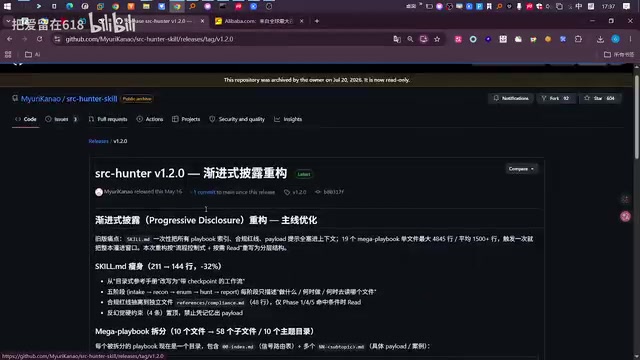
DeepSeek Harness Penetration Testing Mode in Practice: Capabilities and Boundaries of AI-Assisted Vulnerability Hunting
A hands-on look at AI-assisted vulnerability hunting using DeepSeek Harness with a dedicated SKILLS package, covering recon, WebShell backdoors, RCE, and database credential leaks.
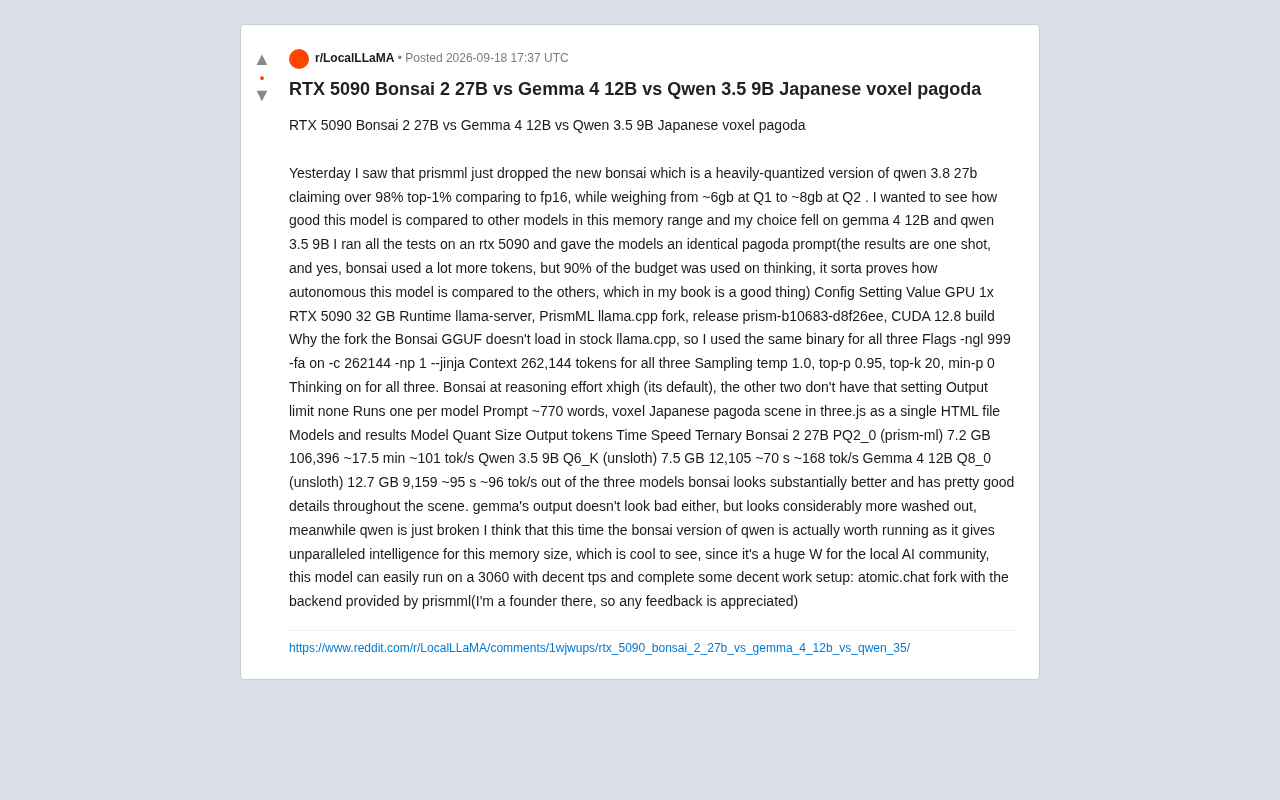
Low-VRAM Local LLM Showdown: Why the Quantized Bonsai 2 Comes Out on Top
RTX 5090 comparison of Bonsai 2 27B, Gemma 4 12B, and Qwen 3.5 9B. Ternary-quantized Bonsai fits 27B params in 7.2GB VRAM and wins on voxel pagoda rendering quality.
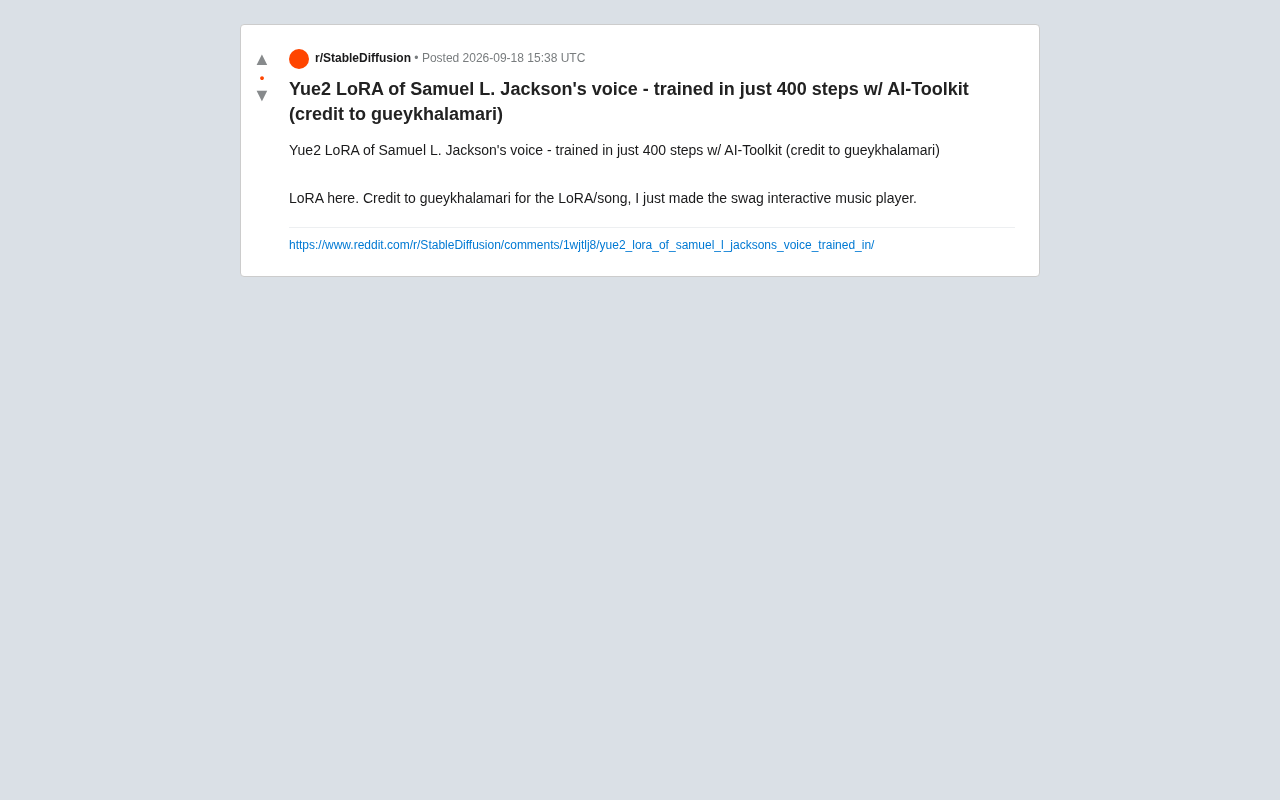
Yue2 Music Model LoRA in Practice: Cloning a Celebrity Voice in 400 Steps
A celebrity voice LoRA built on Yue2 with AI-Toolkit in just 400 steps went viral on Reddit. We break down the tech, its limits, and the voice cloning ethics involved.