Low-VRAM Local LLM Showdown: Why the Quantized Bonsai 2 Comes Out on Top
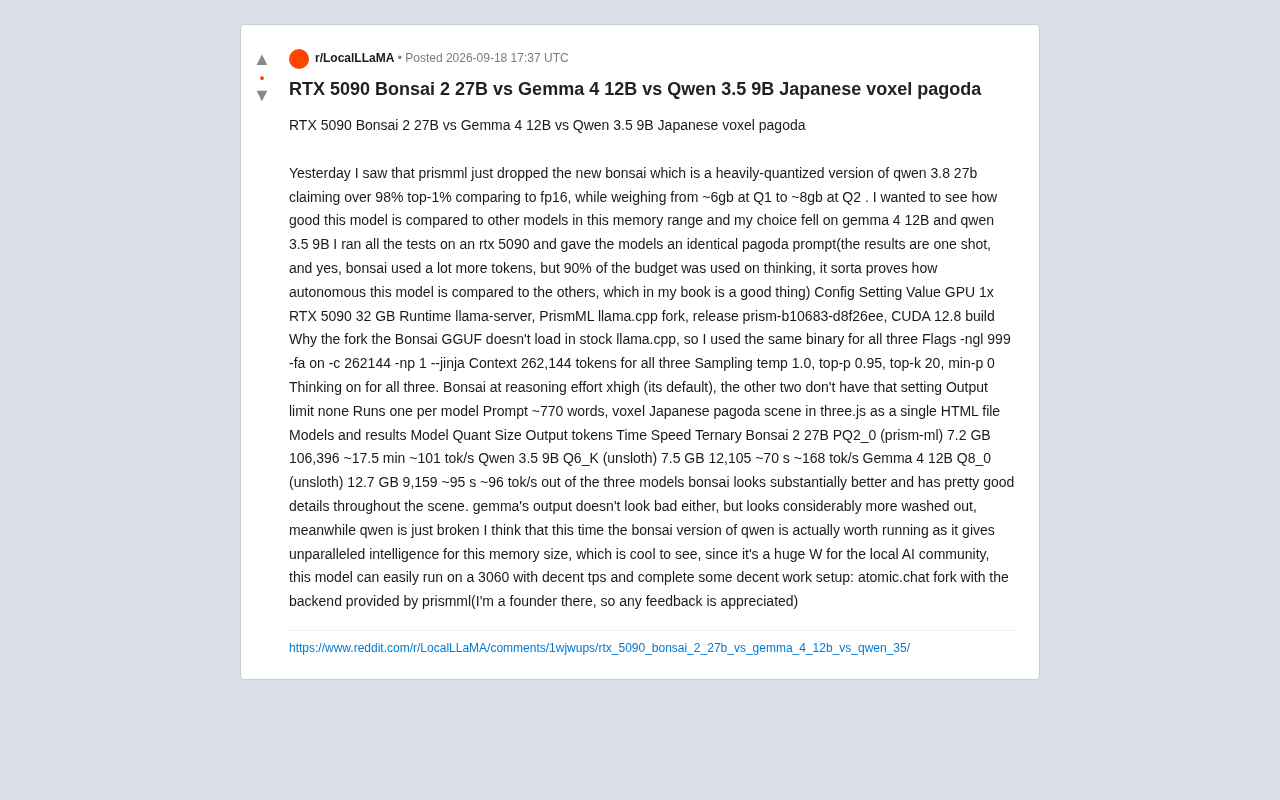
Ternary-quantized Bonsai 2 27B fits in 7.2GB VRAM and beats Gemma 4 and Qwen 3.5 on a one-shot three.js rendering task.
A Reddit user (and PrismML co-founder) compared three similarly-sized local models on an RTX 5090: ternary-quantized Bonsai 2 27B (7.2GB), Qwen 3.5 9B Q6_K (7.5GB), and Gemma 4 12B Q8_0 (12.7GB), tasking them with one-shot generation of a Japanese voxel pagoda HTML scene in three.js. Bonsai led on visual detail, Gemma 4 was passable, and Qwen 3.5 broke entirely. The tradeoff: Bonsai consumed 100K+ tokens and 17.5 minutes, with ~90% in the thinking phase. Its key value proposition is extreme compression — ternary quantization limits weights to three discrete values (~1.58 bits each), enabling 27B-class capability on a 12GB GPU. However, the evaluation has a conflict of interest, a sample size of one, and requires a custom llama.cpp fork.
A Three-Model Comparison for Low-VRAM Scenarios
A Reddit user ran a pretty insightful local model comparison on an RTX 5090. The centerpiece is PrismML's newly released Bonsai 2 — a heavily quantized version of Qwen 3.8 27B that claims to retain over 98% of FP16 performance on Top-1 benchmarks while compressing down to roughly 6GB at Q1 and 8GB at Q2. The author wanted to find out: within the same VRAM budget, can this quantized model outperform native small-to-mid-sized models?
The comparison targets were Gemma 4 12B and Qwen 3.5 9B. All three models were asked to render a Japanese voxel pagoda scene using three.js in a single HTML file — a ~770-word prompt, all one-shot outputs.
Test Environment and Configuration
To keep things fair, the author standardized the runtime environment as much as possible. All three models ran on the same machine with a single RTX 5090 32GB, using PrismML's llama.cpp fork (release prism-b10683-d8f26ee, CUDA 12.8 build). The reason for this specific fork is that Bonsai's GGUF files can't be loaded in the upstream llama.cpp — so the author simply ran all three models with the same binary to eliminate runtime-level differences.
Key parameters: -ngl 999 (all layers on GPU), -fa on (flash attention), -c 262144 (262K token context), -np 1, --jinja. Sampling was set to temp 1.0, top-p 0.95, top-k 20, min-p 0, with thinking mode enabled for all three. Bonsai used its default xhigh inference intensity; the other two had no equivalent setting. Output was uncapped, and each model ran once.
Three Very Different Quantization Approaches
The quantization formats across the three models differ significantly:
- Ternary Bonsai 2 27B: PQ2_0 (prism-ml ternary quantization), 7.2GB
- Qwen 3.5 9B: Q6_K (unsloth), 7.5GB
- Gemma 4 12B: Q8_0 (unsloth), 12.7GB
In other words, Bonsai packs a 27B-parameter model into 7.2GB — that's the core pitch: use extreme quantization to fit a large model into a small VRAM footprint.
Ternary quantization is an extreme form of model compression that constrains neural network weights to just three discrete values (typically -1, 0, and +1), rather than the 65,536 floating-point values of FP16 or the 256 integer values of INT8. In theory, each weight only needs about 1.58 bits of storage — a compression ratio of over 10× compared to FP16. PrismML's PQ2_0 format is built on this principle, ternarizing the parameters of Qwen 3 27B to compress a model that would normally require 14–16GB down to 7.2GB.
By contrast, Q6_K and Q8_0 are conventional linear quantization formats (representing each weight with roughly 6 or 8 bits), with far more moderate compression and relatively manageable precision loss. Ternary quantization is rare precisely because controlling for precision loss is theoretically very difficult — if Bonsai's claimed "98%+ Top-1 retention" holds up, it almost certainly relies on additional training-time compensation techniques like quantization-aware training, rather than simple weight truncation.
Results: The Speed-Quality Tradeoff
The raw numbers show stark differences across the three:
| Model | Quantization | Size | Output Tokens | Time | Speed |
|---|---|---|---|---|---|
| Bonsai 2 27B | PQ2_0 | 7.2GB | 106,396 | ~17.5 min | ~101 tok/s |
| Qwen 3.5 9B | Q6_K | 7.5GB | 12,105 | ~70 sec | ~168 tok/s |
| Gemma 4 12B | Q8_0 | 12.7GB | 9,159 | ~95 sec | ~96 tok/s |
Bonsai consumed far more tokens than the other two (over 100K), taking 17.5 minutes to complete. The author notes that roughly 90% of those tokens were spent in the "thinking" phase. He frames this as evidence of strong model autonomy — the model is willing to reason through things repeatedly rather than rush to an answer. Whether that's a feature or a flaw is debatable; long thinking chains can mean more thorough planning or simply inefficiency, depending on your use case.
Subjective Quality Assessment
In terms of final visual output, the author gave a clear ranking: Bonsai's pagoda scene was noticeably richer in detail and led overall in quality; Gemma 4's output wasn't bad, but looked "washed out" and lacked depth; Qwen 3.5 9B was described as simply "broken."
It's worth noting this is a single-run, single-person subjective evaluation. Different random seeds and sampling variance could easily shift the outcome. This is better treated as directional evidence than a rigorous benchmark.
The speed differences in the table have an underlying explanation worth understanding: inference speed (tokens/s) is dominated by memory bandwidth, not raw compute. The RTX 5090 has extremely high VRAM bandwidth, yet Bonsai runs slower than Qwen 3.5 9B at that same bandwidth (101 vs 168 tok/s). Two main reasons: first, 27B parameters means far more weight data to read per token than a 9B model; second, ternary quantization's decoding path is less mature in terms of GPU optimization compared to traditional GGUF formats, introducing additional compute overhead. Gemma 4 12B's slower speed (96 tok/s) primarily comes from its larger Q8_0 footprint (12.7GB) consuming more memory bandwidth. So the intuition that "smaller size = faster speed" doesn't fully hold here — model architecture and GPU optimization maturity of the quantization format both matter.
What This Means for the Local AI Community
If Bonsai's results prove reproducible, the implications are meaningful. The author's take: this quantized Qwen derivative "is worth a run" because it delivers a level of intelligence that's rare in its VRAM class. More importantly — a 7.2GB footprint means it can run on an RTX 3060 at a respectable tps and complete meaningful tasks.
For users on a budget who can only run local models on consumer-grade GPUs, fitting near-27B-class capability into 12GB or even 8GB of VRAM is a genuine step forward. It also reflects a broader trend in the local LLM space: rather than simply stacking parameters, the push is toward more aggressive quantization techniques that bring large models "down" to more accessible hardware.
Reasons for Caution
One thing that must be disclosed transparently: the poster is themselves a co-founder of PrismML and the associated toolchain (atomic.chat fork). This means the evaluation carries a potential conflict of interest, and official figures like "98% Top-1 retention" require independent third-party verification before being taken at face value. Additionally, Bonsai requires a specialized llama.cpp fork to run, which remains a notable ecosystem compatibility limitation.
Overall, this test demonstrates the potential of ternary quantization for compressing large models — while also reminding us that extreme quantization trades size efficiency for longer inference time. If you're interested in local deployment, it's worth running it yourself on your own hardware with real-world tasks to see if it genuinely delivers value for your use case.
"Top-1 retention rate" is a common benchmark metric for quantized models, referring to the proportion of times the quantized model's highest-probability prediction matches that of the original model on classification tasks. But this metric has real limitations: it's primarily suited for closed-form classification scenarios, and its representativeness for open-ended tasks like code generation or long-form reasoning is questionable. A model can come close to FP16 performance on Top-1 metrics while showing meaningful degradation on tasks requiring precise numerical computation or multi-step logic chains. The "98% Top-1 retention" figure is better understood as an upper-bound reference under favorable conditions, not a universal promise across all task types. Independent benchmark results on code generation, mathematical reasoning, and similar specialized tasks would be far more informative.
Related articles

Cloudflare Quick Tunnels: Expose Your Local Service to the Internet with One Command
Cloudflare Quick Tunnels lets developers expose local services to the internet with one cloudflared command — no account or domain needed, HTTPS included.
SCIM Logs Are Here: Finally Solving the Identity Provisioning Debugging Nightmare
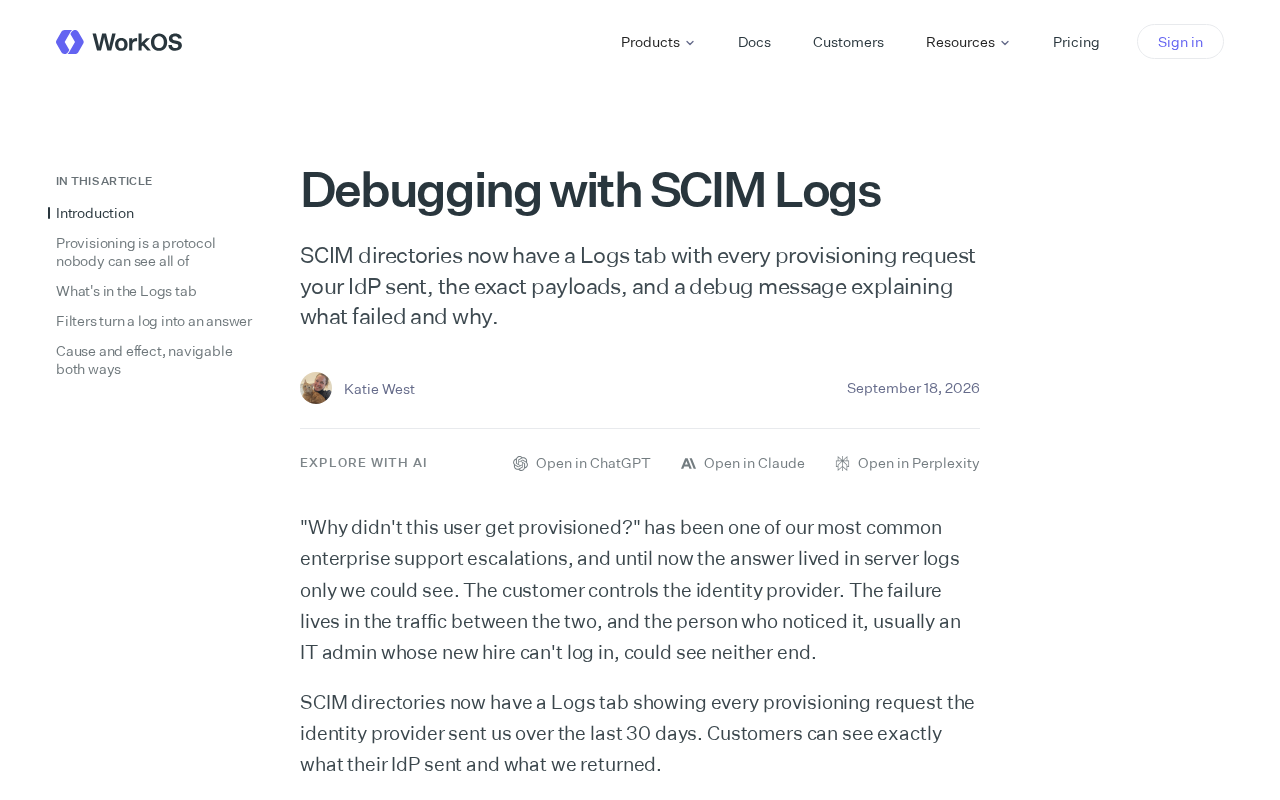
SCIM directories now include a Logs tab showing every provisioning request, full JSON payloads, and human-readable failure explanations — making IdP debugging far easier.

Jev: The New AI Model from a ChatGPT Inventor That's Thrilling Developers
Jev, a new AI model from a core ChatGPT developer, promises cheaper and faster software intelligence. Here's why developers are excited — and what to watch.