Qwen 3.8 27B on a Laptop Can Also Read Model Weights

A 17GB open-source model on a laptop partially replicates the "directly reading neural network weights" experiment, but controversy remains.
The article revolves around the new concept of "weight-space programming": the paper claims GPT-6 Astra can determine a network's training objective purely from raw floating-point weights, and even fix Qwen3.5-0.8B's reasoning loop problem without gradients, raising MATH-500 from 7.9% to 48.1%. But spaCy author Honnibal criticizes the paper for conflating "reading weights without tools" with "modifying weights via code," and Goedecke notes its case steps are no different from a human researcher's. Simon Willison replicated the "guess the game" experiment on a laptop with 17GB Qwen 3.8 27B, correctly identifying three of four games (Freeway failed), with single inference runs taking 46 minutes to over an hour. He believes the path is real and the barrier lower than expected, but it is still orders of magnitude away from "the end of the source code era."
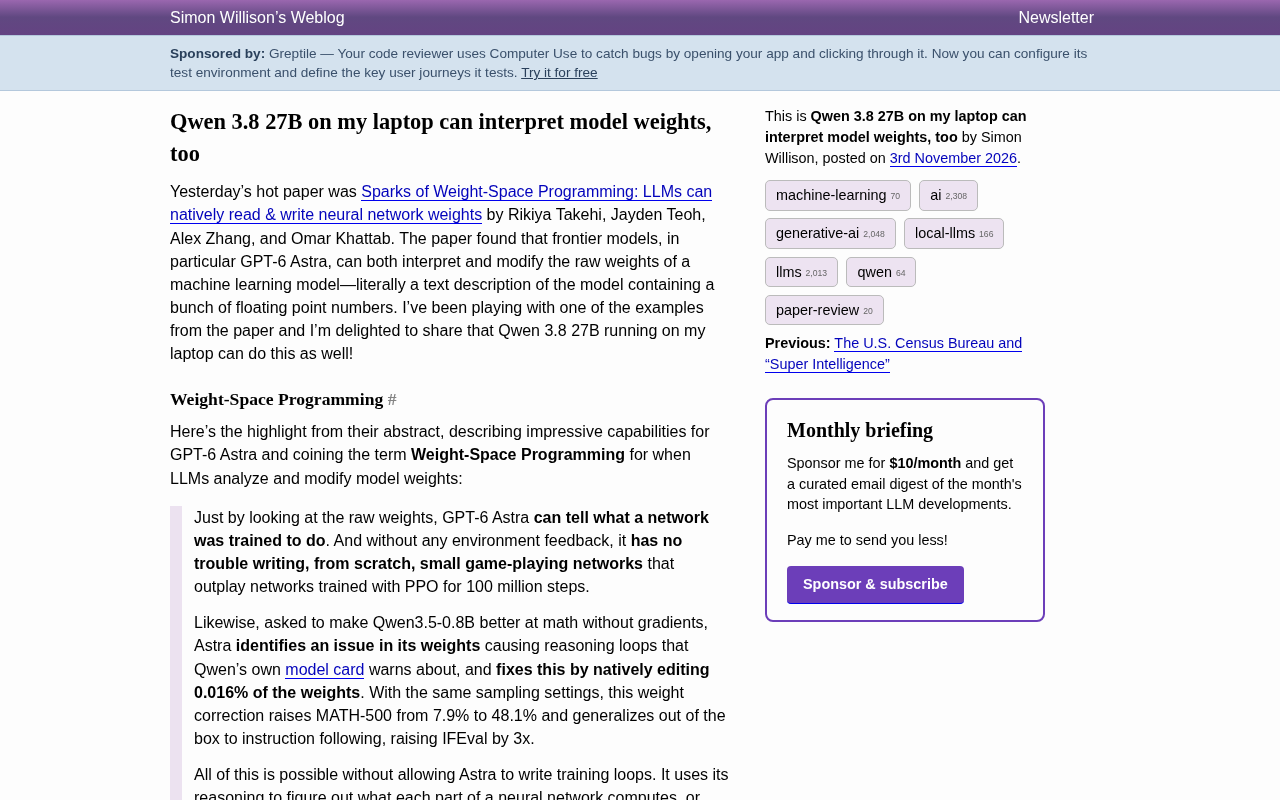
"Weight-Space Programming" is a term that has been spreading rapidly through the AI community lately. Its core claim: large models can directly read the floating-point numbers that make up a neural network's weights, infer what the network was trained to do, and even rewrite those weights without writing code or running any feedback loop. That frontier models can do this at all is surprising enough—but the more interesting question is whether an open-source model small enough to fit in 17GB and run on an ordinary laptop has the same capability.
What the Paper Claims—and the Controversy It Sparked
According to the paper's authors, Rikiya Takehi and colleagues, GPT-6 Astra can determine a network's training objective purely by inspecting its raw weights, and can write small game networks from scratch that outperform networks trained with PPO for 100 million steps. Another example from the paper that drew discussion: Astra was asked to improve Qwen3.5-0.8B's math ability without using gradients. It identified the weights causing reasoning loops—a problem Qwen's own model card had warned about—and fixed it by natively editing 0.016% of the weights. Under identical sampling settings, MATH-500 jumped from 7.9% to 48.1%, and IFEval improved 3x.
Criticism of the paper has been equally direct. spaCy author Matthew Honnibal argues the paper is misleading because it conflates two different things: "directly reading and writing weights without tools" and "using code execution to improve a model." Sean Goedecke broke down the Qwen3.5-0.8B case and pointed out that the steps involved are the same ones a human ML researcher would take. In his replication experiment, Simon Willison explicitly separates the two and focuses only on the more interesting question: what can a model read from weights when no tools are called at all?
PPO (Proximal Policy Optimization) is one of the most widely used policy gradient algorithms in reinforcement learning, proposed by OpenAI in 2017. It balances sample efficiency and training stability by limiting the magnitude of each policy update, and has long been the default choice on benchmark tasks like Atari and MuJoCo. "A network trained with PPO for 100 million steps" in the original text refers to a standard deep reinforcement learning pipeline: an agent repeatedly interacts with the environment, collects trajectories, computes advantage functions, and updates the policy network with a clipped objective. 100 million steps means an enormous amount of environment interaction and gradient computation, typically requiring tens to hundreds of GPU hours. That is precisely why GPT-6 Astra "writing a better-performing game network just by observing raw weights" seems counterintuitive—it skips the entire sampling and gradient descent loop. Understanding the cost of PPO training is the key prerequisite for judging whether this comparison is fair.
Experiment Design: Four Small Games, One Pure-Weight Prompt
The paper's first experiment (exp1_which_game) trained four neural networks to play simplified 10x10 grid versions of Breakout, Pong, Pac-Man, and Freeway. Freeway is a 1981 Atari 2600 game, noticeably less well-known than the other three.
The researchers then dumped all the weights as floating-point numbers into a prompt, along with the same question: the weights below belong to a policy network trained with reinforcement learning to play a grid game; determine which game it was trained on—reason only from the weights, no code execution, no calculator, single response. The prompts for all four games were identical except for the weights themselves, which Simon Willison specifically verified.
Local Replication: Qwen 3.8 27B's Score
Simon Willison used his own LLM command-line tool with LM Studio to run Qwen 3.8 27B (17GB, Q4_K_M quantized version). One operational detail worth noting: LM Studio's default 8192 context window throws an error immediately, so the context had to be manually extended; the timeout also had to be raised to 900 seconds via an environment variable, since a single inference run often took close to an hour.
The result: three out of four games correctly identified. Pac-Man took 46 minutes 12 seconds and 43,506 reasoning tokens, with 72% confidence; Pong took 1 hour 4 minutes 54 seconds with 75% confidence; Breakout was fastest at 52 minutes 25 seconds with 88% confidence. Freeway was wrong—Qwen treated it as a "simplified Pac-Man-style grid game," which is unsurprising given how obscure that game is. As a comparison, Kimi K3.1 Pro running Breakout through OpenRouter answered correctly in 9 minutes 41 seconds using 19,493 reasoning tokens.
The reasoning traces themselves are fascinating. Qwen reads through the floating-point arrays line by line, counting indices while inferring things like "row 436 corresponds to row 8, column 7, channel 0," then uses patterns in activation magnitudes to guess agent positions and reward structure. The text is nearly incomprehensible to read, but it does show the model performing some kind of spatialized weight parsing.
Q4_K_M is one of the GGUF quantization schemes introduced by llama.cpp. In the name, Q4 means weights are compressed to roughly 4 bits, K indicates a k-quant (block-wise) quantization strategy, and M is the medium mixed-precision tier at that bit width—some sensitive layers (such as attention outputs and certain feed-forward layers) retain higher precision while the rest use lower bit widths. Compared with FP16, Q4_K_M typically shrinks model size to about a quarter while keeping perplexity loss small, making it the most common compromise for local deployment. The 27B-parameter model compressed to 17GB in the original text is a direct result of this quantization. Note that quantization alters the distribution of floating-point values in the weights, and weight-space programming depends precisely on the model's ability to interpret raw floating-point patterns—so whether a quantized model can replicate the performance of a full-precision one is itself a variable worth watching.
The context window refers to the maximum number of tokens a model can hold in a single forward pass, including both the input prompt and generated content. Stuffing an entire policy network's weights into a prompt as floating-point text quickly consumes tens of thousands or more tokens; LM Studio's default 8192 window is far from enough, so the n_ctx parameter must be manually increased when loading the model. At the same time, inference time scales roughly superlinearly with context length: attention computation grows with sequence length, and combined with token-by-token autoregressive decoding, a single generation under long context can easily take tens of minutes. The near-hour inference runs consuming tens of thousands of reasoning tokens in the original text are typical of long-context, low-parallelism local inference—a very different experience from cloud-based multi-GPU batch services.
"The End of the Source Code Era" Is Premature
Simon Willison's attitude is notably restrained. He acknowledges it's a cool paper but argues that much of the surrounding commentary has no basis, and he is not prepared to declare that the era of source code is over and that the future will be a swarm of incomprehensible machines editing their own weights in incomprehensible ways.
A more grounded judgment: an experienced human with pen and paper and enough effort could probably also infer the game type from these weights. The real questions worth asking are about the efficiency gap and the capability boundary at scale—not rushing to issue a verdict on programming paradigms. If a local 27B model can already do this partially, the barrier to this technical path is lower than expected—but it is still orders of magnitude away from "replacing source code."
Cross-referencing multiple sources: the paper side provides the capability ceiling of frontier models, Honnibal and Goedecke raise methodological doubts, and Simon Willison provides a reproducible floor validation using a local open-source model. The three sides do not conflict on the point that "weight-space programming does exist"; the disagreement centers on what it actually means.
One-line Summary
A 17GB open-source model on a laptop partially replicates the "directly reading neural network weights" experiment, but controversy remains.
Paragraph Summary
The article revolves around the new concept of "weight-space programming": the paper claims GPT-6 Astra can determine a network's training objective purely from raw floating-point weights, and even fix Qwen3.5-0.8B's reasoning loop problem without gradients, raising MATH-500 from 7.9% to 48.1%. But spaCy author Honnibal criticizes the paper for conflating "reading weights without tools" with "modifying weights via code," and Goedecke notes its case steps are no different from a human researcher's. Simon Willison replicated the "guess the game" experiment on a laptop with 17GB Qwen 3.8 27B, correctly identifying three of four games (Freeway failed), with single inference runs taking 46 minutes to over an hour. He believes the path is real and the barrier lower than expected, but it is still orders of magnitude away from "the end of the source code era."
Related articles

Deleted Reddit Post Sparks Debate Over AI Content Moderation
A Reddit post removed with only a 'Removed by Reddit' notice highlights AI content moderation's transparency gaps, misjudgment risks, and appeal challenges for platforms and creators.

DSH + Ollama Local LLM Deployment in Practice: Free Chat with Da Fei Yu
Bilibili creator tests DSH + Ollama local LLM deployment end to end: Ollama install, Xunlei-accelerated downloads, ModelScope GGUF model import, DSH custom API address setup, and a comparison of Qwen 3.5 4B, 8B, Gemma, and other models on 8GB VRAM, with advice on choosing local deployment vs. API calls.

Tested: A $899 Mac Mini vs. a $200/Month AI Subscription
Real-world test of whether an M4 Mac mini can replace a $200 AI subscription: 16GB can't fit large models, and both speed and quality fall short—but privacy, no caps, and near-zero running costs make it an ideal host for an always-on agent. Includes buying advice per configuration and money-saving strategies.