Qwen 4 First Test Leaks: Performance Rivals Opus 5.5, DeepSeek V4 Series Surfaces

Leaked leads on Qwen 4 and the DeepSeek V4 series show model competition shifting toward series and tiering
The article rounds up several unannounced model leads disclosed by Bilibili creator "AI风向标": early Qwen 4 outputs leaked, with its front-end generation capability evaluated as comparable to the Opus 5.5 and Astra level; the DeepSeek Harness repository code contains the names V4 Mini, V4 Flash, and V4 Pro simultaneously, with context length hard-coded at 1 million; and Ant Group's Ling-3.1-flash appears in the open-source ecosystem at the same time. Combined with OpenAI's 150-millisecond Decisions API, a 164MB local speech model, and the leaderboard landscape, the article concludes that the keywords for the next stage are series and tiering, and that the era of a single flagship model conquering everything is passing.
The pace of the AI model race shows no sign of slowing. Bilibili creator "AI风向标" (AI Compass) rounded up several unannounced model leads in its latest daily briefing: early test outputs from Qwen 4 have leaked, the DeepSeek V4 series has surfaced through a code repository, and Ant Group's Ling-3.1-flash has appeared in the open-source ecosystem at the same time. Pieced together, these fragments sketch the outline of the next round of model iterations.
Qwen 4 First Test Leaks: Front-End Generation Capability in Focus
According to Bilibili creator "AI风向标," Qwen 4 has not yet been officially released, but early testers have already shared their first batch of outputs. Their assessment was remarkably direct — the test version's performance is "nothing short of stunning," its front-end generation capability is "absurdly powerful," and they believe it can already compete at the Opus 5.5 and Astra level.
It should be stressed that these are personal impressions, and final performance is subject to the official release. But the fact that "front-end generation" was singled out as an evaluation dimension is itself noteworthy: it means competition in code generation is shifting from "can it write it correctly" to "can it generate a usable interface in one shot," which could have a direct impact on front-end developers' tool choices.
DeepSeek V4 Series: Mini, Flash, and Pro Names Appear Together
The DeepSeekAd lead comes from test code leaked from the Harness repository. In the code, key information for a smaller model points to "DeepSeek V4 Mini," but the same location also explicitly reads "DeepSeek V4 Flash," with the context length hard-coded at 1 million. The same list also contains "DeepSeek V4 Pro," described as "Preserve Hidden Detail."
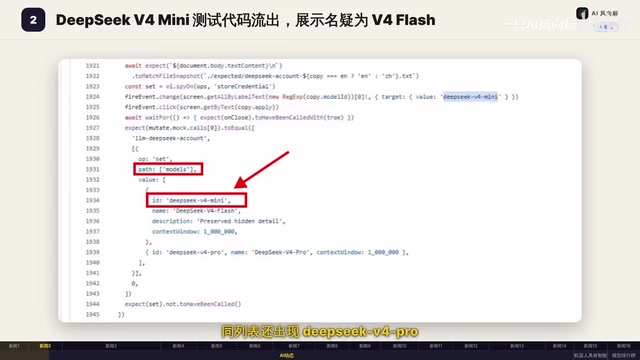
The three appearing side by side suggests DeepSeek may be planning a complete V4 series rather than a single model. The mixed use of Mini and Flash naming may mean the final naming has not been settled, or it could reflect different positioning for different product lines. Nothing has been officially announced yet, so these code traces can only serve as reference.
Ant Group's Ling-3.1-flash and the Chain Reaction in the Open-Source Ecosystem
The original headline mentioned that Ant Group's Ling-3.1-flash "exploded onto the scene in sync," but the source material offers little detail on its specific capabilities. Combined with the naming overlap with DeepSeek V4 Flash, a trend is visible: lightweight, low-latency "flash" tiers are becoming standard across model product lines.
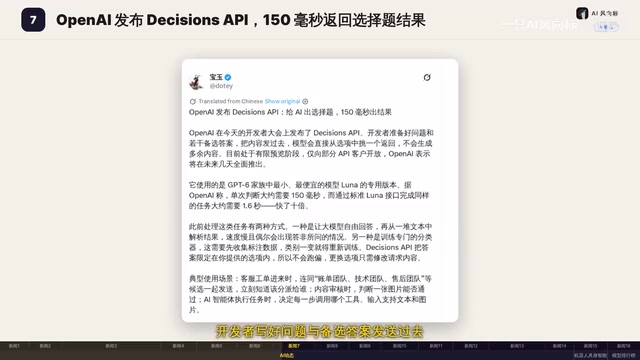
This tier targets scenarios sensitive to response speed — customer service ticket routing, content moderation, agent tool-call decisions, and the like. The source material mentions that OpenAI's Decisions API is a product of exactly this kind of demand: a single judgment takes only 150 milliseconds, using Luna, the smallest model in the GPT-6 family.
In engineering terms, a "flash" tier typically corresponds to a smaller model size than the flagship, a shorter inference chain, and more aggressive batching strategies, with the goal of pushing single-request latency down to the hundreds-of-milliseconds level. Such models do not pursue complex reasoning or long-form generation; instead, they serve high-frequency, short-input scenarios that require fast returns of structured judgments. For enterprises, the value of the flash tier lies not only in speed but also in per-call cost — the same budget can support several times the request volume of a flagship model. Therefore, each vendor opening a separate flash product line alongside its flagship is essentially splitting "capability" and "cost" into two independently priced goods.
On-Device and Lightweight: Lessons from a 164MB Speech Model
Another lead on the open-source side is worth noting: a certain speech recognition model is only 164MB in size, transcribes an hour of audio in about 20 seconds on an ordinary thin-and-light laptop, and achieves a word error rate of 5.21, outperforming larger mainstream models such as Whisper Large V3 Turbo. This means a personal computer can run it smoothly locally without a high-end GPU; currently it supports only English.
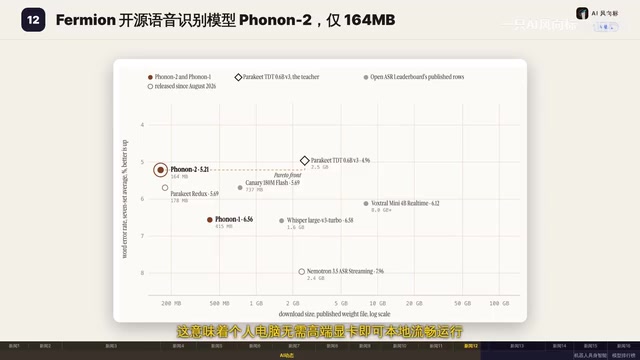
Extremely low-bit weight compression continues to lower the barrier to "running models locally." While cloud models compete on parameter scale, on-device models are opening a different front with size and latency.
Extremely low-bit weight compression generally refers to quantizing model parameters from the common FP16 (16-bit floating point) to 4-bit, 2-bit, or even lower representations while preserving output quality as much as possible. The lower the bit width, the smaller the model file, the less memory bandwidth it consumes, and the faster the inference — but quantization errors accumulate, requiring calibration during post-training quantization or quantization-aware training. The reason the 164MB speech model can process an hour of audio in about 20 seconds on a thin-and-light laptop is precisely the result of both size and compute requirements dropping. This technical path runs in the opposite direction from cloud large models: the latter trade parameter scale for a higher capability ceiling, while the former trades compression for deployability and low latency.
Leaderboard Landscape: Anthropic Still on Top, Domestic Models Break into the Top Ten
The model capability leaderboard in the source material shows that Anthropic dominates the top of the intelligence rankings: Claude Opus 5.5 takes first place with 58 points, Sonnet 5.5 is second with 56 points, and Claude Fable 5.1, GPT-6 Astra, and Gemini 4 Ergon tie for third with 53 points. On the domestic side, Mimo V2.6 Pro ranks tenth with 46 points, successfully breaking into the top ten.
The score gaps on the leaderboard are not large — only 5 points separate the top three — indicating that the absolute capabilities of leading models are converging, with differentiation increasingly reflected in adaptation to specific scenarios and cost structure.
Model capability leaderboards are typically based on a set of standardized evaluation tasks (reasoning, code, math, instruction following, etc.) converted into scores; different leaderboards vary considerably in question distribution and weighting, so cross-leaderboard comparisons should be made with caution. The small score gaps mentioned in the article are partly due to evaluation sets gradually saturating — leading models are already near the ceiling on most conventional questions, and the remaining gaps come mostly from a few highly difficult problems and stability. This also explains why vendors increasingly prefer to differentiate their marketing with real-world tests in specific scenarios (such as generating a usable interface in one shot for front-end work) rather than simply competing on total scores.
What These Leads Mean
Looking at the leaked information, code traces, and leaderboards together, the keywords for the next stage are "series" and "tiering." DeepSeek's V4 series plans, the flash tiers that vendors are converging on, and the downward push of model capabilities to on-device all point in the same direction: the era of a single flagship model conquering everything is passing, and tiering by scenario and cost is the main battlefield ahead.
For developers, what is worth watching is not the name of any particular model, but the pricing and integration methods of each vendor's lightweight tiers in enterprise APIs. Names may still change, but the tiering strategy is already clear.
One-line Summary
Leaked leads on Qwen 4 and the DeepSeek V4 series show model competition shifting toward series and tiering
Paragraph Summary
The article rounds up several unannounced model leads disclosed by Bilibili creator "AI风向标": early Qwen 4 outputs leaked, with its front-end generation capability evaluated as comparable to the Opus 5.5 and Astra level; the DeepSeek Harness repository code contains the names V4 Mini, V4 Flash, and V4 Pro simultaneously, with context length hard-coded at 1 million; and Ant Group's Ling-3.1-flash appears in the open-source ecosystem at the same time. Combined with OpenAI's 150-millisecond Decisions API, a 164MB local speech model, and the leaderboard landscape, the article concludes that the keywords for the next stage are series and tiering, and that the era of a single flagship model conquering everything is passing.
Related articles
uGAP: An AI Platform Unifying 100+ African Geospatial Datasets
uGAP is an African geospatial AI platform by a University of Cape Town team, unifying 120+ African datasets with a Python SDK for discovery, processing, and model training, already used in cyclone flood mapping.

Cursor Can Now Control Your Computer: AI Agents Can Drive Desktop Apps for Testing
Cursor adds desktop control: AI agents can drive desktop apps like the iOS Simulator to test their own features. We analyze the impact on dev workflows, possible technical approaches, and reliability concerns.

Vibecoding a Custom Inference Engine: High Hopes, Harsh Reality
A Reddit developer shares the real experience of vibecoding a custom inference engine: running GGUF Q4 models in the browser with WebGL2 and GLSL, only to fall into tokenizer debugging hell. This article analyzes the engineering challenges of browser-side LLM inference and why cloning llama.cpp is the more rational choice.