Qwen 4 Max Hands-On: 2.4 Trillion Parameters at a Fraction of Claude's Cost?
Qwen 4 Max enters the coding agent market with a 2.4T sparse architecture and low pricing—close to the top but not the strongest.
Alibaba's Qwen 4 Max features a new architecture with 2.4T total and 71B active parameters, text and image understanding, 1M token context, at $1.5 per million input tokens. It tops official 16-benchmark comparisons against the previous generation but ranks 11th in third-party composite testing—the best Chinese model, not the overall best. It leads DeepSWE at 75.7 (nearly tied with Kimi and GPT), beats Opus 5.5 on Agent's Last Exam, but trails in terminal automation and vision. Five real coding tasks all ran, with the cheapest at $0.29; instruction following sometimes beat Claude, though polish and physics fell short. The strategy: compete on price, not on being the strongest.
Alibaba has released Qwen 4 Max, the first model in the Qwen 4 family, built on an entirely new architecture rather than an iteration of the old one, with a parameter count of up to 2.4 trillion. But what really sparked discussion is the combination of price and performance: just $1.5 per million input tokens and $4.5 per million output tokens, along with a 1 million token context window. A YouTube creator ran independent coding tests on it and compared it head-to-head with Claude's top model.
Architecture and Pricing: The Secret to Big and Cheap
2.4 trillion parameters sounds absurd, but only 71 billion parameters are active at any given moment. That's exactly the key to being both large and cheap—sparse activation keeps inference costs manageable.
It supports text and image understanding, with a maximum output of 262,000 tokens. It's a reasoning model, and users can adjust the thinking depth. Note that the weights are closed-source; Alibaba says smaller Qwen 4 models will be open-sourced later, but no timeline was given.
In official benchmarks, Qwen 4 Max surpasses the older Qwen 3.8 Max across all 16 tests. But independent testing by third-party firm Waltz AI ranked it 11th out of 38 models—it's the best Chinese model, but not the strongest overall.
Mixture-of-Experts (MoE) and Sparse Activation: The article's "2.4 trillion total parameters, 71 billion active" describes a typical Mixture-of-Experts architecture. The model consists of a large number of "expert" sub-networks, and each token is routed to only a few experts for computation via a router, so the compute cost of a single forward pass is determined by the number of active parameters rather than the total. This allows model capacity to scale without significantly raising inference costs, at the price of higher memory usage and the need for specialized training techniques for routing and load balancing.
Tokens and Context Windows: A token is the basic unit of text processed by the model, roughly equivalent to 0.75 English words or 1–2 Chinese characters, and APIs price input and output tokens separately. A 1 million token context window means the model can read content on the order of millions of characters in a single pass, suitable for whole-repository code or long document analysis, but long contexts significantly increase memory and compute overhead, and the practical usable length is often limited by the server side.
Benchmarks: Ahead but with a Limited Edge
According to data cited by the creator, on DeepSWE, which tests coding ability on real code repositories, Qwen 4 Max scored 75.7, ranking first, but by a razor-thin margin: Kimi K3.1 at 75.5 and GPT 6.1 Sol at 75.2—essentially a three-way tie.
The real highlight is in long-horizon tasks. On Agent's Last Exam it scored 46.7, ahead of Opus 5.5's 43.4 and far above the older Qwen's 27.9.
But it's not a jack of all trades. On Terminal Bench it scored only 48.5, while Kimi K3.1 reached 67.2; on Program Bench it scored 31.5 versus Opus 5.5's 65. It ranks third in web development, and trails GPT 6 Extra and Opus 5.5 in chart and video understanding. Overall, it leads in 5 of 16 benchmarks.
How to Interpret Benchmarks: SWE-type benchmarks (like DeepSWE) measure a model's ability to locate and fix issues in real code repositories, usually scored by task pass rate; Terminal Bench assesses multi-step operations in a command-line environment; Program Bench leans toward implementing complete programs from scratch. These scores are highly sensitive to prompts, tool scaffolding, and retry counts, and rankings from different organizations often diverge—so "ranked first" and "11th place" are not contradictory: the former is a single leaderboard, the latter a composite evaluation.
Reasoning Models and Thinking Depth: The "reasoning model" mentioned here refers to a model that generates a chain of thought before giving an answer. The user-adjustable "thinking depth" essentially controls the reasoning token budget; a higher budget is usually more accurate, but latency and cost rise accordingly.
Real-World Coding Tests: Five Tasks That Tell the Story
The creator completed five coding tasks with Qwen 4 Max in KiloCode within VS Code, comparing against Claude Fable 5.2 under identical prompts.
Task 1: Rebuilding a Racing Game from a Screenshot
Given only a game screenshot and a single prompt, the task was to rebuild a playable demo matching the layout, camera, and art direction. Qwen 4 Max spent considerable time interpreting the screenshot, generated index.html, and performed live testing and bug fixing. The final version runs, but the vehicle physics aren't realistic, and a rock is left in the middle of the road.
The version Claude Fable 5.2 generated from the same prompt was noticeably more polished: the environment, skybox, and shadows were more realistic. But one detail is worth noting—the road in the screenshot isn't straight, and Qwen 4 Max faithfully reproduced the natural track with curves, whereas Fable 5.2 made it a straight highway. On instruction following, Qwen was actually more accurate. The task cost about $1.65.
Task 2: Three.js 3D Environment
Building a 3D environment from a very detailed prompt. Qwen 4 Max took a long time thinking, and the final result wasn't far off from Claude's version—not perfect, but with considerable completeness. Cost: $0.64.
Task 3: Interior Design Tool
Required creating a React project and implementing a draggable, rotatable 3D interior design tool. Qwen 4 Max produced a usable prototype from a single prompt, supporting drag-and-drop and position adjustment of elements. The creator considered the task itself not too complex, since the prompt already specified all instructions and the model only needed to translate text into React/JavaScript. Cost: $1.26.
Task 4: 3D Rubik's Cube Simulator
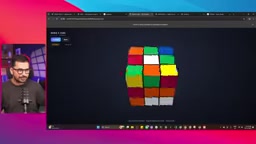
A standard test task requiring a 3D Rubik's Cube simulator. Qwen 4 Max completed it on the first attempt, but lacked a solve button. Cost: just $0.29.
Task 5: 2D Car Driving Demo
Given a reference image, the task was to make a drivable 2D car. Qwen 4 Max implemented a multi-layer parallax background, with the car able to drive and stop. Claude Fable 5.2's version added a driver inside the car, had slightly different physics, and supported reversing. The creator said they preferred Qwen 4 Max's result on this task—both performed excellently.
Conclusion: Not the Strongest, but the Best Value
Qwen 4 Max is not the world's strongest model, and Alibaba's own data shows that. But it approaches top-tier models on coding tasks at a much lower price, with a 1 million token context thrown in.
If you run long-horizon coding agents and are cost-sensitive, it's worth a try. If you need terminal automation or strong visual capabilities, other models still lead. Its strategy is clear: rather than competing head-on with frontier models for the crown, it opens a gap with price. At this price point, the barrier to trying it is already very low.
One-line Summary
Qwen 4 Max enters the coding agent market with a 2.4-trillion sparse architecture and low pricing—close to the top but not the strongest.
Paragraph Summary
Alibaba released Qwen 4 Max with a brand-new architecture: 2.4 trillion total parameters, 71 billion active, text and image understanding, 1 million token context, and just $1.5 per million input tokens. Official benchmarks show it beating the previous generation across all 16 tests, while third-party composite ranking places it 11th—the best Chinese model but not the strongest overall. It tops the DeepSWE coding benchmark at 75.7 but is nearly tied with Kimi and GPT, leads Opus 5.5 on the long-horizon Agent's Last Exam, and clearly trails in terminal automation and visual capabilities. All five real-world coding tasks ran, with the cheapest costing just $0.29 per task; instruction following sometimes beat Claude, though code polish and physical realism fell short. Its strategy is not to fight for the top but to open a gap with price.
Related articles

AI Writes Your Code—Do You Still Need to Learn Git? Five Reasons
AI coding agents handle Git operations automatically—is it still necessary to learn Git? Five reasons: team communication, reviewing agent PRs, monitoring code changes, fallback when AI goes down, and the joy of learning—plus how the focus of learning Git is shifting in the agent era.

Anthropic Reportedly Prices IPO at $83 Per Share, Valuing Company at $1.5 Trillion
Anthropic reportedly prices IPO at $83 per share, above the expected range, with a fully diluted valuation of $1.5 trillion. This article analyzes the signal significance of the pricing and its impact on the AI industry's financing environment.

Open-Source Code Hosting Platform Codeberg Suffers Outage, Sparking Debate in Developer Community
Open-source code hosting platform Codeberg.org suffered an outage, sparking Hacker News debate over nonprofit platform stability and open-source infrastructure dependency risks.