Qwen Complete Review: Full Breakdown of the Free ChatGPT Alternative

Qwen is Alibaba's free, feature-complete AI platform that rivals ChatGPT Plus across text, image, video, and more.
Alibaba's Qwen delivers a surprisingly complete AI experience at zero cost, covering multimodal chat, image and video generation, web development, real-time voice/video interaction, guided learning, and AI-powered travel planning. While it closely mirrors ChatGPT Plus in functionality, users should note limitations in the latest model's vision support, slower Agent task responses, and differing content moderation standards.
A "Completely Free" All-in-One AI Platform
Among the many ChatGPT alternatives out there, Alibaba's Qwen (通义千问Ad) is rapidly gaining global attention for its "zero paywalls, full feature coverage" positioning. According to a comprehensive hands-on review by tech channel SALVAJE, Qwen currently offers capabilities that nearly match everything in ChatGPT Plus — with no paid tier required.
Qwen is a large language model series developed by Alibaba DAMO Academy. Since its public launch in 2023, it has gone through continuous iteration. Its underlying architecture is based on Transformer technology, trained on Chinese, English, and multilingual corpora, with parameter scales ranging from 7 billion to hundreds of billions. Parts of the Qwen series have been released on open-source platforms like Hugging Face, serving both commercial deployment and academic research needs — making it one of the most openly accessible large models in China's tech ecosystem.
From conversations, deep search, image generation, and video generation, to web development, reasoning, and multimodal interaction, Qwen is quite literally a "multimodal all-in-one tool." Multimodal AI refers to systems capable of processing multiple data types simultaneously — text, images, audio, and video — with cross-modal alignment being the core technical challenge: enabling the model to understand semantic relationships across different data types. With the emergence of models like CLIP and Flamingo, and the commercial rollout of GPT-4V and Gemini Ultra, multimodal capability has become a key competitive dimension for next-generation AI platforms. Users can get started immediately after registering, with an interface that supports Chinese, English, Spanish, and other languages, plus light/dark theme options.
Temporary Chat and Privacy Protection
Qwen has a built-in "Temporary Chat" feature — clicking the icon in the top-right corner ensures that conversation content is neither stored nor saved to history, making it suitable for privacy-sensitive use cases.
For reasoning modes, users can freely choose between "Quick Execution," "Deep Thinking," or "Auto Mode." In Auto Mode, the model automatically determines reasoning depth based on prompt complexity, eliminating the need for manual switching.
Image and Video Generation
Qwen's image generation mode supports custom aspect ratios (such as 16:9) and provides a directly accessible prompt template library. The "Explore More" entry also showcases community creations — a feature most AI chat tools currently lack.
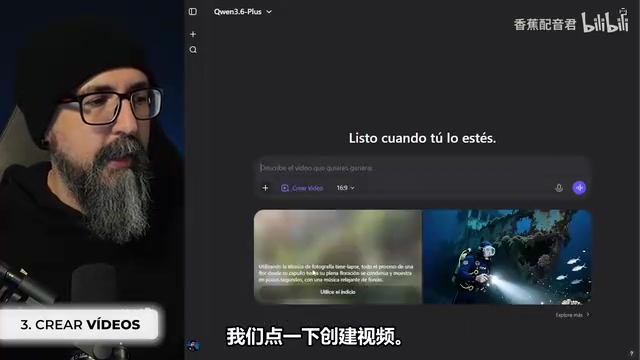
Qwen's image generation capabilities are based on diffusion model technology — the dominant paradigm for mainstream image generation, used by Stable Diffusion, DALL-E 3, and Midjourney alike. Diffusion models generate high-quality images from random noise through a progressive denoising process, offering significant improvements in stability and detail fidelity over earlier GAN (Generative Adversarial Network) approaches. Video generation builds on this by introducing temporal consistency constraints, requiring frame-to-frame coherence while maintaining image quality — a far more computationally intensive task than static image generation, which is the fundamental reason video generation is slower than image generation.
In testing, image quality was quite impressive, especially given that it's completely free. Generated images can be converted to video, re-edited, downloaded, or published to the community with a single click. Video generation is slightly slower than image generation, but the overall time was less than expected, and the output quality is top-tier among free tools.
Web Development and Instant Deployment
Qwen's "Web Dev" feature can generate webpage code directly, with a code panel and preview panel displayed side by side for a WYSIWYG experience. In testing, asking it to "create a solar energy product website" produced an HTML/CSS/JavaScript error where resources couldn't be found.
This moment actually captures the real-world workflow of AI-assisted coding: after pointing out the issue with quotes in the prompt, Qwen regenerated the correct code. This reinforces a core principle — using AI coding tools isn't just about "chatting"; understanding its output is what actually lets you improve the results.
The final webpage was deployed almost instantly to a subdomain via the "Expand" feature, accessible in a browser as a full page — no custom domain required.
Voice and Video Real-Time Interaction
Qwen supports three interaction modes: voice recording, voice chat, and video chat. Voice recording accurately transcribes spoken instructions into the prompt input box; voice chat supports smooth two-way conversation with customizable AI voices.
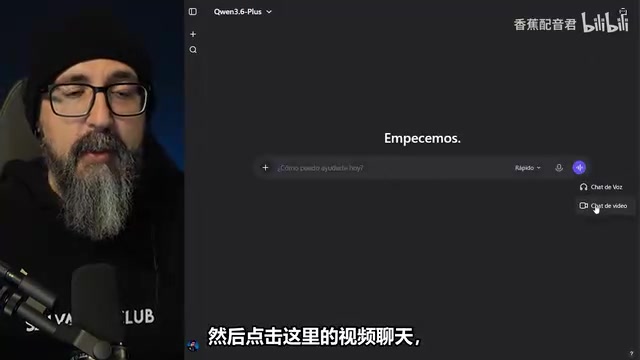
The video chat feature is powered by Vision-Language Model (VLM) technology. VLMs connect a visual encoder (typically ViT, or Vision Transformer) with a language model decoder, enabling the system to convert visual frames captured by a camera into semantic descriptions, then generate responses based on the user's text or voice questions. OpenAI's GPT-4o and Google's Gemini Live use similar architectures. In testing, Qwen correctly identified the reviewer's glasses and could answer questions like "what color are my eyes" based on the live video feed — a test of the model's fine-grained visual understanding under low-latency conditions. The full conversation log, including visual recognition details, is saved to history after the session ends.
Learning Mode and Travel Planning
Qwen's "Learning Mode" follows a guided teaching logic: rather than giving direct answers, it helps users build a conceptual framework step by step through continuous questioning.
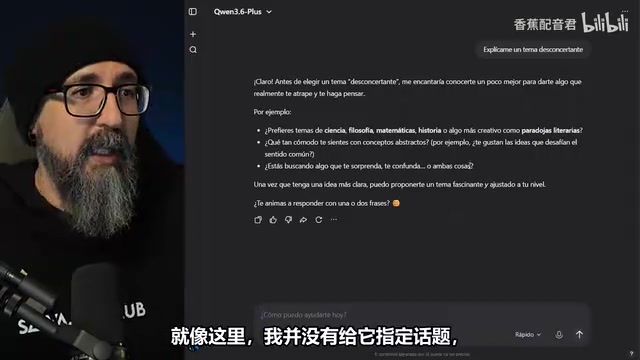
In a test using "philosophy" as the subject, Qwen proactively introduced the classic "Brain in a Vat" thought experiment and created a systematic learning plan. Users can also upload PDFs as learning materials for a highly personalized experience — particularly useful for exam prep.
The "Travel Planner" demonstrates Qwen's Agent reasoning capabilities. An AI Agent is a paradigm that allows a language model to autonomously decompose tasks, invoke tools, reason across multiple steps, and synthesize results — whereas traditional LLMs primarily handle single-turn Q&A, the Agent framework enables a "think → act → observe → rethink" loop. ReAct (Reasoning + Acting) and Plan-and-Execute are two of the most widely used Agent architecture patterns today. After entering "a family of three, 3-day trip from Beijing to Nanjing," Qwen synthesized travel time, attraction distribution, and transportation options to produce a complete itinerary including schedule, transport recommendations, and estimated costs — with PDF export support. This test took around 6 minutes — precisely because the model requires multiple reasoning iterations to coordinate attraction data with transportation information, making the computational chain significantly longer than a standard conversation. Response speed here has room for improvement.
Project Management, Memory, and Data Migration
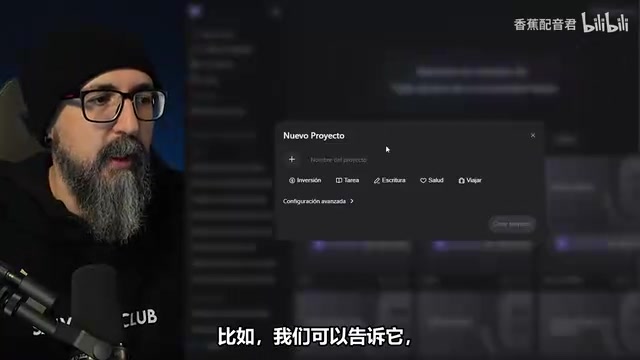
Qwen closely mirrors ChatGPT's core workflow features:
- Projects: Create standalone projects (e.g., "Fitness Plan") with dedicated memory, custom instructions, and project files, with all related conversations centrally archived.
- Memory: Remembers user preferences and habits (e.g., "remind me to drink water every day"), with individual entries manageable, deletable, or clearable all at once in settings.
- Chat History Migration: Supports importing conversation history from ChatGPT and exporting to Claude, Google AI Studio, and other platforms — seamless cross-tool migration. This design addresses the increasingly important "data portability" issue in AI — the EU's Digital Markets Act (DMA) has made data portability a mandatory requirement for large platforms, and Qwen's compatibility with OpenAI's export format (JSON/ZIP) signals that Chinese AI platforms are actively aligning with international interoperability standards.
- Coder: A development environment with GitHub account integration, supporting version control. The demo walked through building a "Word to PDF converter" step by step using natural language.
Limitations and Caveats
A few things worth knowing before using Qwen:
- Content Moderation Standards: Qwen's content moderation is noticeably more permissive than US-based platforms like ChatGPT, Claude, and Gemini, allowing for more diverse creative expression. This difference reflects the geopolitical context of AI content governance — US platforms typically follow more conservative safety guidelines during RLHF (Reinforcement Learning from Human Feedback) alignment training, while Qwen's "permissiveness" is mainly in the realm of creative content and humor rather than politics. On politically sensitive topics related to China, Qwen still enforces strict moderation. Users switching between platforms should understand the policy logic behind these differences and evaluate content accordingly.
- Latest Model Limitations: In testing, the newest 3.7 model only supports text input and does not yet have visual understanding capabilities.
- Complex Task Latency: Agent tasks like travel planning are slow to respond, and the experience has room for improvement.
- Code Generation Stability: Errors can still occur in web development scenarios, requiring users to have basic judgment and debugging skills.
Qwen currently offers full platform support across Windows, Mac desktop, and mobile — all features completely free. For users looking for a free ChatGPT alternative, it's one of the most feature-complete options available today.
Key Takeaways
Related articles

Gaussian Process Bandit Optimization: Exploration Strategies and Inference Regret Guarantees
Cumulative regret guarantees in Bayesian optimization fail to reflect final recommendation quality. This article examines a new study that provides inference regret guarantees for Gaussian process bandit optimization through exploration query strategies and fill distance analysis, validated on hyperparameter optimization and control tasks.

The Most Detailed Codex Guide on Bilibili: From Installation to Real-World Practice
The most detailed Codex guide on Bilibili: from app store installation to daily work mode configuration, with a real coffee shop project demonstrating file organization, data extraction, dashboard creation, and other practical tasks. Learn to use Plan Mode and desktop pets to leverage Codex efficiently.

Appearance Compensation in Volume Rendering: Why RGB Accuracy Cannot Guarantee Density Correctness
Volume rendering research reveals that volumetric data perfectly reproducing external RGB views may still contain density errors: appearance compensation can double central density and keep external rays unchanged even when L2 error exceeds 14.52%. Density recovery depends on appearance capacity, spatial resolution, and measurement design.