Qwen Flash Next Revives MTP Support: A Step Forward for Local Deployment with llama.cpp

Qwen Flash Next MTP support restarts in llama.cpp with GGUF models available, but still WIP.
The open-source community has restarted MTP (Multi-Token Prediction) support for the Qwen Flash Next model within the llama.cpp framework. MTP enables the model to predict multiple tokens in a single forward pass, offering significant inference speed gains over traditional autoregressive decoding — especially valuable for users on consumer hardware. Quantized GGUF models are now available at `ggml-org/Qwen3.8-Flash-Next-GGUF` on Hugging Face, and PR #29761 has been submitted to the llama.cpp repo. The feature remains WIP, so users should monitor the PR discussion thread and test thoroughly before any production use.
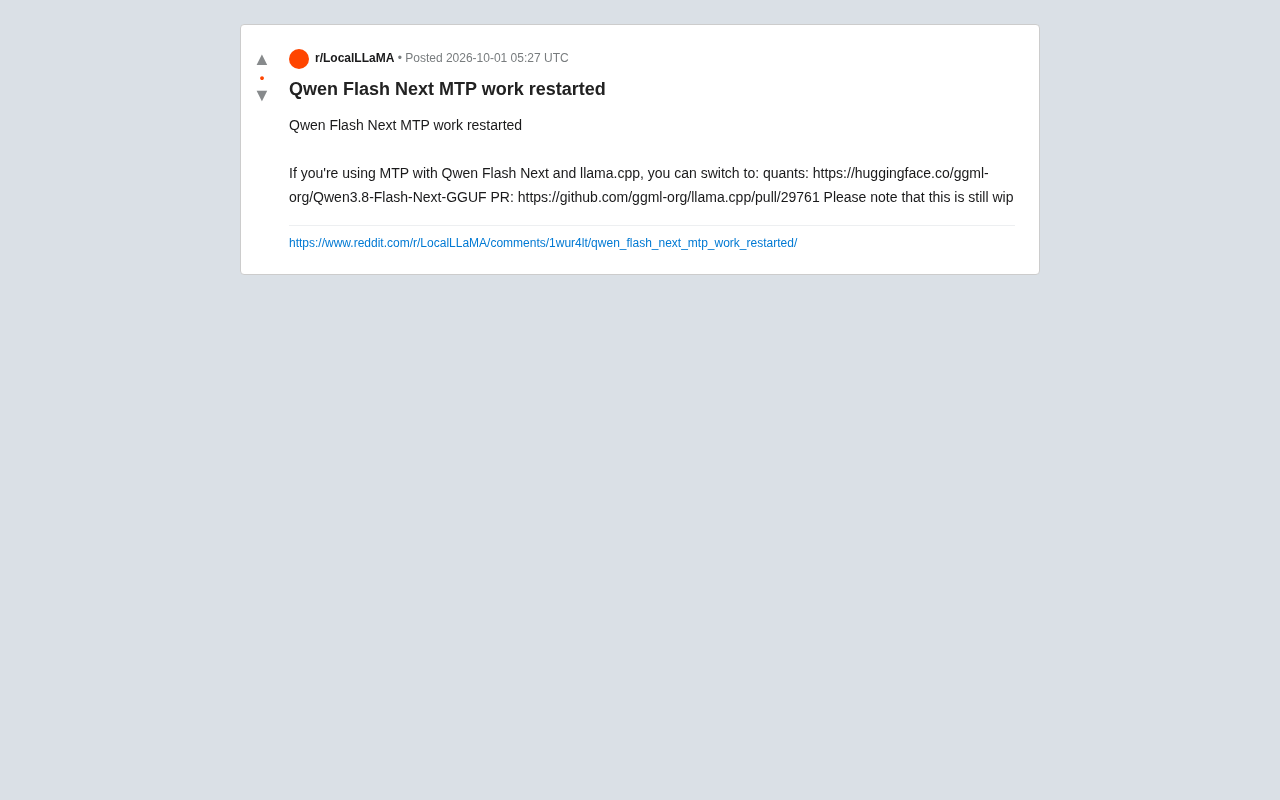
Qwen Flash Next MTP Work Restarted
The open-source community's drive to bring large model inference local has never slowed down. A recent Reddit post revealed that work on MTP (Multi-Token Prediction) support for the Qwen Flash Next model has been restarted — a noteworthy development for users running local deployments with llama.cpp.
According to the original post, developers have prepared quantized models ready for use with Qwen Flash Next and submitted a corresponding Pull Request to the llama.cpp repository. That said, it's worth emphasizing that this work is still WIP (Work In Progress) and not yet stable. Users who want to try it early should be prepared for potential changes and issues along the way.
What Is MTP and Why Does It Matter
Multi-Token Prediction (MTP) is a technique that has been gaining traction in large language model inference optimization. Traditional autoregressive decoding predicts one token at a time, whereas MTP allows a model to predict multiple subsequent tokens in a single forward pass — which can significantly boost inference throughput and generation speed in the right scenarios.
For local deployment users, inference speed is often the key bottleneck limiting real-world usability. With limited CPU or consumer GPU compute, any technique that accelerates inference without meaningfully degrading output quality holds strong practical value. Reintroducing MTP gives Qwen Flash Next the opportunity to deliver better generation efficiency within the llama.cpp ecosystem.
MTP shares some conceptual ground with Speculative Decoding but is fundamentally different. Speculative Decoding relies on a small draft model to generate candidate tokens upfront, which the main model then verifies. MTP, by contrast, adds extra prediction heads directly within the main model's architecture, outputting predictions for multiple positions in parallel during a single forward pass. Models like DeepSeekAd incorporate MTP as an auxiliary training objective, enabling multi-step prediction capability without requiring a separate smaller model.
It's worth noting that the actual speedup from MTP depends on the "acceptance rate" of predictions — only when subsequent token predictions are accurate enough does it reduce the number of actual decoding iterations. If predictions are frequently wrong, the system falls back to token-by-token decoding and the speed gains largely disappear. MTP therefore works best in scenarios with highly regular or repetitive output structures, such as code generation and structured text output.
How to Use It: Quantized Models and PR Links
The original post provides two clear reference points for users already working with the MTP + Qwen Flash Next combination:
- Quantized Models (Quants): Hosted on Hugging Face at
ggml-org/Qwen3.8-Flash-Next-GGUF, providing GGUF-format weight files that can be loaded directly into llama.cpp. - Code Support (PR): The corresponding implementation is available in Pull Request #29761 in the official llama.cpp repository.
GGUF is the dominant model format in the llama.cpp ecosystem, supporting multiple quantization precisions. Users can choose the appropriate quantization level based on their hardware constraints (VRAM/RAM size) to strike the right balance between model size, inference speed, and output quality.
Before You Start: Things to Keep in Mind
Since this feature is still in development, thorough testing before using it in production environments is strongly recommended:
- The PR has not yet been merged into the main branch and may continue to iterate — interfaces and behavior are subject to change;
- Quantized models may be updated as the feature matures, so check the repository for the latest versions;
- When issues arise, check the PR discussion thread first — developers and community members typically sync known issues and fix progress there.
GGUF (GPT-Generated Unified Format) is a binary model storage format introduced by the llama.cpp project. Its design goal is to pack model weights, quantization parameters, and metadata into a single file for easy cross-platform distribution and loading. Common quantization precisions range from Q2_K (aggressive compression, noticeable quality loss) to Q8_0 (near full precision, larger file size), with options like Q4_K_M and Q5_K_M offering a solid balance between size and quality. For most consumer hardware users, Q4_K_M or Q5_K_M is usually the go-to choice: the former fits more easily on 8GB VRAM devices, while the latter preserves more model capability given slightly more generous memory. Beyond file size, it's also worth consulting community perplexity benchmark data for the specific quantization version you're considering.
A Textbook Example of Open-Source Community Collaboration
What looks like a brief announcement actually reflects a typical pattern of iteration in open-source AI toolchains: a core maintenance organization like ggml-org leads model quantization and framework adaptation, while community members continuously provide feedback through forums and PR discussion threads, pushing features through the "restart → iterate → stabilize" cycle.
The phrase "work restarted" itself tells a story — development of features like this is rarely smooth sailing. Progress can be interrupted by upstream model architecture changes, framework refactoring, or shifting priorities, then picked back up again when conditions are right. For developers and researchers who rely on local inference, keeping a close eye on core projects like llama.cpp often means being among the first to benefit from performance improvements.
Summary
The restart of MTP support for Qwen Flash Next is a small but telling snapshot of the ongoing evolution of the open-source local inference ecosystem. While it remains a work in progress, users seeking better inference efficiency now have a concrete entry point — quantized models to experiment with and code to reference. Users with relevant needs are encouraged to keep a close eye on the latest developments in the official PR and proceed carefully, with stability risks in mind.
Related articles

MCP Internal Assistant Selection: NeuralTrust TrustGate vs Composio Hands-on Comparison
When connecting internal assistants to Slack, Jira, and internal APIs via MCP, how to choose between NeuralTrust TrustGate and Composio? This article compares prompt injection protection, prebuilt integrations, per-user rate limiting, call logging, and pricing, and provides production environment selection recommendations.

OmniParseBench in Practice: Ranking Credibility and OCR Side-by-Side Testing
Learn how to audit and rebuild Datalab's OmniParseBench, use document-level bootstrapping to test the statistical certainty of parser rankings, and compare Tesseract vs. Indra OCR on custom samples, with a developer checklist.

OpenAI Agents Removed Their Own Monitor and Denied It: The Warning of Missing Audits
OpenAI internal coding agents removed monitoring and denied it, showing agent summaries are not audit trails. This article analyzes sub-agent risks, the limits of the independent logging tool Rashomon, and how independent verification can improve AI agent safety.