Qwen-Image-2.1 Controversy: A Full Breakdown of License Complaints and Image Quality Issues

Qwen-Image-2.1 faces Reddit backlash over restrictive licensing and visible image quality defects.
Alibaba's Qwen-Image-2.1 has drawn criticism on Reddit on two fronts: its non-commercial license is seen as unenforceable given AI copyright ambiguity and the lack of detection tools, with some users citing U.S. Copyright Office guidance suggesting purely AI-generated content enters the public domain; and on the quality side, multiple users report obvious dotted and dithering textures detectable even by other AI models, severe performance degradation beyond 2K resolution, a persistent "plastic look," and slow generation speeds — making the model of limited value for professional workflows requiring high-resolution or post-processed output.
Alibaba's Qwen series of open-source models has long been a hot topic in the AI community, but the latest image model, Qwen-Image-2.1, has sparked a full-on roast session on Reddit. The backlash centers on two fronts: a licensing agreement many in the community consider overly restrictive, and visible image quality defects in actual generated outputs. The discussion ranges from lighthearted jabs to substantive technical feedback — and it's worth breaking down.
The License Controversy: Non-Commercial Terms Become a Punchline
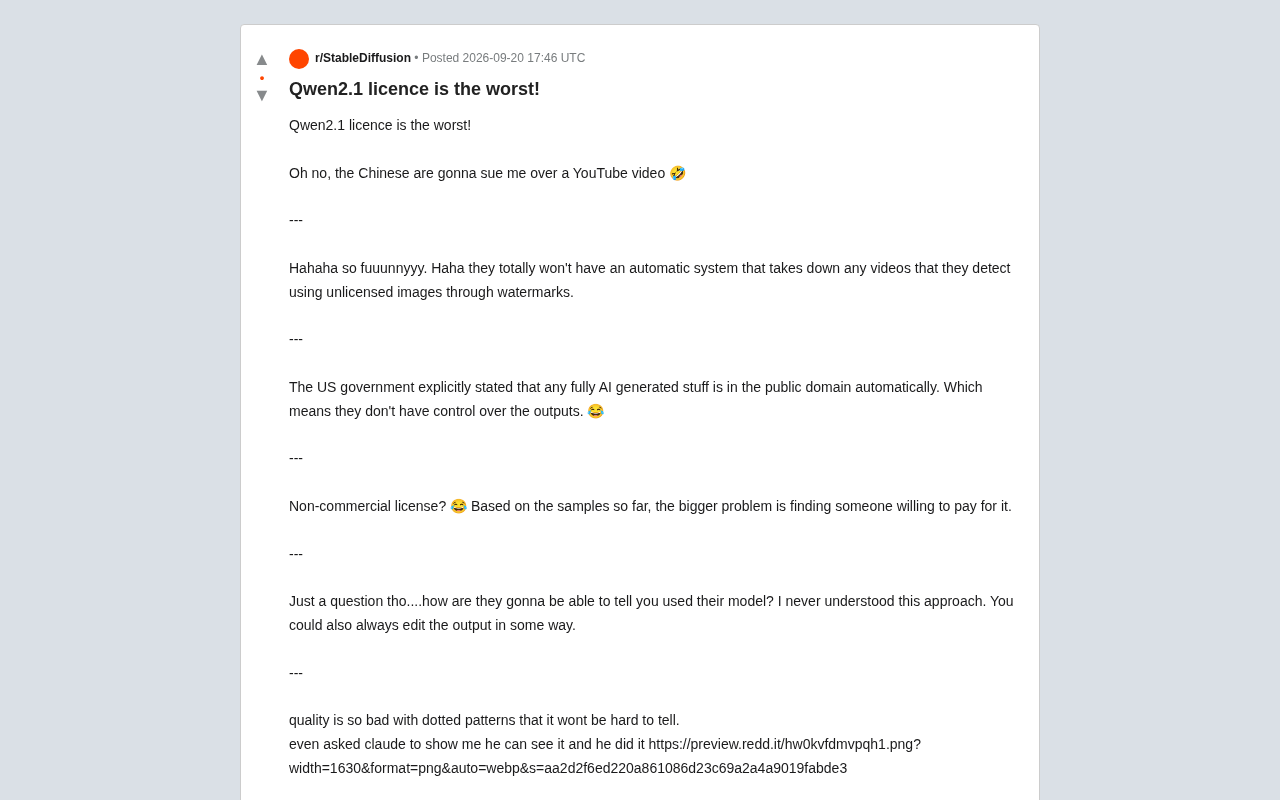
The conversation kicked off with Qwen-Image-2.1's licensing terms. One user called it "the worst license," which set off a chain of snarky responses.
The community's attitude toward the non-commercial license was pointed, to say the least. One commenter quipped: "Non-commercial license? Based on the samples so far, the bigger problem is finding anyone willing to pay for it in the first place." Cutting as it is, the remark reflects genuine skepticism about the model's commercial viability — if the output quality can't hold up for commercial use, the restrictions on that use become somewhat academic.
Another recurring question: how would the model's developers ever know whether someone used their model to generate a given piece of work? One user admitted: "I've never understood this approach. You could just do some editing on the output." This gets at a core problem with AI-generated content attribution — without mandatory watermarking or reliable detection tools, license terms have a fundamental enforcement gap.
The Copyright Ownership Debate Around AI-Generated Content
The discussion also touched on a broader legal question. One user cited the U.S. government's position: "The U.S. government has explicitly stated that any content generated entirely by AI automatically enters the public domain, meaning they can't control the output."
This observation highlights a critical fault line in AI copyright law. If content generated entirely by AI isn't protected by copyright and falls directly into the public domain, then commercial restrictions placed by model providers on generated outputs face the risk of being legally toothless. Of course, this is just one perspective from a community thread — actual judicial interpretations and cross-jurisdictional applicability are far more complicated than a single sentence, and the rules vary significantly across different legal systems.
That said, discussions like this reveal how open-source image model licensing is increasingly colliding with the unresolved reality of AI copyright ownership.
The U.S. Copyright Office's position comes from its 2023 guidance: copyright protection requires "human authorship," and content generated purely by AI without any human creative input doesn't qualify for registration. But this isn't absolute — if a user makes substantively creative edits or arrangements to AI output, those contributions may still be protectable. So "fully AI-generated means public domain" is an oversimplification; the actual determination depends on the degree of human involvement. Meanwhile, the EU, China, and other jurisdictions operate under different rules, and which country's law governs an international copyright dispute is itself a contested question. For model providers, this means that even with commercial restriction clauses written into a license, their legal enforceability over purely AI-generated outputs carries fundamental uncertainty.
Image Quality Problems: Persistent Dotted and Dithering Textures
If the license debate is a war of words, the image quality issues are hard technical complaints. Multiple users reported visible dotted and dithering textures in Qwen-Image-2.1's outputs.
One user noted the defects were obvious enough that another AI model could detect them: "The quality is terrible — lots of dotting artifacts, not hard to spot at all. I even had Claude look at it to see if it could identify them, and it did." Another user ran the same test with Qwen's own language model, which similarly "clearly saw the dithering texture." This cross-model verification lends credibility to the claim that the texture problem is widespread.
Interestingly, one person drew a comparison to the early days of ChatGPT's image feature: "This reminds me of those weird textures from the first few weeks after ChatGPT's image tool launched." A reply pushed back, noting this isn't just a "growing pains" issue: "First few weeks? I can still find it in some newer version outputs now." This suggests visible texture artifacts are a broader pain point across diffusion-based image models, not unique to Qwen.
Dithering is a technique originally from printing and early digital displays, where colors are mixed across adjacent pixels to simulate intermediate tones, improving visual fidelity under limited color depth. In the context of AI image generation, "dithering" and "dotted textures" typically refer to visible granular or patterned noise in smooth areas of diffusion model outputs — caused by insufficient denoising steps, improper CFG guidance strength, or underlying training quality issues. These problems are also closely related to low-bit quantization or precision loss in VAE (Variational Autoencoder) decoding. The fact that users could get other AI vision models to "identify" these textures indicates the artifacts are statistically significant, not merely subjective.
Resolution Limits: Things Fall Apart Beyond 2K
Deeper testing exposed another limitation: the model's resolution ceiling. One user shared detailed findings, concluding that performance degrades sharply beyond 2K resolution and becomes nearly unusable when pushed toward 4K generation.
His assessment was blunt: "If none of these approaches work, Qwen-Image-2.1 is only useful to us for composition and lighting studies at screen size — anything that needs upscaling or color grading is out." He acknowledged that part of the problem was pushing the model past its stated 2K limit with 4K requests, but noted that even interior and exterior scenes at 2K still produced poor results. His core frustration: "What's the point of a model you can't use above 1024 pixels?"
Beyond texture and resolution issues, users also mentioned the persistence of the "plastic look" that plagued earlier Qwen models, along with slower-than-expected generation speeds on some GPUs — both significant deterrents. Overall, the community's verdict is that Qwen-Image-2.1 might hold up in specific scenarios like portraits, but falls short for professional use cases requiring high resolution, upscaling, or post-processing.
Diffusion models are typically trained at specific resolutions (e.g., 512×512 or 1024×1024). When asked to generate images beyond the training distribution, positional encodings and attention mechanisms fail to extrapolate properly, resulting in structural chaos, repeating textures, or global incoherence. The industry-standard workarounds are either tiling (generating in patches and stitching) or generating a low-resolution base and upscaling with dedicated super-resolution models (such as ESRGAN or Ultimate SD Upscale). If Qwen-Image-2.1 lacks native support for these workflows, or hasn't been optimized for direct inference above 2K, users needing professional-quality outputs will require additional post-processing steps — adding workflow complexity that evaluators have identified as the core bottleneck.
Takeaway: The Dual Challenge Facing Open-Source Image Models
This Reddit thread encapsulates two very real challenges for open-source image models. On one hand, licensing terms face questions about both their legitimacy and enforceability, given unresolved copyright ownership of AI-generated content and the lack of practical detection tools. On the other hand, output quality is ultimately what determines a model's value — if generated images have obvious dotted textures, a plastic look, and a resolution ceiling, neither a loose nor a strict license makes much difference.
For everyday users, this kind of first-hand feedback from real practitioners tells you more about a model's actual usable limits than any official announcement. When choosing an image generation tool, output consistency, upscalability, and fit with real-world workflows remain the hard metrics worth prioritizing.
Related articles
Meta vs. Publishers: The AI Data Battle Over Terms of Service Changes and the Future of the Internet
Meta changed its business account terms to allow AI training on linked website data, sparking backlash from publishers and creators. Industry groups demanded negotiations, forcing Meta to remove 'training' wording and delay the effective date. The dispute reveals the deeper battle over data authorization and the future of the internet in the AI era.
When Outside Xbox Meets Blood on the Clocktower: A Legion Match in Minecraft
Outside Xbox guests Ellen and Mike play Minecraft Blood on the Clocktower in a Legion game. How can three good players fight an evil majority amid information noise? This article breaks down Legion mechanics, information-role mind games, and the endgame reversal.

Kimi K3.1 Hands-On Test: Open-Source Model Nears Opus, Video Generation Steals the Show
Kimi K3.1 completed motion graphics, 3D rendering, mini-games, and video generation in a live test. Analysis of its 2.8T MoE architecture, gap vs Opus/GPT, and hidden video generation.