Qwen-Image-2.1 Gets Intel OpenVINO Day-0 Support: One Checkpoint for Both Generation and Editing

Qwen-Image-2.1 gets Intel OpenVINO Day-0 support; one open-weight checkpoint covers both image generation and editing.
Alibaba's Qwen-Image-2.1 received Intel's official OpenVINO Day-0 support on its release day, letting developers deploy the model on Intel CPUs, integrated GPUs, and Arc discrete GPUs without any waiting period. OpenVINO's model conversion, graph optimization, and quantization capabilities extend the model's reach beyond the NVIDIA ecosystem. Additionally, Qwen-Image-2.1's unified single-checkpoint architecture supports both image generation and editing, simplifying deployment and reducing VRAM usage — reflecting a broader industry trend of tighter collaboration between open-source models and hardware vendors.
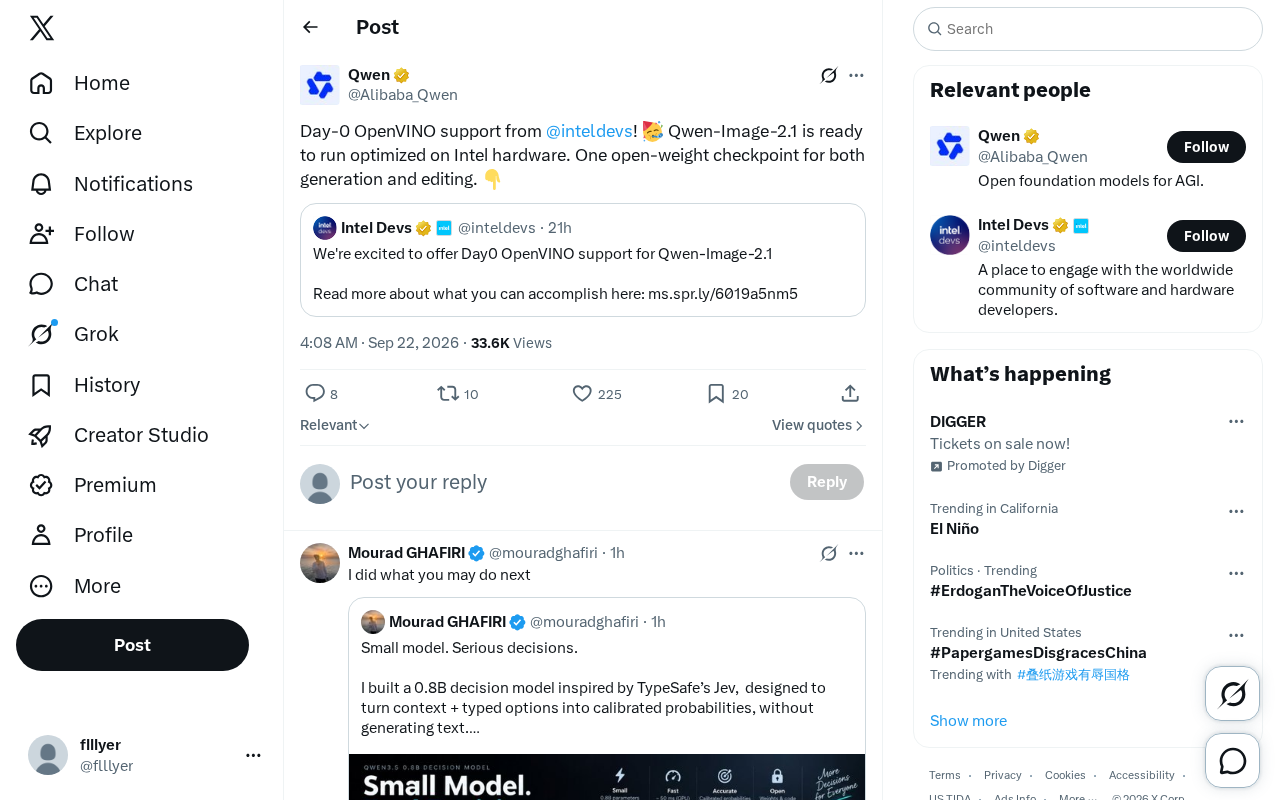
Alibaba's Qwen team image model Qwen-Image-2.1 has received a notable ecosystem milestone: Intel's official developer team (@inteldevs) announced Day-0 level OpenVINO support for the model. This means the model can run in an optimized manner on Intel hardware from the very day of its release, with no lengthy adaptation period required.
What Is Day-0 Support and Why Does It Matter
"Day-0 support" refers to hardware or inference framework vendors completing adaptation and optimization on the same day a model is officially open-sourced, allowing users to immediately deploy it on the corresponding platform. For developers, this often has a greater impact on real-world deployment efficiency than the model's capabilities themselves.
In the past, there was typically a gap of weeks or even months between a model's open-source release and its ability to run efficiently on specific hardware — requiring the community or vendors to gradually complete operator adaptation, quantization optimization, and performance tuning. By providing first-day support for Qwen-Image-2.1 through OpenVINO, Intel has shortened this pipeline and demonstrated its proactive investment in the generative AI inference ecosystem.
The Value of OpenVINO and Intel Hardware
OpenVINO is Intel's inference optimization toolkit, primarily designed to deliver higher inference performance for deep learning models on Intel CPUs, integrated GPUs (iGPU), and discrete GPUs (such as the Arc series). It reduces inference latency and improves throughput through model conversion, graph optimization, and quantization.
For compute-intensive tasks like image generation, the ability to run efficiently on non-NVIDIA hardware carries clear significance. It broadens deployment options for users: whether on Xeon platforms in data centers or Intel integrated and Arc discrete graphics in consumer devices, all become viable hosts for running Qwen-Image-2.1. For teams looking to break free from dependence on a single hardware vendor and control deployment costs, this is a tangible benefit.
The OpenVINO workflow typically consists of two phases: offline conversion (converting models from PyTorch, ONNX, and other formats into OpenVINO IR intermediate representation) and runtime inference (via a unified Runtime API). During conversion, it performs constant folding, layer fusion, dead code elimination, and other graph optimizations, with optional INT8 or FP16 quantization to further compress model size and boost inference speed. For diffusion-based image models (such as the architecture Qwen-Image-2.1 likely employs), OpenVINO has also specifically optimized the repeated forward passes through UNet or Transformer modules. Notably, OpenVINO's GenAI pipeline (openvino-genai) has in recent years added high-level abstractions specifically for generative models, significantly reducing deployment complexity for image generation tasks — developers can achieve near-native optimized performance without needing deep knowledge of underlying hardware instruction sets.
One Checkpoint, Both Generation and Editing
Another key detail in this announcement is that Qwen-Image-2.1 uses a "one open-weight checkpoint for both generation and editing" design.
This means users don't need to load two separate sets of model weights for image generation and image editing — a single checkpoint handles both task types. This unified architecture offers several practical advantages: it reduces VRAM and storage requirements, simplifies the deployment process, and eliminates the need to reload the model when switching between generation and editing tasks. For developers building end-to-end image workflows, this design reduces engineering complexity.
In the image generation field, "generation" and "editing" have long relied on different technical approaches: generation tasks (text-to-image) typically start from random noise, while editing tasks (such as local inpainting or instruction-driven editing) require an existing image as conditional input, demanding that the model perceive and preserve the original content. Early solutions (such as Stable Diffusion inpainting) required separately fine-tuning an editing-specific checkpoint; later, InstructPix2Pix, SDXL-Turbo, and others explored unified frameworks, but often faced trade-offs between generation quality and editing precision. Qwen-Image-2.1's claim of covering both task types with a single checkpoint suggests that its training phase likely adopted a unified task-conditioning design, enabling the model to adaptively perform generation or editing based on input signals. This represents meaningful technical sophistication in architecture design, and is one of the important evolutionary directions for recent multimodal generative models.
Implications for Developers and the Ecosystem
Taking Day-0 support, OpenVINO optimization, and unified weights together, the core value of Qwen-Image-2.1's progress lies in "accessibility." Open-source weights lower the barrier to entry, OpenVINO optimization expands the range of supported hardware, and Day-0 timing makes all these advantages available immediately.
For the broader AI ecosystem, this also reflects a trend: open-source image models are forming tighter collaboration with mainstream inference frameworks and hardware vendors. When a model release is no longer just the publication of weights, but is accompanied by immediately usable hardware optimization solutions, the distance between model and application is further compressed.
It should be noted that this article is based on a brief announcement published on official social platforms. Specific performance benchmarks for Qwen-Image-2.1, the full list of supported Intel hardware models, quantization precision, and other technical details are still pending disclosure in official documentation. Interested developers can follow Intel and the Qwen team for complete technical documentation and deployment guides as they become available.
Related articles

JobRunner MCP Server: AI Agents Can Now Fix Failed Java Jobs
JobRunner launches an open-source MCP server enabling AI agents to view cluster status, diagnose failures, and recover Java jobs—incident response from any cloud coding environment or existing agent.

MLAI Digital Launches 9 Security Agents: MCP Server Safeguards the Full Lifecycle of Agentic AI
MLAI Digital launches Security MCP Server with nine built-in specialized security agents covering vulnerability discovery, attack simulation, prompt injection detection, API and infrastructure assessment, and accelerated remediation—embedding security validation across the full Agentic AI lifecycle from development to production.

Running Isaac Lab on H100 GPUs: Exploring Better Approaches
Exploring optimization methods for running Isaac Lab on NVIDIA H100 GPUs, including MIG configuration, mixed precision, TensorRT acceleration, and community experience to improve robotics simulation and reinforcement learning efficiency.