Qwen3 27B Local Deployment Real-World Test: Frontier-Level Coding Performance on Just 16GB VRAM

Qwen3 27B runs locally on 16GB VRAM and delivers frontier-model-level coding results in systematic testing.
An overseas tech blogger systematically tested the Qwen3 27B dense model running locally on an RTX A2000 with just 16GB VRAM. Despite generating only 3 tokens/second, the model achieved 100% on 256K context retrieval, 85% on HumanEval (with 99% response rate), and produced stunning one-shot results on Kanban apps, physics simulations, and dungeon generators. It also delivered the best-ever results on Blender MCP integration. The verdict: the strongest local coding model tested, trading speed for intelligence.
The latest iteration of Qwen (Tongyi Qianwen), China's homegrown large language model series, has once again pushed the capability ceiling for locally deployed models. Overseas tech YouTuber Luke (Luke's Dev Lab channel) conducted a systematic evaluation of the Qwen3 27B dense model, and his conclusion was remarkably direct: this is the strongest coding model he has ever tested running locally, bar none.
This article is based on the complete testing workflow from that video, covering the model's real-world performance across multiple dimensions including speed, memory, tool calling, code generation, and MCP advanced tool integration, while objectively presenting both its strengths and trade-offs.
Qwen3 27B Test Environment and Quantization Choice
The test used the GGUF quantized version provided by Unsloth, specifically the Q4_K_XL quantization format. GGUF (GPT-Generated Unified Format) is a model file format defined by the llama.cpp project, designed specifically for efficiently running large language models on CPUs and consumer-grade GPUs. Quantization is the process of compressing model weights from high-precision floating point (such as FP16/BF16) to lower-precision representations, trading some accuracy for smaller file sizes and lower VRAM usage. Q4_K_XL is a mixed quantization scheme developed by the Unsloth team, where "Q4" indicates the main weights use 4-bit quantization, "K" represents k-quant technology (using different quantization precision for different layers to preserve critical information), and "XL" means more critical layers retain higher precision. Compared to naive uniform 4-bit quantization, this strategy significantly reduces precision loss at nearly the same VRAM footprint, making it one of the community's consensus best value-for-money quantization schemes.
The tester's hardware setup is quite representative — and quite modest:
- GPU: RTX A2000 (workstation card, only 16GB VRAM)
- RAM: 32GB DDR4 (for VRAM overflow)
- Memory bandwidth: approximately 225–250 GB/s
A notable detail: this is not a fast workstation GPU. The tester explicitly pointed out that even a gaming GPU with 16GB VRAM would run faster than his setup. In other words, the performance numbers from this test represent a "conservative lower bound" — most users with equivalent VRAM would achieve a better experience.
The test suite was comprehensive: prefill/decode speed, 256K long-context memory retrieval, tool calling (agency), all 164 Python problems from OpenAI's HumanEval, Kanban frontend development, sandbox physics simulation, dungeon generation algorithms, and advanced tool calling via MCP connections to Blender and Godot.
Dense Model Architecture: Why 27B
Qwen3 27B is labeled as a "Dense Model," in contrast to another model in the Qwen3 series — the 235B parameter MoE (Mixture of Experts) model. A dense model activates all parameters during every inference pass; 27B means every token generated passes through all 27 billion parameters. MoE models, while having larger total parameter counts, only activate a subset of "expert" networks per inference, potentially requiring less actual computation. The advantage of dense models is more uniform knowledge distribution and more predictable inference behavior; the disadvantage is higher hardware compute requirements at the same parameter count. This explains why the 27B dense model can only achieve 3 tokens/second on a 16GB A2000 — all parameters are participating in computation.
Inference Performance: The 3 Tokens/Second Trade-off
Let's address the weakness first. Because this is a 27B dense model, and the test environment did not enable MTP (Multi-Token Prediction) or speculative decoding, performance can only be described as barely adequate.
- Prefill speed: Slow (the tester deliberately disabled caching, which likely lowered the numbers)
- Decode speed: Approximately 3 tokens/second
MTP (Multi-Token Prediction) is a technique that allows a model to predict multiple subsequent tokens in a single forward pass. The Qwen3 series natively supports this feature at the architecture level. Traditional autoregressive models generate only one token at a time, while MTP uses additional prediction heads to simultaneously output multiple candidate tokens, which combined with verification mechanisms can significantly boost generation speed. Speculative Decoding is another acceleration strategy whose core idea is to use a small "draft model" to quickly generate multiple candidate token sequences, which the large model then verifies in a single pass, accepting the correct portions. Both can improve generation speed by 2-5x without sacrificing output quality. The tester mentioned these optimizations were not yet enabled, meaning the 3 tokens/second speed still has significant room for improvement.
Generating 3 tokens per second is admittedly not smooth in terms of interactive experience. But the tester's attitude was pragmatic: "If the model is smart enough, I can tolerate this speed until I get MTP running." This highlights the core trade-off in local large model usage — trading speed for intelligence. For users willing to wait and pursuing output quality, this trade-off is worthwhile.
256K Long-Context Memory Retrieval: 100% Pass Rate
A 256K context window means the model can process approximately 250,000 tokens in a single conversation, roughly equivalent to the entire contents of a 400-page book. Achieving such a long context window requires multiple key technologies working together: first, the positional encoding scheme — Qwen3 uses RoPE (Rotary Position Embedding) with extensions like YaRN for extrapolation; second, attention mechanism optimizations like GQA (Grouped Query Attention) that dramatically reduce KV cache VRAM usage for long sequences; and finally, training strategies that require specialized continued training on long-text data.
In the 256K ultra-long context memory retrieval test, after filling the context to capacity, data was inserted at five depth positions — 0%, 25%, 50%, 75%, and 100% — with retrieval requested at each, across 15 total runs. This is essentially the classic "Needle in a Haystack" test — verifying whether the model truly utilizes its full context rather than only attending to the beginning and end positions.
The result was a 100% pass rate — the target data was accurately found at every depth, every single time. Output content was mostly clean and well-formatted, with only minor "thinking padding" redundancy. Overall memory performance was excellent. The 100% pass rate demonstrates that Qwen3 27B's long-context capability is genuinely reliable, not marketing hype.
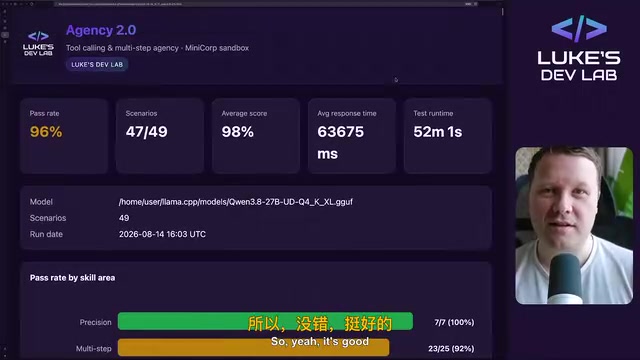
In the tool calling (agency) test, the model completed simple tool calls in a simulated corporate sandbox environment, achieving a 47/49 (96%) pass rate — roughly on par with the previous 3.6 version and a reliable standard for models in this size class.
HumanEval Coding Benchmark: 85% Pass Rate and 99% Response Rate
OpenAI HumanEval is a code generation benchmark released by OpenAI in 2021, containing 164 hand-written Python programming problems. Each problem provides a function signature, docstring, and several unit test cases. The model must generate a complete function implementation based on the signature and description, then pass all unit tests to count as a success. HumanEval uses the pass@k metric for evaluation, where pass@1 (passing on the first generation) is the strictest measure.
The model achieved an 85% pass rate across the 164 problems. On the surface this might not seem stunning, but it needs to be understood in the context of model scale — GPT-4 scores approximately 87% on this benchmark, and Qwen3 27B, as a model that can run locally on consumer hardware, reaches a comparable level. The real highlight is the 99% response rate — only 1 out of 164 problems failed to produce an answer. This is a critical signal: the model doesn't fall into overthinking loops and can reliably produce results. In practical use, response rate is often more important than pass rate itself — a model that always gives an answer is far more trustworthy than a high-scoring model that frequently gets stuck.
Real-World Code Generation: Stunning Results Worth the Wait
What truly amazed the tester was the practical coding tasks. All code tasks were run under 128K context with officially recommended parameters.
Kanban Board App: One-Shot Excellence
The Kanban app test consumed nearly 87% of the context. The model was "extremely thorough," but at no point did it enter a thinking death spiral. The final deliverable was stunning:
- Beautiful UI with smooth interactions
- Card dragging, column sorting, and status toggling all working correctly
- Filtering, assignee selection, and search functionality
- Complete card/column archiving, restoration, and deletion
- Clear position preview animations during drag operations
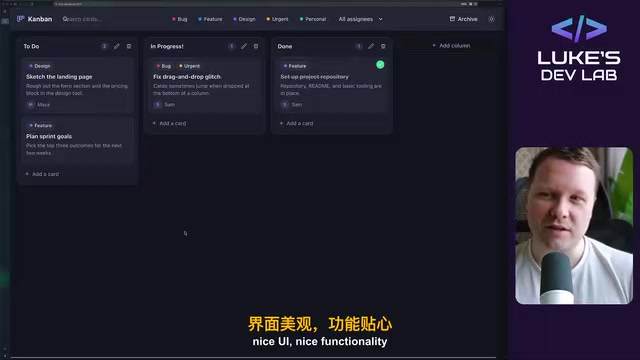
While the new card creation interaction had minor imperfections, the overall result was a bug-free one-shot output. The tester's verdict: "It took a long time and burned a lot of tokens, but the result is superb."
Sandbox Physics Simulation: Self-Built Test Scripts for Quality Verification
This was the most impressive segment of the entire evaluation. The model not only completed the task but proactively wrote its own test scripts, performed 26 assertion checks, and iteratively verified until achieving 10/10 all green. This is precisely why it consumed so many tokens — it was rigorously self-checking.
The deliverables included: material textures, visual circles for mouse brush size, keyboard shortcuts for switching materials, acid corrosion with glow effects, pause/resume functionality... The tester stated plainly: "This is the best result I've ever seen on this test — it's perfect. If I put it alongside other results, I'd assume a frontier model did this."
Dungeon Generation Algorithm: Unexpectedly Efficient Complete Implementation
The dungeon crawler test surprisingly used only 42.5% of the context. The model again built its own test scripts and delivered a complete integration of multiple classic algorithms in one shot: BSP (Binary Space Partitioning) for procedurally generating reasonable room layouts — recursively dividing rectangular space into subspaces, placing rooms within each, then connecting them with corridors; Bresenham line-of-sight algorithm for calculating whether a player can "see" a grid position on a pixel grid, implementing fog of war effects. Additionally, it included previously unseen details like a 60×60 grid, player glow effects, and an "explored percentage" display. The model's ability to correctly implement these classic algorithms and integrate them into a complete dungeon exploration system demonstrates deep understanding of algorithmic principles and game development patterns.
MCP Tool Chain Testing: Blender and Godot Integration
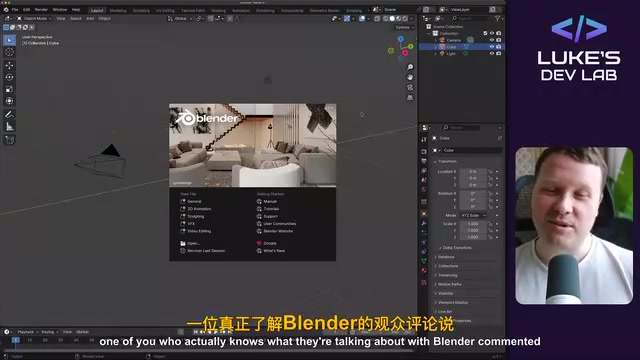
MCP (Model Context Protocol) is an open standard protocol proposed by Anthropic in late 2024, designed to provide LLMs with a unified interface for interacting with external tools and data sources. In the MCP architecture, the model acts as a "client" communicating with various "servers" (tool providers) through a standardized JSON-RPC protocol, with each server exposing specific tool capabilities. In this test, Blender and Godot each ran as MCP servers, allowing the model to directly call Blender's modeling API to create 3D assets or manipulate the Godot engine for game logic development. The significance of this architecture is extending the model from "pure text generation" to "actually controlling software" — a crucial manifestation of AI Agent capabilities.
Blender Asset Generation: Best Performance Among All Models
Considering the model's training data recency, the tester deliberately downgraded Blender to version 4.1. The task was to generate a simple marble and a complex finish gate.
The model used 96.4% of the context (nearly triggering compression), but the result was "the best performance of any model on this test to date." It even automatically took screenshots of the scene from multiple angles and exported a complete blend file — behaviors never seen before. The model needed to not only understand Blender's API semantics but also plan calling sequences and handle return results, representing an extremely demanding test of reasoning and tool-use capabilities.
Godot Game Development: The Only Section Requiring Human Intervention

The Godot game engine was the only test that exposed the model's limitations. The model incorrectly believed "the player cannot jump," and even after the tester manually verified and informed it that jumping worked fine, it stubbornly maintained its position. Only after two interventions from the tester did the model finally fix the issue.
Despite the rocky process (context filled and compressed, then used to 79%), the final result was still impressive: movement, sprinting, collision detection, collecting all 5 orbs, reaching the endpoint and triggering an end state — things no other model has managed to accomplish in this test in a single run.
Conclusion: A New Capability Benchmark for Local Coding Models
Overall, Qwen3 27B exhibits a distinct behavioral pattern: It's slow, it burns tokens, but its results are the best.
It tends to build its own test scripts and repeatedly verify its output — this is both the root cause of its heavy token consumption and the guarantee of its high-quality output. The tester's conclusion was unequivocal: "As a local coding model, this is without question the best I've ever tested. As long as speed and performance aren't issues for you, I 100% recommend using it."
He also revealed his planned follow-up comparison: this model's coding ability exceeds Meta's Muse Glimmer, but with higher token consumption — if you're constrained by token budgets, Muse Glimmer still has its value.
For developers with 16GB of VRAM who prioritize local private deployment and don't mind waiting, the Qwen3 27B dense model has undoubtedly established a new capability benchmark.
Related articles

Amphibious Transforming Drone: Beyond 100x Power Savings, What Are the Real Needs?
Is the amphibious transforming drone just a gimmick? Starting from the 100x power difference of the M4 Morphobot, explore real application scenarios and thesis topic ideas, analyzing boundary conditions where pure drones and pure ground robots both fail.

Warhound Raises $200 Million: Genetically Engineered "War Dogs" Paired with Anduril Gear
Warhound raises $200M, backed by Ben Lamm and Palmer Luckey, to genetically engineer dogs for military and law enforcement use and equip them with Anduril gear. This article analyzes its technology direction, funding logic, and ethical controversy.

Claude API Comes to Google Cloud: IAM Integration and SDK Access Guide
Anthropic hosts the full Claude API on Google Cloud with IAM-controlled permissions and unified billing. This guide covers the Vertex AI and Anthropic-hosted entry points, IAM role configuration, and SDK access.