Qwen3 27B Open-Sourced: A Multimodal Agent Model That Runs on a Single GPU
Qwen3 27B: an open-source multimodal agent model with GUI control that runs on a single consumer GPU.
Alibaba has open-sourced Qwen3 27B, a 27-billion-parameter dense multimodal model supporting text, image, and video understanding with a 262K-token context window. Its hybrid linear-full attention architecture enables local deployment on a single consumer GPU (~17GB VRAM with 4-bit quantization). The model excels at coding benchmarks (SWE-bench Pro 61.7) and GUI operations (OSWorld 84.3), released under Apache 2.0 for free commercial use.
On the evening of August 14, the Alibaba Tongyi Qianwen team officially open-sourced the 27B dense multimodal model from the Qwen3 series. It's not the largest flagship by parameter count, but it packs native multimodality, a 262K-token context window, controllable reasoning, and computer-use capabilities — all into a dense model that can run locally with just ~17GB of VRAM after quantization.
More importantly, it's released under the Apache 2.0 license and is available on both Hugging Face and ModelScope. Any developer can freely download, deploy, and even use it commercially. For engineers focused on open-source agents and local deployment, this is an update worth trying immediately.
What Is Qwen3 27B: A Dense Native Multimodal Model
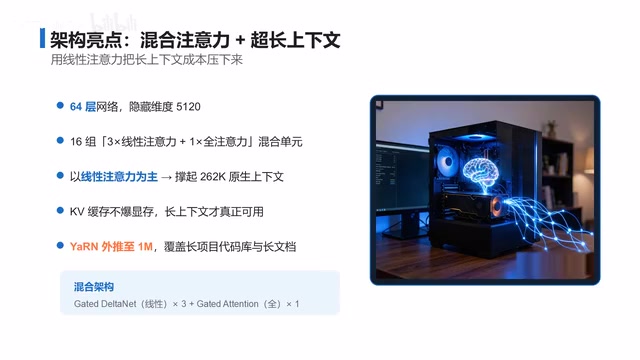
This is a dense native multimodal model with 27 billion parameters. It natively supports text, image, and video understanding — rather than having a vision module bolted on after the fact. Architecturally, it uses a 64-layer network with a hidden dimension of 5120 and employs a hybrid architecture combining Gated DeltaNet and gated attention — composed of 16 groups, each consisting of 3 layers of linear attention plus 1 layer of full attention.
Dense Models vs. Mixture-of-Experts Models
To understand Qwen3 27B's positioning, it helps to clarify the difference between dense models and Mixture-of-Experts (MoE) models. A dense model activates all parameters during inference — every input token passes through all 27 billion parameters. An MoE model may have total parameters in the tens or hundreds of billions, but only activates a subset of "expert" subnetworks for each inference step, making the actual computation far less than the total parameter count. MoE's advantage is achieving near-super-large model performance with fewer compute resources, but it comes with higher engineering complexity, VRAM usage that still scales with total parameter count (all expert weights must be loaded into memory), and additional tuning costs for load balancing and routing strategies. Qwen3 27B's choice of a dense architecture means its parameter count equals its actual compute load. Deployment logic is simpler, and quantization benefits are more straightforward — 4-bit quantizing the 27B parameters yields a ~16GB weight file, without the VRAM waste that MoE models face from having "large total parameters but small active parameters."
It's precisely this hybrid design — predominantly using linear attention — that enables the model to natively support a 262K-token context at the 27B scale, with the ability to extrapolate to 1 million tokens via YaRN, all without the KV cache consuming all available VRAM.
Its positioning is clear: rather than competing against the largest MoE flagships, it takes proven agent and multimodal capabilities and packages them into a version that can actually run on consumer-grade hardware.
Hardware Requirements: Runs on a Single High-End GPU
Qwen3 27B's FP8 version uses fine-grained quantization with a block size of 128, delivering virtually lossless performance. The 4-bit version weighs in at only ~16.1GB.
Background on Quantization: Model quantization compresses neural network weights from high-precision floating-point numbers (e.g., BF16 at 16 bits per parameter) to lower-precision representations. FP8 (8-bit floating-point) quantization compresses each parameter from 16 bits to 8 bits, theoretically halving model size. Because the FP8 format retains exponent bits, it offers better dynamic range than integer quantization at the same bit width, resulting in minimal performance loss. Qwen3 27B's FP8 version uses a "block size of 128" fine-grained strategy, where every 128 parameters share a set of quantization scaling factors — adapting more precisely to the numerical distribution of different parameter regions compared to global uniform quantization. 4-bit quantization is even more aggressive, representing each parameter with just 4 bits. Mainstream algorithms like GPTQ and AWQ minimize error on calibration datasets to select optimal quantization parameters, maintaining quite usable output quality even at extreme compression ratios.
This means:
- 4-bit quantized version: Can run on a 32GB MacBook Pro / Mac Studio, or a consumer GPU with ~17GB of VRAM;
- BF16 full version: ~55.6GB, requiring more powerful hardware.
In other words, a single high-end gaming GPU or a Mac laptop with ample memory can run this native multimodal model in full. For teams and individual developers who want private deployment without stacking servers, this VRAM threshold is extremely accessible.
Hybrid Attention Architecture: The Key to Long Context
Traditional full-attention models see explosive VRAM growth as context length increases. Qwen3 27B uses a structure of 16 groups of 3-layer linear attention plus 1-layer full attention, delegating most sequence modeling to linear attention while preserving full attention only at critical positions. This enables native 262K-token context support at the 27B scale.
Technical Principles of Gated DeltaNet and Linear Attention
Standard Transformer full attention mechanisms compute attention scores for every pair of tokens in the sequence, with time and space complexity of O(n²), where n is the sequence length. When context reaches 262K tokens, the VRAM overhead from KV cache and attention matrices becomes unacceptable. Linear attention reduces complexity to O(n) through kernel function approximation or state-space methods, dramatically lowering computation and VRAM costs for long sequences — at the cost of somewhat diminished ability to capture long-range dependencies.
DeltaNet is a recently proposed efficient sequence modeling method that uses delta update rules to maintain a compressed hidden state. It can be thought of as a linear recurrent network with forget and update gating. Adding gating mechanisms (i.e., Gated DeltaNet) allows the model to more flexibly control information retention and discarding. Qwen3 27B alternately stacks 16 layers of this efficient linear attention with 1 layer of full attention, enabling the model to efficiently process long sequences at linear complexity in most layers while performing precise global information integration through full attention layers at key positions — balancing efficiency and expressiveness.
YaRN Extrapolation: From 262K to 1 Million Tokens
Qwen3 27B uses YaRN (Yet another RoPE extensioN method) to extrapolate the context window from the native 262K tokens to 1 million tokens. Modern Transformer models widely use Rotary Position Embedding (RoPE) for position awareness, but RoPE typically suffers severe performance degradation beyond the maximum sequence length seen during training. YaRN groups and scales RoPE's frequency components — keeping high-frequency components unchanged to preserve local positional precision, while interpolating low-frequency components to accommodate longer context — and introduces a temperature scaling factor to adjust attention distribution. This allows the model to significantly extend its context window without requiring full long-sequence fine-tuning, making it possible to process ultra-long documents, entire code repositories, or long videos.
More practically, its reasoning is controllable. Thinking mode is enabled by default, and you can dynamically adjust depth between "very high, medium, and low" using a reasoning intensity parameter. Multi-turn agent tasks can also retain historical thinking context. This dual restraint on VRAM and inference cost is exactly what makes it feasible to run long document and long codebase tasks locally.
Coding and Agent Capabilities: Significant Leads on SWE-bench Pro
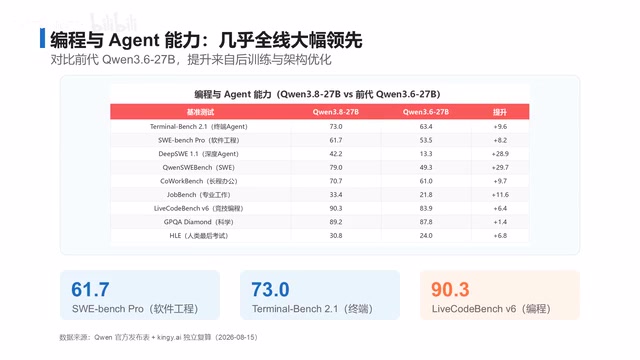
Compared to the previous-generation Qwen3 26B, this version shows substantial across-the-board improvements on coding and office agent benchmarks. Three numbers stand out:
- SWE-bench Pro: 61.7
- Terminal-Bench 2.1: 73.0
- LiveCodeBench V6: 90.3
What the SWE-bench Series Benchmarks Mean
SWE-bench is a benchmark suite developed by Princeton University for evaluating LLMs' software engineering capabilities. It extracts issues and corresponding pull requests from real GitHub open-source projects, requiring models to autonomously locate code problems and generate correct patches given an issue description. SWE-bench Pro is its advanced version, featuring more complex cross-file modifications and stricter test validation. Unlike traditional coding evaluations (like HumanEval's single-function writing), SWE-bench requires models to understand entire repository structures, dependencies, and context — much closer to real software development work.
These benchmarks don't measure multiple-choice accuracy — they test actually modifying open-source project code, actually working in the terminal, and actually writing programs on unseen problems. You might have missed the long-horizon autonomous coding metric DeepSWE, which jumped from 13.3 to 42.2, significantly closing the generational gap. DeepSWE evaluates a model's ability to autonomously plan, execute, and debug in multi-turn interactions over long development chains — this dramatic improvement indicates a qualitative leap in Qwen3 27B's code comprehension and modification capabilities in real engineering scenarios.
More importantly, on several coding and computer-use benchmarks, this 27B version has caught up with or even surpassed larger Qwen flagship versions, as well as some publicly reported numbers from closed-source models.
Native Multimodal Capabilities: Driving Desktop and Mobile GUI Operations
Native multimodality is another ace up this model's sleeve. With an integrated vision encoder forming a unified model, it can directly process images, documents, and even long videos.
Performance on computer-use benchmarks:
- OSWorld Verified: 84.3 (desktop operations)
- WebArena Verified: 64.8 (browser use)
- AndroidWorld: 81.9 (mobile operations)
What GUI Operation Benchmarks Mean Technically
These three benchmarks correspond to GUI operation evaluations in desktop OS, browser, and Android phone environments respectively. Their difficulty far exceeds traditional visual question-answering tasks. OSWorld, developed by teams including Tsinghua University, simulates real desktop environments in virtual machines, requiring models to observe screenshots, move the mouse, click buttons, and type text to complete multi-step tasks (such as opening file managers and modifying system settings). WebArena tests browser operation capabilities in real web applications (such as shopping sites, forums, and code hosting platforms). AndroidWorld evaluates the ability to operate mobile apps in an Android emulator. The common characteristic of these three benchmarks is that models need comprehensive capabilities spanning visual understanding, spatial localization, action planning, and multi-step execution.
This means a 27B open-weight model can already drive desktop and mobile graphical interfaces on ordinary hardware — clicking buttons, filling forms, executing workflows — which is precisely the capability countless local agent developers have been waiting for.
Why 27B and Not Larger
The answer is pragmatic. For the vast majority of teams that need private deployment and care about cost and data, whether a model can actually run on their own machines matters more than absolute benchmark scores.
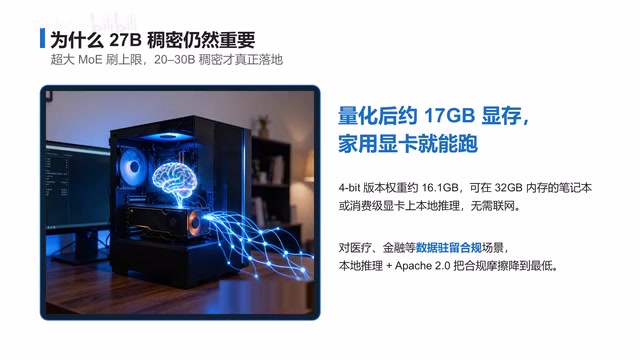
Qwen3 27B brings proven agent and multimodal capabilities down to a size that a single consumer GPU can handle, paired with the Apache 2.0 license — commercial use, redistribution, and product integration all require no additional authorization. Compliance friction is minimal, and data never needs to leave the internal network.
The Deeper Significance of the Apache 2.0 License
Apache License 2.0 is one of the most permissive mainstream open-source licenses, created by the Apache Software Foundation. Under this license, users can freely use, modify, distribute, and commercialize the software — even integrating it into closed-source products. The only core requirements are retaining the original copyright notice and license text, and noting changes in modified files. Unlike GPL-family licenses, Apache 2.0 has no "copyleft" clause — you don't need to open-source derivative products that use Apache 2.0 code. Compared to custom "community licenses" or "research-only restriction agreements" used by some models, Apache 2.0 offers clear advantages in legal certainty and commercial friendliness, and enterprise legal teams typically have mature compliance review experience with it. This means small teams and individual developers can directly embed Qwen3 27B in commercial products, offer API services, or even fine-tune and redistribute its weights without signing additional commercial licensing agreements with Alibaba.
This is especially critical for industries like healthcare and finance that have data residency compliance requirements. It's not trying to fully replace the strongest closed-source models — it's giving small and medium teams a realistic option that's truly good enough, runnable, and commercially viable.
Two Typical Application Scenarios
First: Local code agents and terminal automation. The model can directly read documents and charts on screen, automatically click buttons in graphical interfaces, execute commands in the terminal, and complete long-horizon cross-application tasks. Terminal-Bench 2.1 scores 73.0 in real testing, making it suitable for automated repair in private codebases and local office automation.
Second: Private deployment on consumer hardware. After quantization, inference runs on a single high-end GPU or a 32GB laptop — no internet connection needed, data stays on the internal network. This suits industries with data residency compliance requirements, and also lets individual developers test-drive at low cost.
Local Deployment Tutorial: Get Started in 5 Minutes
Deploying with vLLM
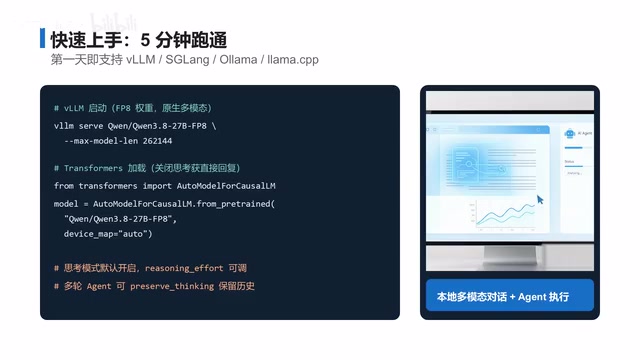
Spin up a service with vLLM — a single command can launch FP8 weights with native multimodality. Set tensor-parallel-size to 1, max context length to 262000, and allow up to 32 images and 8 video segments per prompt. vLLM is one of the most popular LLM inference frameworks, using PagedAttention technology for efficient KV cache memory management, supporting continuous batching for improved throughput, and providing OpenAI API-compatible formatting for seamless integration with existing applications.
Loading with Hugging Face Transformers
If loading with Hugging Face Transformers, a few lines of Python can bring up the model and processor — just set device_map to auto. Note that thinking mode is enabled by default and can be adjusted via the reasoning intensity parameter. Disabling thinking mode gives you direct responses. Multi-turn agent tasks can use the option to retain thinking context, balancing quality, speed, and cost.
Conclusion
Qwen3 27B represents a very pragmatic approach: rapidly bringing proven agent and multimodal capabilities from the flagship series down to a locally runnable size. For developers and small teams that need private deployment and care about cost and data, this "good enough and actually runnable" combination is often more valuable than benchmark scores alone.
Search for the corresponding model name on Hugging Face, or find the same model on ModelScope to download. (Note: Some model names and data in this article follow the original source; please refer to official announcements for the latest information.)
Related articles
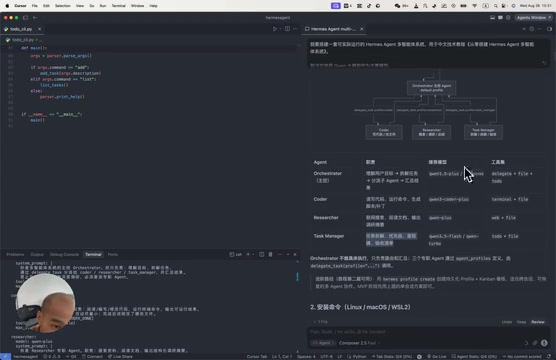
Hermes Multi-Agent System Setup Tutorial: Master Orchestrator + Sub-Agent Collaboration
Learn how to build a Hermes multi-agent system from scratch using Qwen models, with a master Orchestrator coordinating Coder, Researcher, and Task Manager agents through delegate task workflows.
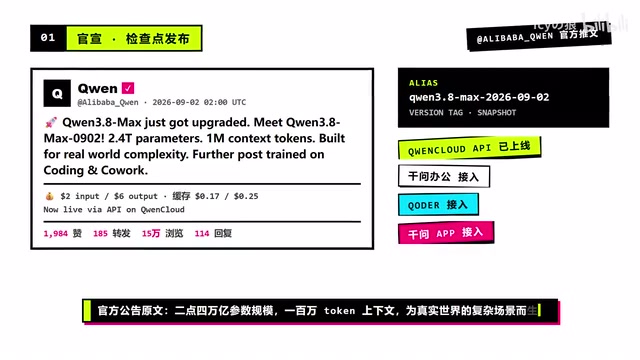
Qwen2.5-Max-0902 Released: Tops Coding Leaderboard with 1691 Points, Priced at Just $5
Alibaba Cloud's Qwen2.5-Max-0902 tops LiveCodeBench at 1691 points with a 22-point surge, surpassing GPT-4.5. Just $5 per million tokens with 1M context window.

Qwen3.8-Flash-Next Deep Dive: How a Static Embedding Table Architecture Takes on DeepSeek
Deep dive into Alibaba's Qwen3.8-Flash-Next: 181.5B params, 51B static embedding table, 6B active params, FP8/BF16 VRAM needs, and how it compares to DeepSeek V4 Flash.