Qwen3.8-27B Becomes the Most Popular Open-Source Model in History: A Dominant Lead Over DeepSeek-R1

Qwen3.8-27B sets a new record as the most popular open-source model, dominating over DeepSeek-R1.
Qwen3.8-27B has become the most-used open-source model in Unsloth's community history, far surpassing DeepSeek-R1 and Qwen3.6-35B-A3B. Its 27B parameter sweet spot allows local deployment on consumer GPUs after quantization. Combined with the GGUF format ecosystem and tools like llama.cpp and Ollama, it marks a new era where practicality and accessibility drive open-source LLM competition.
Open-Source LLMs Welcome a New King
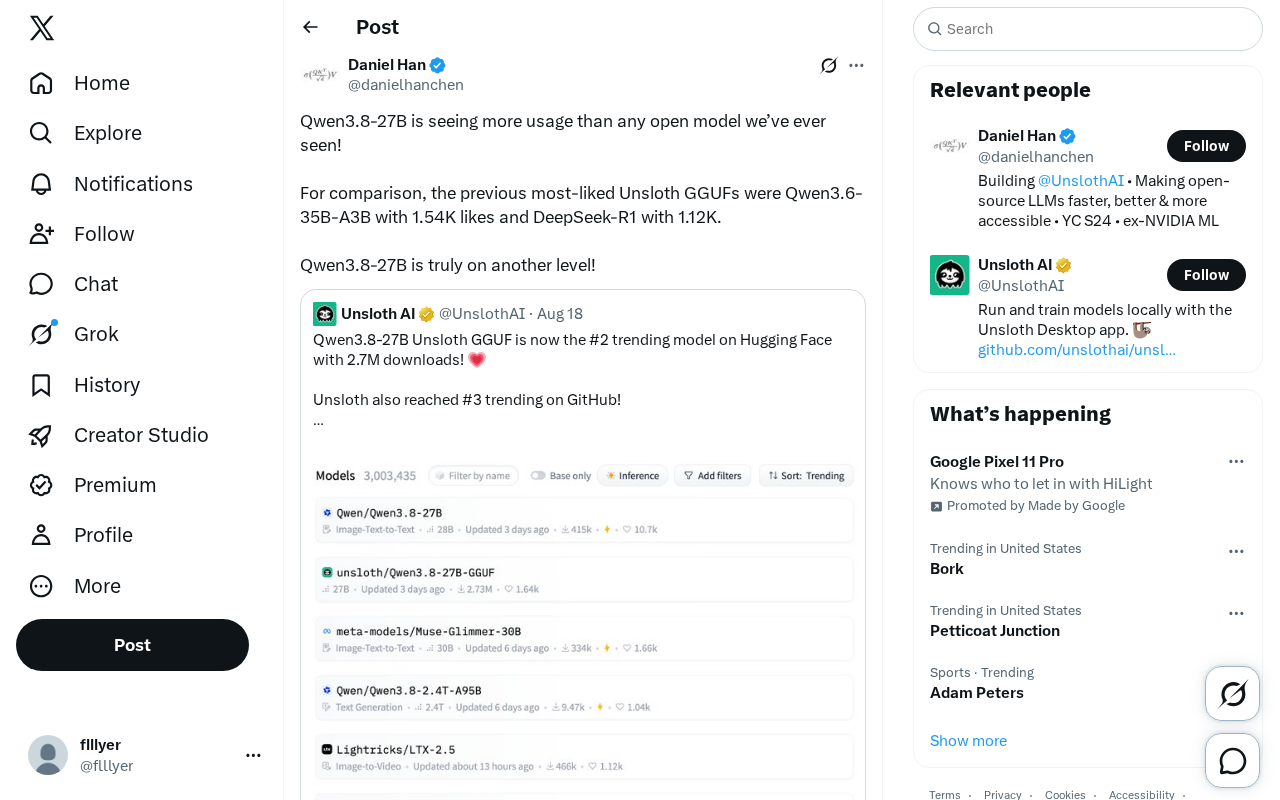
Recently, community discussions around Qwen3.8-27B have been heating up. According to observations shared by the Unsloth team on social media, Qwen3.8-27B is becoming the most-used open-source model they have ever seen, surpassing the popularity of any previous open-source model.
This conclusion is far from unfounded. As a well-known open-source tool team specializing in LLM quantization and fine-tuning acceleration, Unsloth has long provided GGUF quantized versions for mainstream open-source models. Their community data reflects, to a significant extent, developers' real preferences across different models. Unsloth's core technical contributions include boosting LoRA/QLoRA fine-tuning speed by 2–5x, reducing VRAM usage by 50–70%, and making it possible to fine-tune and deploy large models on consumer-grade hardware through low-level optimizations such as manual backpropagation kernel rewrites, intelligent memory management, and operator fusion. Their quantized models published on Hugging Face are widely adopted by the community for their consistent quality and standardized formats. When a model's quantized version receives massive downloads and likes, it typically means it's being actively deployed in production environments or local inference scenarios.
Data Comparison: Qwen3.8-27B Leads by a Wide Margin
According to the comparison data provided by Unsloth, the two previously most popular GGUF quantized models were:
- Qwen3.6-35B-A3B: 1.54K likes
- DeepSeekAd-R1: 1.12K likes
Both of these models were already star products in the open-source community. The "A3B" in Qwen3.6-35B-A3B indicates that the model uses a Mixture of Experts (MoE) architecture — with a total parameter count of 35B but only approximately 3B parameters activated during each inference pass. The MoE architecture sets up multiple expert networks with a routing mechanism, selectively activating only a subset of experts during each forward pass. This maintains the large model's capacity and knowledge while significantly reducing computational overhead. This design represents an important paradigm for balancing performance and efficiency in current large models.
DeepSeek-R1, as an open-source model with outstanding reasoning capabilities, once attracted global attention. However, Unsloth stated bluntly that Qwen3.8-27B's performance is "on another level," meaning its usage and attention have clearly pulled ahead of the previous record holders.
Why Is the 27B Parameter Size So Popular?
The 27B parameter count sits in a strategically significant sweet spot. Compared to flagship models with tens or even hundreds of billions of parameters, 27B-class models can run smoothly on consumer-grade or prosumer GPUs (such as a single GPU with 24GB of VRAM) after 4-bit or 5-bit quantization.
Here's a brief explanation of quantization: Quantization is the process of compressing model weights from high-precision floating-point numbers (such as 16-bit FP16 or 32-bit FP32) to low-precision integers (such as 4-bit INT4 or 8-bit INT8). For a 27B parameter model, FP16 precision requires approximately 54GB of VRAM, while 4-bit quantization reduces this to roughly 14–16GB. Modern quantization algorithms (such as GPTQ, AWQ, and the various k-quant schemes used by llama.cpp) employ strategies like group quantization and mixed precision, controlling accuracy loss to levels that are virtually imperceptible in practical use.
This enables a large number of individual developers, small and medium-sized businesses, and researchers to deploy models locally without relying on expensive cloud computing or API calls. This "good enough and affordable" positioning is key to the rapid adoption of open-source models. It retains sufficient capability for complex tasks while lowering the deployment barrier to a range accessible to ordinary developers.
GGUF Format: The De Facto Standard for Local Deployment
The explosive popularity of Qwen3.8-27B is inseparable from the widespread adoption of the GGUF format. GGUF (GPT-Generated Unified Format) is a model file format developed by Georgi Gerganov, the creator of the llama.cpp project. Designed specifically for CPU and hybrid CPU/GPU inference scenarios, it is an upgraded version of the earlier GGML format. GGUF supports more flexible metadata storage and backward compatibility, with its core advantage being support for multiple quantization precisions from 2-bit to 8-bit. This allows users to make optimal trade-offs between inference speed, memory usage, and model accuracy based on their hardware. The format has become the de facto standard for local LLM deployment, with virtually all mainstream open-source models releasing GGUF versions as a top priority.
The Continuous Evolution of the Qwen Series
The data also reveals a clear trend: in previous records, Qwen3.6-35B-A3B was already ahead of DeepSeek-R1, and now Qwen3.8-27B has pushed the record even further. This indicates that Alibaba's Qwen (Tongyi Qianwen) series is steadily growing its influence in the open-source community.
The Qwen series has been continuously iterating on model capabilities, multilingual support, code generation, and reasoning abilities in recent years. Combined with its relatively permissive open-source licensing, it has gradually become one of the go-to foundation models for developers building local AI applications. Whether for fine-tuning, RAG (Retrieval-Augmented Generation), or building local intelligent assistants, Qwen offers a complete range of parameter sizes from small to large.
It's worth noting that RAG (Retrieval-Augmented Generation) is one of the most mainstream deployment paradigms in enterprise AI applications today. Its workflow involves first using vector retrieval to find relevant document fragments from an external knowledge base based on the user's query, then feeding these fragments as context along with the original question into the LLM to generate an answer. RAG effectively addresses pain points such as the model's knowledge cutoff date, hallucination issues, and the inability to directly train on private data. A model like Qwen3.8-27B — capable and locally deployable — is an ideal choice for building local RAG systems.
Quantization Tools and the Open-Source Ecosystem as Catalysts
Interestingly, a model's popularity depends heavily on ecosystem tools like Unsloth. By optimizing quantization workflows and inference speed, Unsloth makes otherwise unwieldy large models accessible to everyone. The widespread adoption of the GGUF format, combined with inference frameworks like llama.cpp and Ollama, forms a complete and mature toolchain for local LLM deployment.
Specifically, llama.cpp is a pure C/C++ LLM inference engine that can run large models without a GPU while also supporting GPU acceleration. Through extreme engineering optimizations — including SIMD instruction set utilization, memory mapping, and quantization kernel optimization — it achieves efficient inference on ordinary consumer hardware. Ollama, built on top of llama.cpp, is a higher-level application framework that provides a Docker-like model management experience. Users can download, run, and manage various open-source LLMs with a single command (e.g., ollama run qwen3.8:27b), dramatically lowering the technical barrier to local deployment. Together, they form the infrastructure layer of the local AI inference ecosystem.
It's fair to say that Qwen3.8-27B's success is not just a testament to the model's own capabilities — it's also the result of the entire open-source ecosystem developing in concert. Excellent foundation models paired with efficient quantization tools are what truly bring AI to every developer's workstation.
Conclusion: Open-Source LLM Competition Enters a New Phase
Qwen3.8-27B breaking the open-source model usage record sends two important signals: first, medium-sized, locally deployable open-source models are becoming the community mainstream; second, the Qwen series has established considerable brand appeal. For developers following open-source AI, this may be an important inflection point worth considering in their technology selection.
Of course, Unsloth's data primarily comes from its own community and represents a single-channel observation. Absolute usage figures still need to be assessed by combining data from multiple platforms. Nevertheless, this phenomenon clearly demonstrates that the competition among open-source LLMs is entering a new phase dominated by "practicality" and "accessibility." In this phase, what determines success is no longer just benchmark scores — it's whether a model can create value for real users on ordinary hardware at a reasonable cost.
Related articles

Cursor Can Now Control Your Computer: AI Agents Can Drive Desktop Apps for Testing
Cursor adds desktop control: AI agents can drive desktop apps like the iOS Simulator to test their own features. We analyze the impact on dev workflows, possible technical approaches, and reliability concerns.

Vibecoding a Custom Inference Engine: High Hopes, Harsh Reality
A Reddit developer shares the real experience of vibecoding a custom inference engine: running GGUF Q4 models in the browser with WebGL2 and GLSL, only to fall into tokenizer debugging hell. This article analyzes the engineering challenges of browser-side LLM inference and why cloning llama.cpp is the more rational choice.

How High Are Anthropic's Early Investor Paper Returns Ahead of IPO?
Anthropic's early investor paper returns draw attention ahead of IPO. This article analyzes sources of book gains, capital structure, pre-IPO games and risks, and implications for the AI startup ecosystem.