Qwen3.8 27B Local Benchmark: Flagship-Level Performance — But Configuration Is Everything
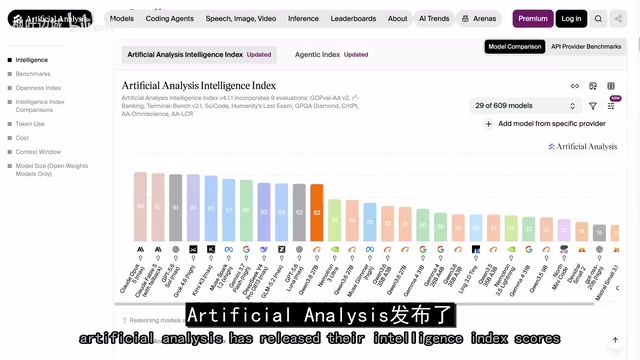
Qwen3.8 27B is the strongest locally-runnable open model — if you configure it right.
Qwen3.8 27B scores 52 on Artificial Analysis's intelligence index, rivaling GLM 5.2 and DeepSeek V4 Pro, making it a genuine open-source benchmark for consumer and prosumer hardware. But actual performance hinges on three variables: version choice (BFloat16, FP8, or NVFP4 — obliterated versions not recommended due to decoding loops), thinking budget setting (medium is the sweet spot; X-high burns tens of thousands of tokens), and inference framework (SGLang with official NVFP4 weights and D-Spark decoding reaches ~200 tokens/sec vs vLLM's 120). Get these three right, and it's the model to beat in local AI.
Last week, Qwen released the weights for Qwen3.8 Max — a 2.4-trillion-parameter behemoth with impressive capabilities that the vast majority of people simply cannot run locally. What the community had been eagerly waiting for was Friday's release of Qwen3.8 27B: an open-source model that can actually run on consumer and prosumer hardware. After hands-on testing, one overseas blogger delivered a blunt verdict: if you can serve it properly, this is the benchmark local AI model right now.
This article is based on that blogger's full evaluation. The focus isn't on listing benchmark scores, but on answering two more practical questions: which version of the model should you choose, and how should you configure it to actually run well.
Benchmark Results: A Small Model With Flagship-Level Scores
Looking at Qwen's official benchmarks, 3.8 27B delivers meaningful improvements over the previously popular 3.6 27B across nearly every dimension — it's a painless drop-in upgrade. Even more noteworthy is vision performance: on tasks like computer use and browser operation, it actually surpasses Opus 4.6 Max (to be fair, earlier Opus models weren't as optimized for these scenarios as newer versions).
The blogger also noted that when Meta rushed out Muse Glimmer 30B, many examples used 3.6 27B as the comparison baseline. He suspected at the time that Meta was trying to get ahead of the 3.8 27B release, and that has largely proven true — 3.8 27B clearly outscores Muse Glimmer on benchmarks. That said, he cautions that Muse Glimmer was trained with better generalization coverage, so benchmark scores alone don't tell the whole story; it's still worth testing against your specific use cases.
The real surprise came from third-party evaluations. Artificial Analysis's intelligence index gave this 27B model a score of 52, putting it right behind GLM 5.2 (53) and DeepSeek V4 Pro, leaving 3.6 27B and virtually every other locally runnable open-source model far behind. On the agentic index, it even beats GLM 5.2 and some GPT 5.6 models. For a model that can run at meaningful speeds locally, these numbers are remarkable.
The Version Maze: Quantization, Fine-Tunes, and Uncensoring
On Hugging Face, the 27B has already spawned a long list of variants. Officially, Qwen provides a BFloat16 full-precision version and an FP8 version. Unsloth has released a 4-bit version using NVFP4 quantization — note that not all GPUs support this quantization format.
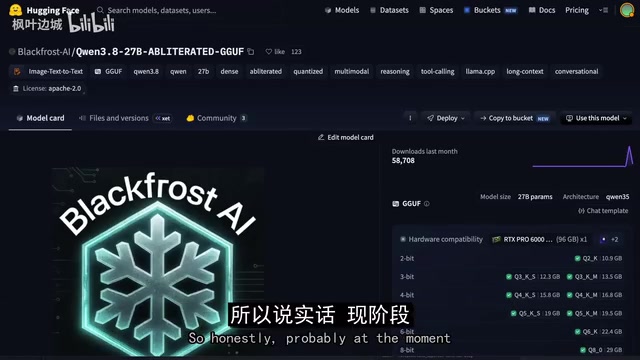
Beyond that, there are numerous community fine-tunes: some trained on different datasets to unlock new capabilities, others focused on removing censorship. The uncensoring approaches split into two camps — one through fine-tuning, the other through obliteration. The Black Frost AI team was among the first to attempt obliteration, and multiple obliterated versions have since appeared.
For Mac users, the MLX community has already released multiple versions covering BFloat16, 8-bit, 4-bit, and various quantization schemes as MLX ports.
After testing, the blogger expressed reservations about obliterated versions: while interesting and genuinely more permissive, they tend to fall into repetitive decoding loops during the thinking phase, getting stuck in cycles they can't escape. For now, he doesn't recommend using obliterated versions.

A note on the technical concepts: Quantization compresses model weights from high-precision floating point to lower-precision representations, with the primary goals of reducing VRAM usage and computational overhead. BFloat16 is a 16-bit brain floating-point format that preserves float32's dynamic range while halving storage. FP8 compresses further to 8 bits, with hardware acceleration support on Hopper and Blackwell architecture GPUs. NVFP4 is NVIDIA's proprietary 4-bit quantization format, with native instruction support only on specific GPUs like Blackwell (RTX 50 series, H100 successors) — which is why the blogger specifically warns that "not all GPUs can run this quantization."
Obliteration and fine-tune-based uncensoring work through fundamentally different mechanisms: fine-tune uncensoring continues training on new datasets to steer the model away from safety refusals; obliteration directly locates and "erases" direction vectors associated with refusal behavior in weight space, requiring no additional training. Obliteration is aggressive and irreversible, and can disrupt the model's internal attention consistency — which is the root cause of obliterated versions falling into repetitive decoding loops during the thinking phase.
The Make-or-Break Factor: Reasoning Budget Configuration
This is the most important insight from the entire evaluation — how well the model performs depends far less on quantization than on how you configure the reasoning (thinking) budget.
The blogger ran different budget settings through a classic HTML webpage generation test and Simon Willison's "draw a pelican in SVG" test:
- No thinking: Goes straight to generation. Results are actually quite good — sometimes even more appealing than outputs with thinking enabled.
- Low thinking: Approximately 512 thinking tokens. Good results, but starts losing some detail.
- Medium thinking: Interestingly, on some tasks it consumes fewer tokens than low, with comparable results.
- X-high thinking: The model "goes crazy." With max output capped at 32k tokens, thinking alone burned through 17,500 and even up to 22,000 tokens, frequently hitting the limit before the webpage could finish generating.
In the pelican SVG test, X-high consumed 11,000 tokens just thinking, while medium produced a reasonably good pelican with fewer than 1,000 tokens. He switched to "a red dragon riding a bicycle" to check for overfitting: with no thinking, the bicycle was drawn correctly but the dragon looked childish; medium actually regressed somewhat on the dragon; X-high used 35,000 tokens (21,000 of which were thinking) to produce a barely passable dragon.
His conclusion: medium is the sweet spot. X-high does yield better results, but the token consumption is absurdly high — you'd need both an enormous context window and the patience to wait it out.
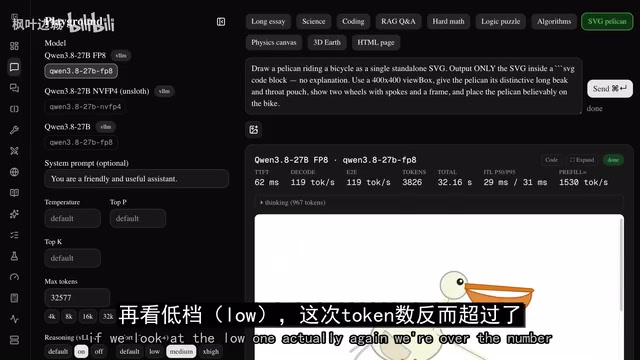
A note on thinking budget mechanics: The Qwen3 series introduces a controllable "hybrid thinking" mechanism: users can specify a thinking budget via system prompt or API parameter, measured in tokens, to constrain how much "inner monologue" the model produces before generating its final output. This is similar to approaches used in OpenAI's o-series or DeepSeek R1, but Qwen3 exposes the budget levels more explicitly — from no thinking (0 tokens), low (~512 tokens), medium, all the way to X-high, forming a continuous capability-cost tradeoff curve. Thinking tokens consume context window space and directly determine inference latency. When thinking tokens fill the context window, the model doesn't have enough space left to output its final answer — which is exactly why X-high mode burns tens of thousands of tokens on thinking and runs out of space before generation completes. Choosing the right thinking budget is fundamentally about finding the balance between "depth of reasoning" and "practical usability."
Version and Inference Engine Benchmarks: Speed Comparison
The blogger's test platform was a Dell Pro Max (sponsored compute), centered on an NVIDIA RTX Pro 6000 with 96GB of VRAM — loading the full-precision model was no problem at all, though this is clearly a luxury most people don't have access to. Running the full 16-bit BFloat16 version simply isn't an option for most.
He tested five versions, primarily using vLLM:
- BFloat16 original: ~30 tokens/sec (without speculative decoding). Enabling speculative decoding with MTP=3 (multi-token prediction) delivered a noticeable speedup.
- Official FP8 version: With built-in MTP speculative decoding, approximately 120 tokens/sec, with virtually no quality difference compared to the 16-bit version. vLLM can handle this configuration automatically.
- Obliterated version: Prone to repetitive thinking loops. Not currently recommended.
- Unsloth version: Very good quantization quality; similarly reaches ~120 tokens/sec with MTP.
The real winner came last — SGLang. With deep optimizations for Blackwell GPUs, the blogger used official NVFP4 weights with D-Spark speculative decoding inside a Docker container with all extraneous workloads stripped out, achieving an average of approximately 173 tokens/sec, with short tasks approaching 200 tokens/sec — all while running a full 262k context window smoothly. SGLang's official X account claims a peak of 206 tokens/sec. He also noted that using SGLang with Unsloth quantization performs worse than using official weights.
A note on speculative decoding: Speculative Decoding accelerates autoregressive generation through a two-phase "draft-and-verify" process: a lightweight draft model rapidly predicts several candidate tokens, which are then verified in parallel by the main model. Accepted tokens are committed all at once, reducing the number of sequential calls to the main model. MTP (Multi-Token Prediction) mentioned in the article is a built-in speculative decoding variant in Qwen3 that uses the model's own multi-head output to simultaneously predict multiple future positions — no separate draft model required. D-Spark is SGLang's deeply fused speculative decoding optimization targeting Blackwell GPUs, combining NVFP4 quantization with CUDA kernel fusion to achieve the ~173–200 tokens/sec throughput — an exceptional figure for locally running a 27-billion-parameter model. Both vLLM and SGLang are mainstream open-source LLM inference frameworks: vLLM has a more mature ecosystem and broader compatibility, while SGLang pursues more aggressive peak-performance optimization on newer GPU architectures.
Practical Recommendations and What's Next
The blogger's recommended workflow is clear: first test different model versions against your specific use case, then dial in the reasoning token budget, and finally choose your inference framework. In his final configuration, SGLang won out — but if your GPU has limited VRAM, he recommends trying llama.cpp. He even suggests feeding these configuration docs directly to your coding agent and letting it find the optimal combination for you.
Looking ahead, he's watching for a few things: Will there be fine-tuned versions similar to ThinkingCap that achieve equivalent intelligence with fewer tokens? Will there be further fine-tunes that push intelligence even higher? Will fused kernel optimizations or similar efficiency improvements push serving speeds even further?
The conclusion is clear: Qwen3.8 27B represents a major step forward for both open-source weights and local AI, bringing near-flagship capabilities within reach of prosumer hardware. If you can serve it correctly, this is the model that everything else in local AI needs to beat.
Related articles

Letting AI Build AI Tools: A 7-Day, 31-Commit Bootstrapping Post-Mortem
An engineer ran a fully autonomous AI-builds-AI pipeline for 7 days, 31 commits, with a 1-in-6 success rate. This post-mortem covers 5 failure types, 11 structural rules, and how every mistake became a permanent immunity gate.
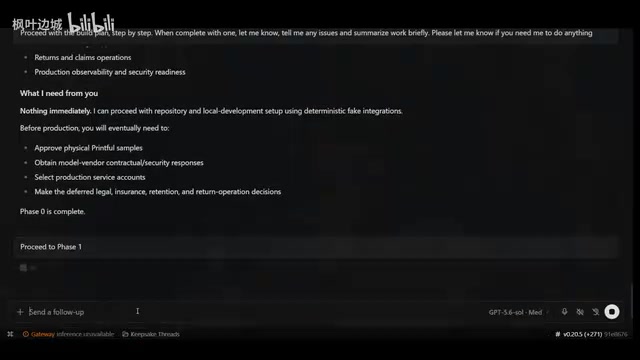
Building an AI-Powered E-Commerce Business from Scratch: A Real-World Account of Multi-Agent Architecture for Print-on-Demand
A blogger builds a print-on-demand e-commerce company from scratch using AI agents — documenting specialized Agent profiles, GPT-5.6 vs Claude Fable multi-model orchestration, and reusable skill accumulation.

AI Agent Earns $10K in One Week: 3 Key Upgrades Explained
A blogger shares how he earned $10K in a week with an AI Agent — not by adding more skills, but through verification, approval gates, and subagents to raise trust and enable true automation.