Qwen3.8-Flash-Next Coming Soon: Deep Dive into the 125B Parameter MoE Architecture
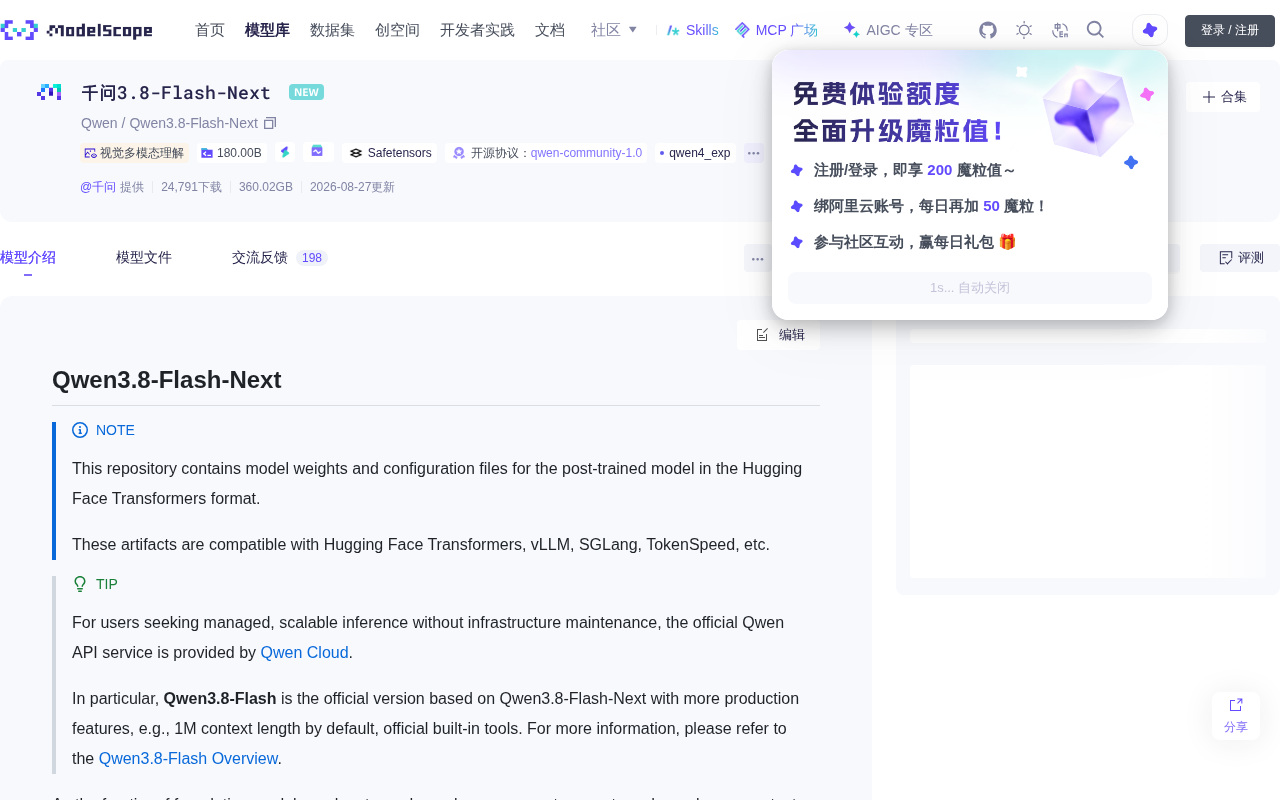
Qwen3.8-Flash-Next brings 125B parameter MoE architecture with only 6B activation for efficient inference
Alibaba's upcoming Qwen3.8-Flash-Next employs a 125B total parameter, 6B activated parameter MoE architecture—achieving large-model knowledge capacity at small-model inference costs. With an aggressive 4.8% activation ratio, it represents the cutting edge of efficiency-focused LLM design.
Alibaba Qwen Unveils New Version
According to the Hacker News community, Alibaba's Qwen team is preparing to release a new-generation model, Qwen3.8-Flash-Next, featuring a Mixture of Experts (MoE) architecture with 125B total parameters and 6B activated parameters (125B a6B). The announcement quickly garnered 71 upvotes and nearly 20 comments, reflecting the open-source LLM community's sustained interest in the Qwen series.
While the official technical whitepaper has not yet been released, the naming and parameter configuration already reveal the model's design philosophy—maintaining large-scale knowledge capacity while pursuing extreme inference efficiency. This represents a mainstream path in the evolution of open-source large language models.
Understanding the MoE Architecture Logic Behind "125B a6B"
Core Advantages of MoE Architecture
The "125B a6B" notation is key to understanding this model. It indicates that the model has a total of 125 billion parameters, but only activates approximately 6 billion parameters during each inference. This is the hallmark of Mixture of Experts (MoE) architecture.
In traditional dense models, every forward pass invokes all parameters—the larger the parameter count, the higher the computational cost. MoE architecture uses a routing mechanism that activates only a small subset of "expert" networks during the processing of each token. This means the model can maintain knowledge storage capacity at the 125B parameter level while incurring inference overhead equivalent to only a 6B-scale model.
From a technical implementation perspective, MoE architecture's core components include Expert Networks and a Gating Router. Expert networks are typically multiple feed-forward networks (FFNs) with identical structures but independent parameters. During training, each expert naturally learns to handle different types of input patterns—some experts may excel at processing math reasoning-related tokens, while others are better at language generation or knowledge recall. The gating router is a lightweight trainable network responsible for assigning the top-K experts with the highest weights for each input token. For example, in the 125B a6B configuration, the model might contain dozens of experts, but the router selects only a very small number (such as 2-4) to participate in computation during each inference.
This sparse activation concept traces back to Google's 2017 paper "Outrageously Large Neural Networks: The Sparsely-Gated Mixture-of-Experts Layer," but true large-scale deployment in large language models only became an industry trend in recent years following the release of Mixtral 8x7B. A core challenge of MoE is load balancing—if the router consistently favors a few experts, it leads to some experts being overloaded while others remain idle. Training typically introduces an auxiliary loss function to encourage even distribution. DeepSeek-V3 proposed a load balancing strategy without auxiliary loss, implementing balance through learnable bias terms for each expert, avoiding potential performance degradation from auxiliary loss.
Inference Cost Differences Between Dense and Sparse Models
To more intuitively understand MoE's cost advantages, it's important to know about two key stages of LLM inference: prefill and decode. The prefill stage processes the complete input prompt and is primarily compute-bound (FLOPS-limited); the decode stage generates output token by token and is primarily memory-bound (Memory Bandwidth-limited).
For dense models, 125B parameters means inference requires loading approximately 250GB of weights (at FP16 precision) into GPU memory and performing complete matrix operations across all layers during each forward pass. While MoE models also have 125B total parameters (requiring full loading into memory), each computation involves only 6B parameters worth of matrix operations. This makes MoE models computationally equivalent to 6B dense models, with inference speeds potentially several to ten times faster. However, it's important to note that MoE's memory footprint remains proportional to total parameter count—while it computes faster, the model file itself is still large, an important constraint to consider during deployment.
Model Positioning from "Flash" and "Next" Naming
The naming provides clues: Flash typically indicates optimization for high throughput, low latency scenarios, highly consistent with the design of activating only 6B parameters. Minimal activated parameters mean faster response times and lower deployment costs, ideal for production environments requiring large-scale concurrency or latency sensitivity.
Next suggests an iterative upgrade of the current architecture, possibly with improvements in training data, routing strategies, or long-context processing capabilities. Overall, the model's positioning is quite clear: achieve near-large-model performance at small-model cost.
Why the Open-Source Community Continuously Follows Qwen
Since going open-source, the Qwen series has been among the most active forces in the global open-source LLM ecosystem. On platforms like Hugging Face, Qwen series derivative models consistently rank highly in downloads and fine-tuned versions.
Reviewing Qwen's evolution reveals Alibaba's strategic positioning in open-source LLMs. In August 2023, Qwen-7B and Qwen-14B were first open-sourced, marking Alibaba's official entry into the open-source LLM arena. Qwen-72B released at the end of 2023 matched Llama 2 70B across multiple benchmarks. The Qwen1.5 series in early 2024 introduced efficiency optimizations like GQA (Grouped Query Attention). The Qwen2 series released mid-2024 further improved multilingual capabilities and code generation quality. The Qwen2.5 series from late 2024 to early 2025 covered a complete scale spectrum from 0.5B to 72B and introduced the first MoE version. The Qwen3 series made major innovations in chain-of-thought reasoning and hybrid thinking modes, supporting flexible switching between deep reasoning and fast response. The emergence of Qwen3.8-Flash-Next represents further deepening of Qwen's MoE efficiency approach.
The community's anticipation for Qwen3.8-Flash-Next stems from several factors:
- Dramatically reduced deployment costs: The 6B activated parameter MoE design enables individual developers and small-to-medium enterprises to deploy near-top-tier models with relatively low hardware requirements.
- Open-source control with data security guarantees: Compared to closed-source APIs, open-source models allow local deployment, private customization, and data sovereignty—especially important for security-conscious enterprises.
- Stable iteration cadence: From Qwen to Qwen2 and Qwen3 series, the Alibaba team has maintained a high update frequency, building stable trust expectations in the community.
MoE Has Become the Key Battleground for LLM Efficiency Competition
Interestingly, Qwen3.8-Flash-Next's technical approach is not unique. From Mixtral to DeepSeek-V3 and major vendors' flagship models, MoE architecture has become the industry consensus for balancing "capability" and "cost".
The competitive landscape for MoE LLMs is already quite intense. Mistral AI's Mixtral 8x7B, released in late 2023, was the first open-source MoE model to spark widespread industry attention, using 8 experts of 7B each (46.7B total parameters, 12.9B activated) to achieve performance approaching Llama 2 70B. DeepSeek subsequently released DeepSeek-V2 (236B a21B) and DeepSeek-V3 (671B a37B), achieving multiple innovations in routing strategies and training efficiency, including Multi-Head Latent Attention (MLA) and other attention compression techniques that dramatically reduced KV Cache memory overhead. Google's Gemini 1.5 series is also widely believed to employ MoE architecture. In this arena, vendors compete not only on parameter scale but on routing efficiency, expert utilization, training stability, and other systems engineering capabilities.
Notably, Qwen3.8-Flash-Next's 125B a6B configuration means its activation ratio (activated parameters / total parameters) is only 4.8%—an extremely aggressive sparsification design. By comparison, Mixtral 8x7B has an activation ratio of approximately 27.6%, while DeepSeek-V3's is about 5.5%. If Qwen3.8-Flash-Next can maintain strong performance at such a low activation ratio, it will set a new benchmark for inference efficiency.
The underlying logic is straightforward: the marginal returns from simply stacking dense parameters are diminishing, while compute and inference costs grow linearly or higher. Through MoE's sparse activation mechanism, vendors can continuously expand models' knowledge capacity and task generalization without significantly increasing inference costs.
For developers, this trend means the future brings stronger model capabilities at more reasonable budgets. 125B total parameters required expensive clusters to run just two years ago, but today, thanks to MoE's sparse activation characteristics, deployment barriers are rapidly falling.
Tempered Expectations: Official Technical Details Still Awaited
It's important to note that current information about Qwen3.8-Flash-Next comes from community rumors and naming speculation—official performance benchmarks, context length, training data scale, and other key metrics have not been released. Therefore, we should maintain a measured perspective on this model's actual performance.
Here are several key questions to focus on after official release:
- How does it actually perform on mainstream evaluation benchmarks? Several core benchmarks deserve particular attention: MMLU (Massive Multitask Language Understanding) contains over 14,000 multiple-choice questions across 57 subjects, covering broad knowledge domains from humanities to STEM, serving as a comprehensive indicator of model knowledge breadth and reasoning ability, with top models now scoring above 90%. GSM8K (Grade School Math 8K) contains 8,500 elementary school math word problems requiring multi-step mathematical reasoning, a core benchmark for evaluating logical reasoning and computational abilities. HumanEval, released by OpenAI, contains 164 Python programming problems and is the standard test for code generation capability. The industry also follows MATH (competition-level mathematics), ARC-Challenge (scientific reasoning), IFEval (instruction following), LiveBench (dynamically updated to avoid data contamination), and other benchmarks. Notably, as model capabilities improve, many traditional benchmarks are approaching saturation, and the community is developing more challenging new benchmarks to differentiate top models.
- What is the maximum supported context window length?
- Will different-sized versions be provided to accommodate diverse deployment needs?
- Are the specific open-source license terms commercial-friendly?
Conclusion
The impending release of Qwen3.8-Flash-Next reaffirms that open-source LLMs are steadily evolving toward "large capacity, low activation, high efficiency." The 125B a6B MoE configuration represents the current mainstream engineering approach balancing performance and cost.
For developers and enterprises following the open-source AI ecosystem, this model merits continued attention. True value assessment must await official release of complete technical details and independent third-party evaluations.
Related articles
AI Agent Cost Optimization in Practice: Engineering Wisdom That Saved $1 Million in One Hour
Databricks eliminated $1M/year in wasted AI Agent spend in just one hour. Learn the root causes of Agent cost overruns and key strategies like model tiering, context pruning, and caching.
How the FDA Is Building an AI-Ready Data Foundation on Databricks
Explore how the FDA leverages Databricks for Government to build a unified Lakehouse architecture and AI-ready data foundation while meeting federal security and compliance standards.
The Power of Security Collaboration: Why Vulnerability Discovery Cannot Do Without Human Intelligence
Explore how security collaboration outperforms tool dependency, the value of vulnerability stories, cross-team knowledge sharing practices, and building stronger defenses by investing in people and collaboration.