Qwen3 Next Flash Hands-On Review: An In-Depth Evaluation of the Qwen4 Architecture Preview Model
Qwen3 Next Flash previews the Qwen4 architecture with stunning visuals, strong code gen, and clever MoE design.
Alibaba's Qwen3 Next Flash is a preview of the Qwen4 architecture featuring a 125B-parameter MoE model with only 6B active parameters and a 51B Ngram embedding table offloadable to CPU RAM. Testing reveals exceptional pixel-level visual replication, C++ 3D racing game generation rivaling GPT-5.2 Pro without Raylib, and autonomous Blender+Godot tool selection. Spatial understanding remains a weakness, and local 4-bit quantized runs require substantial hardware but demonstrate the model's accessibility potential.
Alibaba recently released a major preview model in its Tongyi Qwen series — Qwen3 Next Flash. This isn't just another routine iteration; it's the first public preview of the underlying architecture for the upcoming Qwen4 series. YouTube tech creator Bijan Bowen immediately put it through rigorous testing, covering everything from visual understanding to complex 3D game generation. This article combines insights from that hands-on evaluation with an analysis of Qwen3 Next Flash's capability boundaries and technical highlights.
Qwen3 Next Flash's Mixture-of-Experts Architecture: How Ngram Embeddings Reduce VRAM Pressure
Qwen3 Next Flash employs a Mixture-of-Experts (MoE) architecture with a fascinating parameter configuration: the main model has 125 billion parameters with only 6 billion active during inference, plus an additional 51 billion-parameter Ngram embedding table.
MoE architecture is one of the most important efficiency breakthroughs in the large model space in recent years. Traditional dense models activate all parameters during inference, whereas MoE models split the feed-forward network layers into multiple parallel "expert" sub-networks, activating only a small subset through a gating mechanism for each inference pass. This means a model can have an enormous total parameter count — granting it greater knowledge capacity and expressiveness — while the actual compute cost is proportional only to the number of activated experts. Google's Switch Transformer (2021) was an early representative, and Mistral's Mixtral 8x7B brought MoE architecture into mainstream popularity in the open-source community. Qwen3 Next Flash's roughly 20:1 ratio between 125 billion total parameters and 6 billion active parameters represents a highly aggressive sparsity design, meaning inference costs are compressed to the extreme.
The most noteworthy technical innovation here lies in how Ngram embeddings are handled. Ngram (N-gram) is a classic concept in natural language processing, referring to combinations of N consecutive words or characters. Qwen3 Next Flash innovatively uses the Ngram embedding table as an auxiliary model component — the model retrieves pre-stored vector representations based on local word combinations in the current context, rather than computing them step by step through neural network layers. Since table lookups are essentially memory accesses rather than matrix multiplications, they consume virtually no GPU compute while significantly expanding the model's vocabulary and semantic coverage. The model uses this local context lookup to extend model capacity with almost no additional computational overhead. More critically, this embedding table can be offloaded to host memory (CPU RAM) and executed in overlap with model computation through asynchronous prefetching.
Asynchronous prefetching is a classic computer systems optimization technique: while the current computation task is executing, the data needed for the next step is loaded ahead of time from a slower storage tier (such as CPU memory) to a faster one (such as GPU VRAM). This way, data transfer latency is "hidden" within the compute time, preventing the GPU from sitting idle. In Qwen3 Next Flash's design, the 51 billion-parameter Ngram embedding table resides in CPU RAM, and while the model executes current-layer computations on the GPU, it asynchronously prefetches the embedding vectors needed for the next query into GPU VRAM — this pipeline-style design ensures the massive embedding table doesn't occupy precious GPU VRAM while barely impacting inference speed.
What does this mean in practice? On the surface, a 176 billion-parameter MoE model seems like a pipe dream for ordinary users. But since the Ngram embedding portion is explicitly designed to be offloadable to CPU memory, the actual GPU VRAM pressure is significantly reduced. In the reviewer's words, it's a clever design that both lightens the load on large GPUs and enhances model capability — though you still need enough system memory to accommodate it.
In terms of accessibility, the model's weights are openly available on Hugging Face, and Unsloth has provided day-zero support. The Unsloth team specializes in high-quality quantization conversion and inference optimization, and their "day-zero support" means optimized quantized versions are available on the model's release day — crucial for rapid adoption by the open-source community. The 4-bit quantized version (Q4K XL) weighs in at roughly 111GB — Q4K is a grouped quantization scheme in the llama.cpp ecosystem that applies different quantization precision to different layers based on importance, achieving a good balance between compression ratio and precision loss. API pricing is also quite competitive: just $0.16 per million input tokens and $0.47 per million output tokens, placing it in a very affordable price range.
Visual Capability Testing: Pixel-Level Replication Accuracy Is Stunning
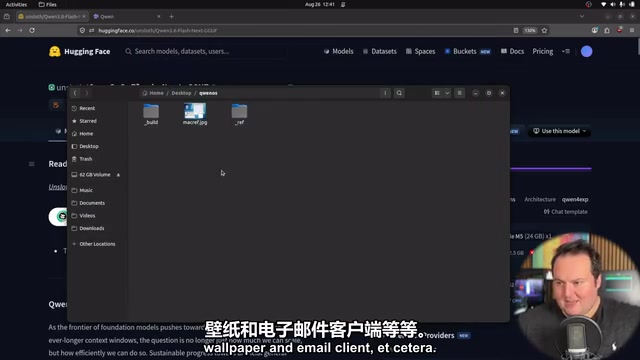
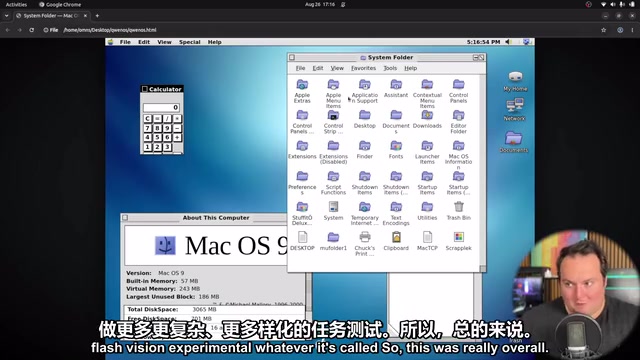
The reviewer first ran the classic "browser OS" test, but this time with a multimodal twist — giving the model a reference screenshot and asking it to perform pixel-level replication while also implementing a GTA clone game, procedural wallpapers, an email client, and a full suite of features.
The result left the reviewer exclaiming "unbelievable." He stated this was the clearest image replication he had ever seen, bar none. To accomplish this task, the model even sliced the source image, generated heatmaps, and performed side-by-side comparisons to ensure more precise pixel-level reproduction.
The generated desktop system was packed with detail Easter eggs: the email client contained creative copy about games and meta information (self-deprecating sticky notes like "remember to buy more floppy disks"), along with a full complement of apps including calendar, calculator, and screensaver settings. The screensaver's visual style was deliberately crafted to match the retro aesthetic of the reference image's era rather than using modern UI — a remarkably nuanced grasp of period aesthetics.
C++ 3D Racing Game Generation: Matching GPT-5.2 Pro Even Without Raylib
In the C++ 3D low-poly rally racing game test, the reviewer deliberately prohibited the model from using the Raylib library to increase difficulty and avoid potential "score padding" — since this task has virtually no ready-made references.
Raylib is a lightweight cross-platform game development library written in C with C++ bindings, wrapping low-level functionality like OpenGL graphics rendering, audio playback, and input handling. In AI coding capability evaluations, Raylib often serves as a "crutch" due to its clean and intuitive API design — training data contains abundant Raylib example code, allowing models to easily combine these patterns into seemingly complete games. Banning Raylib means the model must directly work with lower-level graphics APIs (such as native OpenGL), or implement rendering pipelines, physics simulation, and other modules from scratch — a far more demanding test of code generation capabilities.
The results were stunning: the generated racing game featured drifting, crash mechanics, tracks with water surfaces and terrain elevation, grandstands with spectators watching the race, plus a minimap and speedometer. The reviewer noticed an interesting detail: the car hits the rev limiter and "shudders" in first gear because it doesn't shift — a remarkably authentic physics simulation.
To highlight the significance of this achievement, the reviewer directly compared it against GPT-5.2 Pro (whose Pro version delivers notably stronger performance) on a similar C++ racing game task. Notably, GPT-5.2 Pro used the Raylib library, while Qwen3 Next Flash completed the task under the harder condition of Raylib being disabled — in this comparison, Qwen's performance was "absolutely impressive." The reviewer emphasized that this represents something not to be overlooked for "the democratization of intelligence that can reasonably run on local systems."
Proactively Calling Blender + Godot: AI's Autonomous Tool Chain Selection
In the 1980s aesthetic-styled 3D wrestling game test, Qwen3 Next Flash demonstrated remarkable initiative. The prompt didn't specify a tech stack, but the model proactively checked whether Godot and Blender were installed on the system, then decided to use Blender for asset creation and Godot for game assembly, rather than taking the easier route with Three.js.
Blender is the world's most popular open-source 3D modeling, animation, and rendering software, widely used for game asset creation, visual effects, and architectural visualization. Godot is an open-source cross-platform game engine supporting both 2D and 3D game development, known for its lightweight footprint and MIT license. The AI model's proactive choice of Blender + Godot over Three.js (a WebGL-based JavaScript 3D library) shows it recognized the task's complexity — Three.js is suitable for quick in-browser 3D demos, but for projects requiring detailed modeling, skeletal rigging, and complete game logic, the Blender asset creation + Godot assembly workflow is the more professional approach. This kind of "autonomous judgment in tool selection" reflects a deep understanding of software engineering practices.
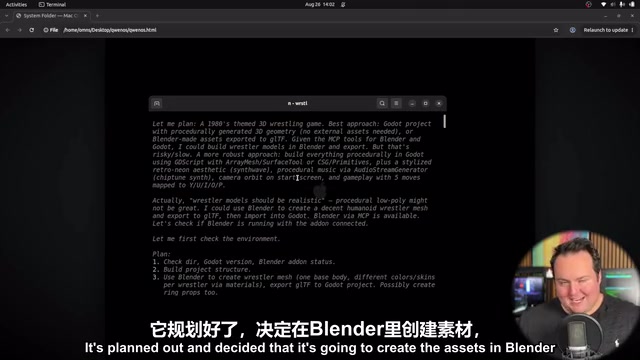
After sneaking a peek at the character renders the model generated in Blender, the reviewer described them as "absolutely mind-blowing" — the model seriously modeled muscles, costumes, and even fighting poses for the wrestlers, complete with a referee character and a full roster. Although the models looked somewhat "terrifying," the sheer amount of work invested was genuinely impressive.
However, reality didn't quite match the ambition. When actually running the game, problems emerged: a huge white block appeared in the center of the ring that proved difficult to debug, and the wrestlers would clip through the floor and fall when the arena loaded. The reviewer admitted "the potential is enormous, but it's not quite at 100% yet." This also confirms the positioning of a preview model — the architectural direction is clear, but the details still need polish.
Spatial Understanding Remains a Weakness: 3D Room Rendering Exposes a Qwen Series Shortcoming
In the test of "creating an isometric view scene in Blender based on a reference photo of a room," Qwen3 Next Flash revealed a persistent weakness.
The model cleverly sliced the source photo and used the slices directly as texture maps in the scene — for example, the paintings on the wall and the Apple history posters were reused photo textures. It even captured subtle details like the purple light effect in the corner, RGB lighting from the PC, and light spots on the CPU heatsink.
However, the overall spatial organization of the scene was quite chaotic: the entire scene was "flipped," the PC was placed on the wrong wall, and cables dangled to the floor. The reviewer pointed out: "Qwen models seem to have a persistent issue with spatial understanding." Here, "spatial understanding" refers to the model's ability to infer 3D spatial layouts from 2D images — including relative positional relationships between objects, depth arrangement, occlusion relationships, and the room's overall geometric structure. This capability requires the model to not only recognize "what" is in an image, but also understand "where" things are and "how they're arranged" — a relatively advanced reasoning task in computer vision. By comparison, DeepSeek V4 Flash, while inferior to Qwen in individual element detail on this task, produced more accurate overall spatial reconstruction.
Local 4-bit Quantized Run Test: Unsloth Q4K M Version Subway FPS Validation
The reviewer also ran the Unsloth Q4K M quantized version locally for a Subway FPS test. The hardware setup consisted of an RTX Pro 6000 GPU paired with a Threadripper processor and 128GB DDR5 memory.
The RTX Pro 6000 is NVIDIA's flagship GPU for professional workstations, featuring 96GB GDDR7 VRAM based on the Blackwell architecture. AMD Threadripper is a multi-core processor platform for high-end workstations, typically offering 64-96 cores with 8-channel DDR5 memory support. The 128GB DDR5 memory is crucial in this scenario — as mentioned earlier, the 51 billion-parameter Ngram embedding table needs to be offloaded to CPU memory, the 4-bit quantized main model weighs roughly 111GB, and the operating system and inference framework have their own memory overhead, putting 128GB close to the operational limit.
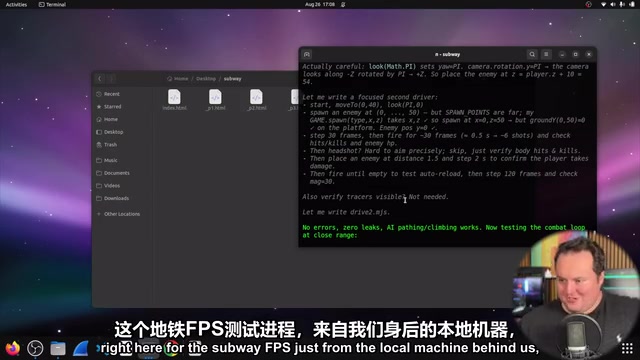
The native local context was limited to 262K tokens, while Qwen Cloud supports up to 1 million tokens. KV Cache grows linearly with context length — longer contexts mean more VRAM and memory consumption, which is one of the main bottlenecks for local deployment. During testing, the system crashed once due to memory bloat (with the process consuming 12GB and causing a system freeze), but after restarting, the model was still able to recover and produce runnable results. The generated FPS game featured flashlights, subway cars, graffiti, and other scene elements. While the weapon sound effects were "laughably weak" and enemy movement patterns were somewhat bizarre, for a 4-bit quantized version of a preview model, this was already a notable achievement.
Conclusion: Glimpsing Qwen4's Future Potential Through Qwen3 Next Flash
As the first preview of the Qwen4 architecture, Qwen3 Next Flash delivers an exciting report card:
- Visual capabilities are extremely powerful, with unprecedented accuracy in pixel-level replication;
- Complex code generation is impressively strong, matching GPT-5.2 Pro's racing game even with libraries disabled;
- Proactive tool invocation awareness is outstanding, autonomously selecting professional tool chains like Blender + Godot;
- Spatial understanding remains a weakness, with multiple generations of Qwen models showing relatively poor 3D spatial organization.
The reviewer gave this preview model a "very, very excited" verdict. In his view, what's most exciting isn't the specific performance right now, but rather that this rapid succession of moderately-sized, highly capable open-weight models is driving the adoption of "subscription-free AI" and locally runnable intelligence. With competitors like GLM 5.3 Flash entering the scene, the future of local AI is truly something to look forward to.
Related articles
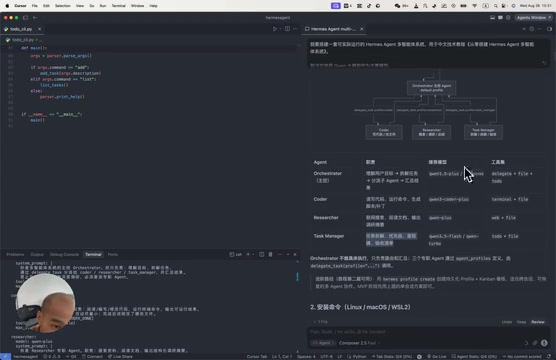
Hermes Multi-Agent System Setup Tutorial: Master Orchestrator + Sub-Agent Collaboration
Learn how to build a Hermes multi-agent system from scratch using Qwen models, with a master Orchestrator coordinating Coder, Researcher, and Task Manager agents through delegate task workflows.
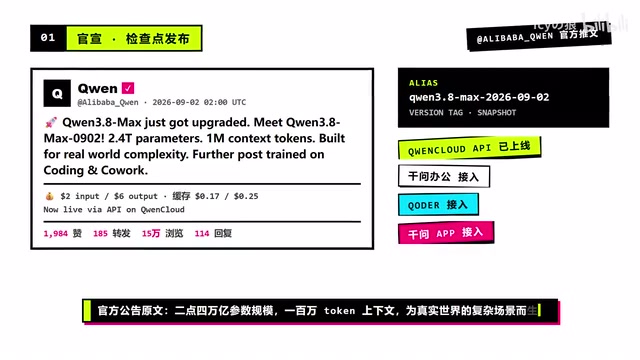
Qwen2.5-Max-0902 Released: Tops Coding Leaderboard with 1691 Points, Priced at Just $5
Alibaba Cloud's Qwen2.5-Max-0902 tops LiveCodeBench at 1691 points with a 22-point surge, surpassing GPT-4.5. Just $5 per million tokens with 1M context window.

Qwen3.8-Flash-Next Deep Dive: How a Static Embedding Table Architecture Takes on DeepSeek
Deep dive into Alibaba's Qwen3.8-Flash-Next: 181.5B params, 51B static embedding table, 6B active params, FP8/BF16 VRAM needs, and how it compares to DeepSeek V4 Flash.