Qwen4 and Kimi3.1 Spotted on Arena: Community Awaits Qwen4 Flash

Qwen4 and Kimi3.1 appear on Arena; the community focuses on Qwen4 Flash's size and open-source availability.
Reddit users discovered Qwen4 and Kimi3.1 in the LMSYS Chatbot Arena model list. Since Arena often includes unreleased models in advance for blind testing, the community sees this as a signal that new models are about to debut. Discussion quickly focused on Qwen4 Flash's model size: many developers hope it will remain consistent with 3.8 Flash Next and worry that vendors will continue the trend of making Flash models larger, raising hardware costs for local deployment. Meanwhile, some users expressed concern that recent discussions on model regulation in China could affect the availability of open-weight models, though such claims remain speculative. Overall sentiment is characterized by both anticipation and anxiety.
Qwen4 and Kimi3.1 Spotted on Arena: Community Awaits Qwen4 Flash
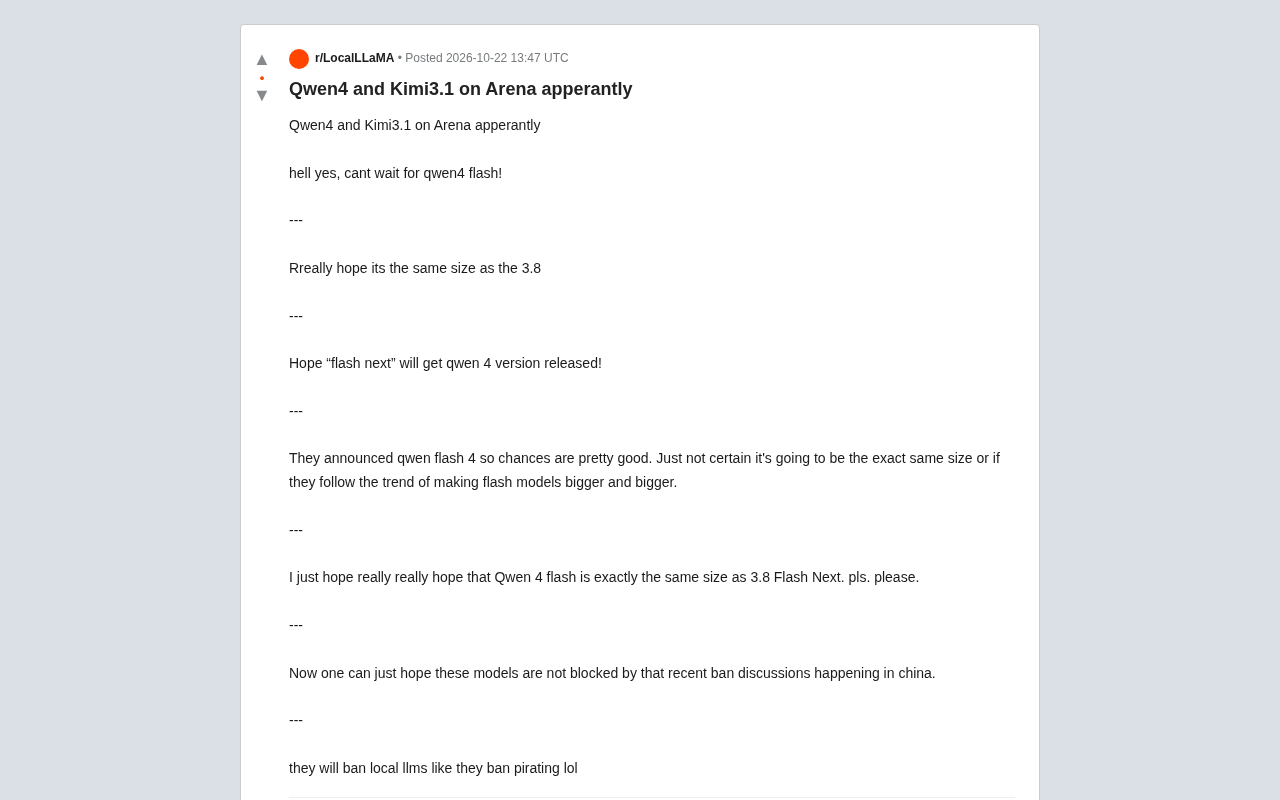
Recently, a user on the Reddit community posted that traces of Qwen4 and Kimi3.1 had been found on the LMSYS Chatbot Arena platform. Although there has been no official announcement yet, this discovery quickly sparked heated discussion in the open-source model community, especially around the upcoming Flash version of the Qwen series. [Screenshot]
Mysterious Figures on Arena: Qwen4 and Kimi3.1
According to the Reddit post, a user saw entries for Qwen4 and Kimi3.1 in Arena's model list. As a large-model arena, Arena typically includes upcoming models in advance for blind comparison testing, so this is seen as a signal that new models are about to debut.
The post author could hardly contain their excitement: "hell yes, cant wait for qwen4 flash!" The comment section quickly gathered a large number of developers following the Qwen series. The appearance of Kimi3.1 is also noteworthy, indicating that Moonshot AI is also continuing to advance its model iterations.
LMSYS Chatbot Arena (also known as LMArena) is a blind-test battle platform for large models maintained by the LMSYS team at UC Berkeley. After users submit questions, the system randomly calls two anonymous models to generate answers, and users vote for the better one, ultimately forming a model leaderboard through an Elo-like ranking system. Because the platform supports anonymous testing, model vendors often connect new models under code names or temporary names before official release to collect real human preference data. Therefore, the appearance of undisclosed names in Arena's model list is often regarded by the community as indirect evidence that a new model has entered the pre-release testing stage. It should be noted that an Arena entry itself does not constitute official confirmation of release; models may also be removed or renamed after testing ends.
What the Community Cares About Most: The Size of Qwen4 Flash
The most concentrated topic in the discussion is the model size of Qwen4 Flash. Multiple users expressed concern about the model "getting bigger." One user wrote: "Really hope its the same size as the 3.8", while another said bluntly: "I just hope really really hope that Qwen 4 flash is exactly the same size as 3.8 Flash Next. pls. please."
This concern is not unfounded. Some users analyzed that vendors do have a trend of making Flash models bigger and bigger: "They announced qwen flash 4 so chances are pretty good. Just not certain it's going to be the exact same size or if they follow the trend of making flash models bigger and bigger." For developers who need local deployment, model size directly affects hardware cost and inference efficiency. If Qwen4 Flash can improve capabilities while maintaining the scale of 3.8 Flash Next, that would be the ideal outcome.
The "Flash" suffix in the Qwen series usually refers to a lightweight or efficient version aimed at high-throughput, low-latency scenarios, rather than simply a small-parameter model. Taking the mentioned 3.8 Flash Next as a reference, such models often maintain strong capabilities with a smaller number of activated parameters through architectural optimization, distillation, or Mixture-of-Experts (MoE) design, thereby fitting consumer-grade GPUs or single-machine local deployment. The community's worry that "Flash is getting bigger" is essentially a worry that activated parameters and VRAM usage will rise, causing models that could originally run on 24GB or even 16GB VRAM devices to require higher hardware thresholds. For local deployers, model size also affects usability after quantization, inference speed, and batch throughput, so whether the size stays the same as the previous generation often directly affects adoption willingness more than leaderboard scores.
The Open-Source Future Under the Shadow of Regulation
In addition to technical details, the discussion also includes concerns about the policy environment. One user mentioned recent discussions in China about model regulation: "Now one can just hope these models are not blocked by that recent ban discussions happening in china." Another user's response was somewhat sarcastic: "they will ban local llms like they ban pirating lol"—implying that actual enforcement may be limited.
Such concerns reflect the open-source community's sensitivity to model availability. The Qwen series has long been known for open weights, and if it is subject to policy restrictions in the future, the impact on the global developer ecosystem should not be underestimated. However, these discussions currently remain at the level of speculation, and no substantive policy has been implemented.
Open-weight models are not completely equivalent to open-source software: the former usually only discloses the model parameters needed for inference, while training data, code, and license terms may still carry usage restrictions. The Qwen series has long been released with open weights, allowing developers worldwide to download, fine-tune, and deploy locally, which is also key to its reputation in the open-source community. If regulatory policy imposes restrictions on model export, weight distribution, or downstream use, the impact will propagate along the chain of downloads, redistribution, and commercial integration. The "ban local llms" mentioned by users in the article is an exaggerated expression of the community's uncertainty about policy; actual regulation usually targets specific capabilities, uses, or distribution entities rather than banning local operation outright. However, before official terms are clarified, such speculation can easily amplify anxiety.
Community Sentiment: Anticipation and Anxiety Coexist
Judging from the overall atmosphere of the thread, the community's attitude toward Qwen4 is a typical case of "deep love, strict expectations." On the one hand, users eagerly anticipate improvements in the new model's capabilities; on the other hand, they fear that the iteration direction may deviate from practical needs—becoming bigger, heavier, and harder to deploy.
This sentiment is common in the open-source model community. When trade-offs must be made between model capability and deployment cost, every choice by vendors affects developers. The final form in which Qwen4 Flash appears will directly affect its popularity in local deployment scenarios.
At present, the appearance of Qwen4 and Kimi3.1 on Arena is still a community observation, and there has been no official confirmation. But one thing is certain: once officially released, discussions around size, performance, and licensing will only become more heated.
One-line Summary
Qwen4 and Kimi3.1 appear on Arena, with the community focusing on Qwen4 Flash's size and open-source availability.
Paragraph Summary
Reddit users found Qwen4 and Kimi3.1 in the LMSYS Chatbot Arena model list. Because Arena often includes unreleased models in advance for blind testing, this discovery is seen by the community as a signal that new models are about to debut. Discussion quickly focused on the model size of Qwen4 Flash: multiple developers hope it will remain consistent with 3.8 Flash Next and worry that vendors will continue the trend of making Flash models bigger and bigger, thereby raising the hardware cost of local deployment. At the same time, some users expressed concern that recent discussions on model regulation in China could affect the availability of open-weight models, but such claims remain speculative. Overall sentiment shows a mix of anticipation and anxiety.
Related articles

Linux Kernel's AI Civil War: Anti-AI Activist Elected to TAB, Torvalds Scraps AI Disclosure
Anti-AI activist Laurent Pinchart elected to the Linux kernel TAB as Linus Torvalds scraps AI code disclosure. A rundown of the kernel community's AI civil war, both sides' positions, and the impact on open source.

When Did Paid Childcare Become the Norm? Working Mothers and the Evolution of Childcare
When did paid childcare become the norm? This article traces the evolution from the rise of childcare centers in the 1970s–80s and the 1990s linking of federal subsidies to work requirements, to declining stigma and rising costs, and explores advocates' 25-year effort to catch up with other countries on childcare and paid parental leave.

Red Flags for Product-Market Fit: A Practical Guide from Top VCs and the Superhuman Founder
Investors from Iconiq and Sapphire Ventures and Superhuman founder Rahul Vohra share PMF red flags and practical methods, including the 40% disappointment rule, retention curves, and acquisition costs.