Qwen4-Max Launches Overnight at 80% Off, Gemini 4 Carbon Opens to All

Gemini 4 Carbon opens, Qwen4-Max previews at low prices, and multiple models and agent products see dense updates.
The article rounds up recent high-density AI news: Google's Gemini 4 Carbon fully opens its API and rolls out to Ultra users at launch pricing of $2 input and $10 output per million tokens; Alibaba's Qwen4-Max enters preview, focused on world understanding and coding agents, with prices as low as 80% off in China; Claude launches whiteboards, spreadsheets, and the Data dashboard to enter office scenarios; Minimax open-sources the 33.1B-parameter H3 Image diffusion model, generating 4K images in 6 steps. On the agent side, Anti-Gravity's swarm architecture and ChatGPT merchant-specific agents point to collaboration and e-commerce monetization respectively; on hardware, Gemini Robotics 2.5 tests over 200 operations on the Mercedes assembly line with a 96% success rate. The article closes with quick news on Grok, Cursor, IPOs, and more.
The AI world is being bombarded again. From Google's full opening of Gemini 4 Carbon, to Alibaba's late-night surprise launch of Qwen4-Max, to Minimax open-sourcing a 4K image generation model, both software and hardware are firing on all cylinders — almost every item deserves its own deep dive.
Google Shows Its Hand: Gemini 4 Carbon Opens to All
According to the daily briefing from Bilibili creator "Ben Miao," Google's Gemini 4 Carbon is now officially open to all users. Described as a "performance beast built for ultra-long, deep reasoning," the model has not only landed on the API but is also rolling out gradually to Ultra subscribers.
On pricing, the launch special is $2 per million tokens for input and $10 for output, reverting to $4 and $20 after the end of the month. Google CEO Pichai personally showed off a 3D game demo built with Blender, Cursor benchmarks hit 60.4%, and researchers can apply for the highest usage tier for up to six months. Google has clearly unleashed its flagship model this time.
Token Billing and Per-Million-Token Pricing
Large model APIs are billed in Tokens — the smallest unit of text the model processes. An English word typically maps to one to several tokens, while a Chinese character maps to roughly one to two tokens. Vendors quote prices "per million tokens" to compress unit prices into a directly comparable scale. The "$2 input, $10 output" in this article refers to separate pricing for user prompts fed into the model versus generated responses; output is usually more expensive because decoding generates token by token with higher compute consumption. At this rate, one million tokens roughly equals 700,000 to 1,000,000 English words, which developers can use to estimate the cost of a long-document reasoning run or a large batch of calls. The gap between the launch special and the restored price also means call costs will double after the end of the month, so high-volume operations need to plan budgets in advance.
Qwen4-Max Strikes: Prices Slashed to 80% Off
No sooner had Google made its move than Alibaba counterattacked at light speed. Qwen4-Max has entered preview on multiple platforms including Alibaba's Token PlanAd, focusing on world understanding and coding agent capabilities.
The biggest surprise is the price: starting at 20% off in China, and with nighttime discounts stacked on top, as low as 80% off the original price. There's no word yet on the fourth generation being officially open-sourced, but this late-night bonus event runs until November 25. The creator said he was "stunned on the spot" and reminded developers to grab the deal during the preview period and, while they're at it, verify the real strength of China's top-tier model.

Claude Serves Up a Full Office Suite
Claude, dubbed "top student Miss Xiao Ke," rolled out an entire set of office tools in one go. Whiteboard and spreadsheet features have entered public beta in paid plans — users can pull up flowcharts and planning tables right in the chat box, with support for multi-sheet formulas and team collaboration, plus seamless export to spreadsheet files and CSV.
The original data dashboard has been upgraded and renamed Data, now officially launched, capable of connecting to data warehouses to generate narrated videos. Team plans now have it enabled for all members by default. The creator remarked that this move "is out to uproot traditional office software."
Data Dashboards and Data Warehouse Connections
A data dashboard is an interface that presents key metrics in chart form, commonly used for business monitoring. Claude's Data feature lets users connect to a data warehouse — a system that centrally stores an enterprise's structured data for analytical queries (such as Snowflake or BigQuery) — and then automatically generates narrated videos. This means the model doesn't just draw charts; it first understands table structures and metric definitions, then converts query results into visualizations and natural-language explanations. For non-technical roles, it eliminates the two steps of writing SQL and configuring charts; for enterprises, data stays in their own warehouse and the model reads it through connectors, with permissions and compliance boundaries configured separately.
Minimax Open-Sources a 4K Image Generation Model
Anime artists, rejoice. Minimax's H3 Image is now fully available — a 33.1B-parameter diffusion model. The company claims it can generate 4K images in about 10 seconds with just 6 steps, natively supports 4096×4096 resolution, and accepts up to 16 reference images.
It works across multiple platforms, with a limited-time 50% off during launch week, and even ships with an open-source community license. Multi-image consistency now has a new solution — artists working on character designs should pay close attention.
Diffusion Models, Steps, and Reference Images
Diffusion models are the mainstream architecture for text-to-image today: during training they learn to gradually restore noise into an image, and during generation they start from pure noise and iterate through several "denoising steps" to produce a result. More steps usually mean better detail but slower speed, so "6 steps to a 4K image" is few-step sampling after distillation acceleration, trading some diversity for speed. The 33.1B parameters refer to the model's weight scale — larger parameters generally mean stronger fitting to complex prompts and art styles, but also higher inference memory overhead. The reference image mechanism injects style, character, or composition features into the generation process via image encoding; multiple reference images constraining together is the mainstream approach to alleviating "multi-image consistency" problems — where the same character's appearance or outfit drifts across different images.
New Developments in Agent Collaboration and Commercialization
Anti-Gravity brought out its rumored swarm architecture, with the new slash Swarm command entering preview. A coordinator can dispatch tasks to multiple independent agents, each of which can choose a different model and collaborate via a shared message board. CLI 1.5.5 simultaneously supports viewing whiteboards and dashboards, and integrates the Carbon entry point. The catch is that every worker consumes quota, but the experience of having a swarm of AIs work for you is genuinely novel.
On OpenAI's side, Altman has stuffed merchants into the chat box. ChatGPT is officially testing merchant-specific agents: after enterprises claim their store, they can independently maintain product prices and inventory, and users can invoke brand-specific agents to check logistics and shop within the chat interface. The first batch opens to US e-commerce, and merchants can only see aggregated data — not users' raw chat logs. The vision of turning the chat box into a cyber mall is becoming reality.

Multi-Agent Collaboration Architecture
A multi-agent system refers to multiple agents, each with its own model and tool-calling capabilities, dividing labor to complete the same task. The common form is "coordinator–worker": the coordinator breaks down goals and dispatches subtasks, while workers execute in parallel and report results back. Anti-Gravity's swarm architecture with a shared message board in this article is one such example — the message board serves as public context, avoiding repeated point-to-point messaging between agents. Its advantages lie in parallelism and specialization — different agents can use different models to balance cost and capability; the cost is that every worker independently consumes quota, and coordination overhead, error propagation, and result aggregation complexity rise with the number of agents, making task decomposition granularity a key design consideration.
Robots Enter the Assembly Line
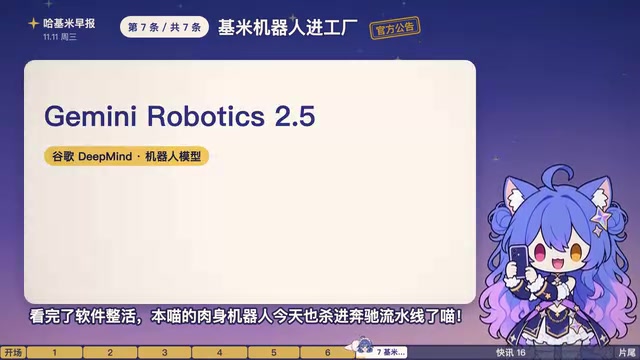
Beyond software, Google's physical robots have stormed the Mercedes assembly line. Gemini Robotics 2.5 has tested over 200 complex operations, mounted on the Apollo humanoid robot to disassemble auto parts, with a success rate soaring to 96%. In the official 29-second demo, handling small parts and folding clothes both looked remarkably stable. From writing code to tightening screws, AI's tentacles are reaching into the physical world.
Quick News Roundup
Other notable developments include: Grok 4.8 finished training with rewritten reinforcement learning, rolling out to a small group as early as this week; Qwen Code 1.0 preview integrates agents with no environment configuration required; OpenAI announced it will discontinue the old voice mode on December 11, going all-in on GPT Live; Cloud launched interactive connectors that embed operations for multiple external mainstream software in the chat sidebar; Cursor refactored team project features, allowing multiple engineers and their respective agents to collaborate on the same stage; Carbon cranked out over 6 million lines of code, validating Signal's core security in four weeks; Dripe announced the completion of its acquisition of OpenRouter; Gropic officially kicked off its IPO roadshow, planning to issue 825 million shares; Odysia's founder announced joining OpenAI, with the company fully acquired.
It's been a day of extremely high information density — worth following up item by item for developers.
Related articles

OpenAI to Shut Down Agent Builder and Two Other Services on November 30, Developers Must Migrate Urgently
OpenAI will shut down Agent Builder, the evals dashboard, and reusable prompts on November 30; evals is already read-only. Here's the scope, OpenAI's migration paths (Agent SDK, PromptFu, your own code), and what developers should export and rebuild this week.
RankSpot: A Pay-Per-Use SEO & AI Search Execution Layer That Lets Agents Write, Publish, and Build Backlinks for You
RankSpot is an SEO & AI search execution layer for AI Agents. Connect via MCP to Claude or ChatGPT to write, publish & build backlinks. Pay-per-use, $3/article.

Appxiom: Giving AI Coding Assistants Production Context
Appxiom gives AI coding agents production context—crashes, jank, memory leaks, failed network calls—across Android, iOS, Flutter, KMP, and Web, ranking bugs by Goal Friction Impact.