Radar: Giving AI Agents a Kubernetes Cluster Radar

Radar skips the AI SRE and feeds Kubernetes cluster context to coding Agents via MCP.
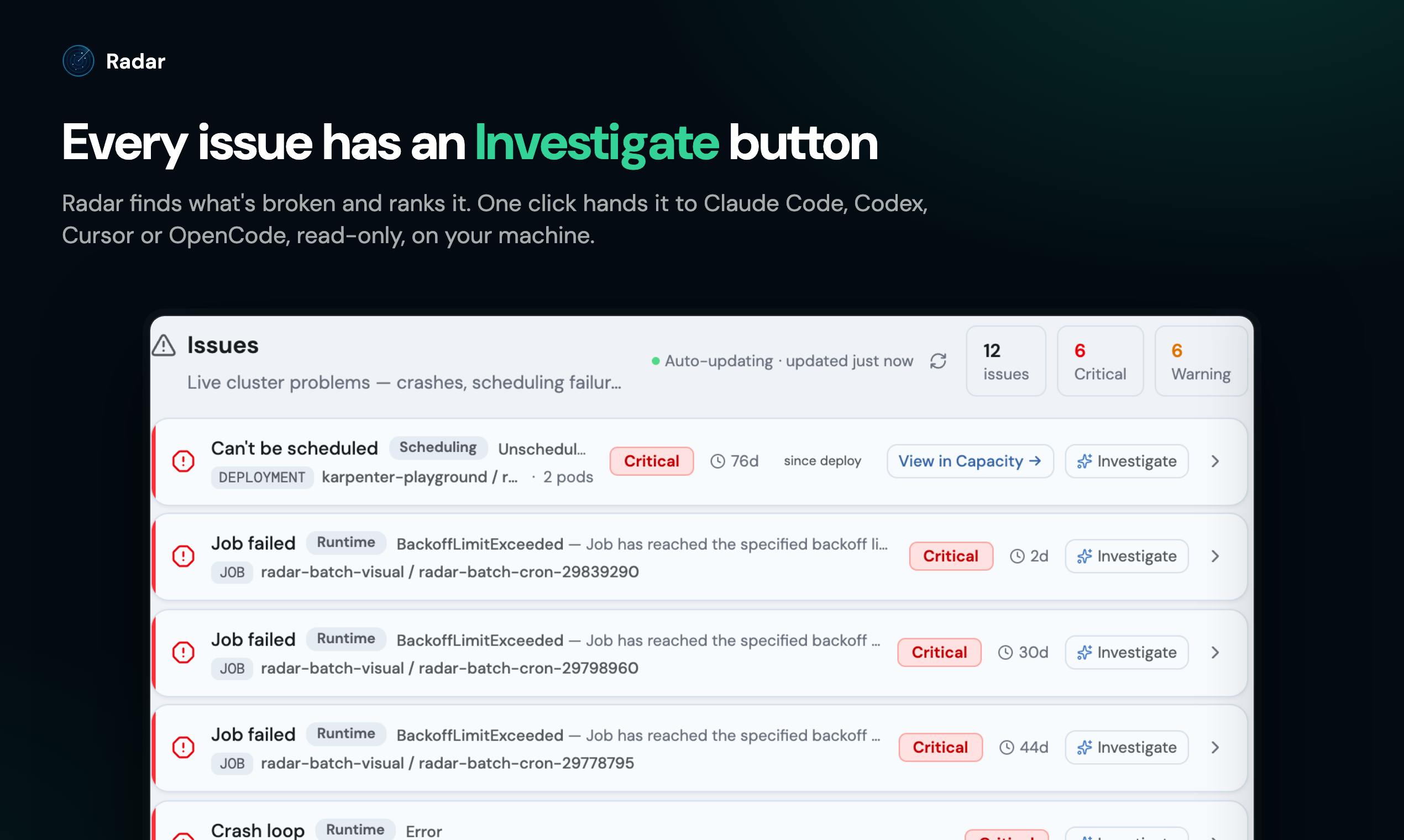
Radar is an open-source project arguing you don't need an AI SRE—just give your Agent a Radar. Via MCP, it aggregates four key Kubernetes signals—prioritized issues, change timeline, logs, and ownership—into structured context for Claude Code, Codex, and Cursor. Its read-only Investigate feature requires evidence for each conclusion. Radar Cloud extends this to alert-driven investigation with Slack reporting, though it stops short of auto-remediation.
From "AI SRE" to "Radar for Agents": A Shift in Positioning
An interesting project has appeared on Product Hunt—Radar—and its tagline is blunt: "You don't need an AI SRE. Give your Agent a Radar." This line is itself a product positioning statement: rather than building a black-box agent that replaces the SRE, feed cluster context into the coding agents developers already use.
Radar's core judgment is this: your Agent understands Kubernetes, but it doesn't understand your cluster. This gap is exactly what many "AI operations" products try to fill with end-to-end automation, while Radar takes a lighter path—exposing cluster context through MCP (Model Context Protocol) to tools like Claude Code, Codex, and Cursor, letting them perform investigation within their own workflows.
MCP Integration: Aggregating Four Key Signals into One View
Radar is an open-source project that provides Agents with structured cluster context, specifically four types of information: a prioritized issue list, a change timeline, logs, and resource ownership (owners). These four types of information correspond precisely to the most time-consuming parts of real-world troubleshooting—not querying a particular metric, but switching back and forth between "what changed recently," "who owns this," and "are there any clues in the logs."
By aggregating these signals into a single view, what the Agent receives is no longer scattered kubectl output, but a context package with ordering and correlation. This is also the boundary between Radar and a general Agent's native capabilities: the Agent's Kubernetes knowledge is generic, and what Radar supplements is "local knowledge" of this specific cluster.
Model Context Protocol (MCP) is an open protocol proposed by Anthropic in late 2024 to let AI applications connect to external data sources and tools in a standardized way. It uses a client-server architecture: the Agent (e.g., Claude Code, Cursor) acts as the client, calling an MCP Server implemented by an external service through a unified JSON-RPC interface to obtain context such as files, databases, APIs, or cluster state. For tool developers, the value of MCP lies in "implement once, reuse everywhere"—you don't need to write a separate plugin for each coding Agent; just expose an MCP Server and it can be integrated by all clients that support the protocol. Radar leverages this mechanism to encapsulate Kubernetes cluster query capabilities as an MCP Server, giving developers' existing coding Agents a cluster perspective directly, without switching tools or building custom integrations.
Investigate: Read-Only Troubleshooting and the Evidence Chain
Radar's newly added Investigate feature deserves separate mention. When a workload is in a failed state, the user can click Investigate, and Claude Code, Codex, or Cursor will locate the root cause. Two design constraints are key here: first, read-only; second, every conclusion must be accompanied by evidence.
Read-only means the Agent will not modify cluster state during troubleshooting, reducing the risk surface of "AI misoperation"; attaching evidence turns the troubleshooting result from "the model says this is the cause" into a verifiable reasoning chain. For production operations scenarios, these two constraints determine whether a tool can truly be trusted and adopted far more than the model's raw intelligence.
Read-only mode in operations-oriented AI tools typically means the Agent is granted only Kubernetes RBAC verbs such as get, list, and watch, without write permissions like create, update, delete, or patch. This constraint takes effect at both the protocol layer and the execution layer: the MCP Server only exposes query-type tools, and the underlying ServiceAccount is also restricted to a read-only role via RBAC. Its significance is not just "preventing accidental deletion," but more importantly enabling the tool to safely connect to production clusters—many enterprises prohibit automation tools from holding write permissions, and read-only mode bypasses this compliance obstacle. The trade-off is that the Agent cannot verify hypotheses by temporarily modifying configurations, so troubleshooting can only rely on observational data, making the completeness of the evidence chain even more critical.
Benchmark Performance and Cloud Offering
The Radar team has provided a benchmark result: across 50 real failure scenarios covering six tools, Radar found the most root causes. It should be noted that this is a vendor-reported test result, and the specific test design and comparison baselines are not detailed in the source material, so readers may want to retain some caution when accepting it.
In terms of product form, in addition to the open-source local version, Radar also offers Radar Cloud: it performs investigation for every alert and pushes findings to Slack. This extends it from "a tool developers trigger manually" to "an alert-driven automated process," but the degree of automation still stops at "investigate and report," rather than "auto-remediate."
Several Signals Worth Noting
Radar received 93 upvotes and 8 comments on Product Hunt, ranking 7th, with category tags including open source, developer tools, artificial intelligence, and GitHub. This level of traction is not a blockbuster, but within the relatively rational category of developer tools, it indicates that it hits a real pain point for some people.
From an industry perspective, Radar represents an emerging product paradigm: not building vertical-domain AI applications, but building a vertical-domain context supply layer. Agent capabilities continue to strengthen at the general level, and true differentiation comes from whether it can obtain the right data. For scenarios like Kubernetes operations, where context is highly privatized and changes frequently, this approach is especially valid.
Of course, this path has its boundaries. The value of a context supply layer depends heavily on the quality of the upstream Agent, and the reliability of the evidence chain, the coverage of read-only mode, and performance in multi-cluster scenarios all need to be verified in actual use. The benchmark of 50 failures is a starting point, not an endpoint.
One-line Summary
Radar doesn't build an AI SRE; it supplies Kubernetes cluster context to coding Agents via MCP.
Paragraph Summary
Radar is an open-source project arguing that "you don't need an AI SRE—give your Agent a Radar." Through the MCP protocol, it aggregates four key Kubernetes cluster signals—a prioritized issue list, change timeline, logs, and resource ownership—into structured context for coding Agents like Claude Code, Codex, and Cursor, filling in their missing local cluster knowledge. The new Investigate feature uses read-only mode and requires evidence for every conclusion to reduce production risk. The team reports the most root causes found in a benchmark of six tools across 50 real failures, but test details are undisclosed. Radar Cloud further extends investigation to alert-driven workflows with Slack push notifications, but still stops at investigation and reporting rather than auto-remediation.
Related articles
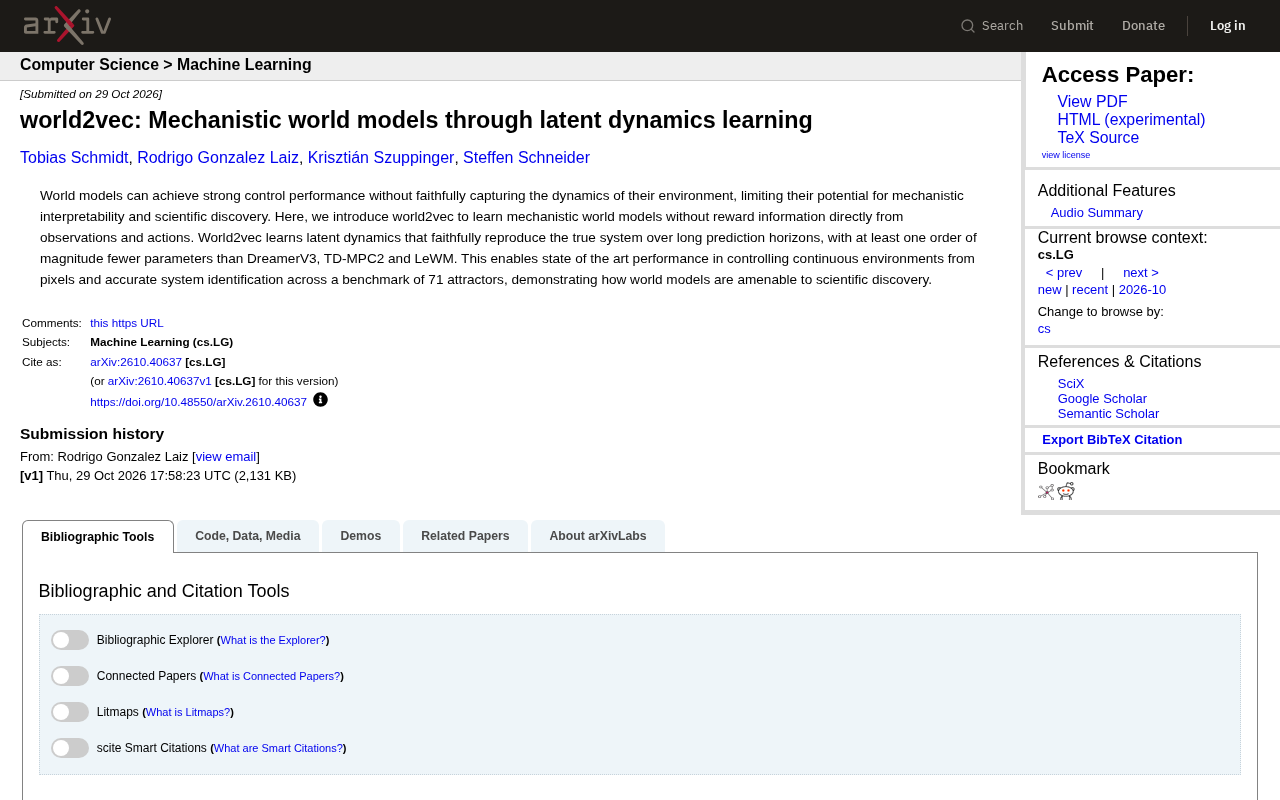
world2vec: Building Mechanistic World Models with Latent Dynamics Learning
world2vec proposes a reward-free method for learning mechanistic world models via latent dynamics, faithfully reproducing systems over long horizons with at least an order of magnitude fewer parameters than DreamerV3, TD-MPC2, and LeWM, and achieving accurate system identification on 71 attractor benchmarks.

A New KL-DRO Paradigm: Adaptive Scenario Generation Around a Learned Density Model
KL-DRO research proposes centering the KL ball on a learned density model instead of the empirical distribution, with adaptive scenario generation guiding sampling toward the worst case. Experiments show lower cost under distribution shift when records are scarce and the model can extrapolate, with comparable in-distribution cost.

ODE Samplers for Discrete Diffusion Models: Exponential Residual Flows Accelerate Generation
Discrete diffusion models lack deterministic ODE sampling? This article introduces Exponential Residual Flows (ERFs), which introduce continuous residual variables per token to construct piecewise ODEs for deterministic sampling and support consistency distillation acceleration. Superior to prior methods on code and text generation tasks.