Radiomics + Conformal Prediction: A New Framework for Thyroid Nodule Classification

Radiomics + interpretable GAM + conformal prediction enables uncertainty-aware triage for thyroid nodule diagnosis.
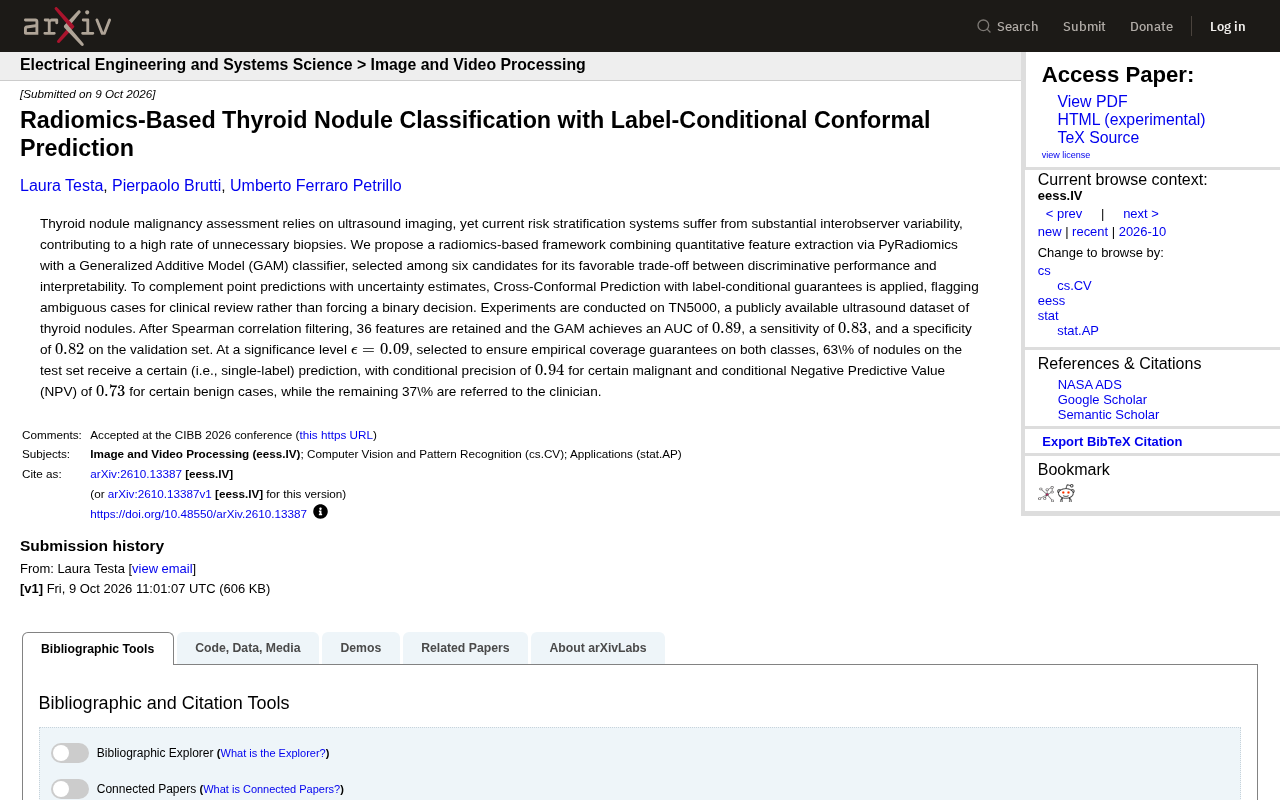
This study addresses the interobserver variability and over-biopsy issues in thyroid ultrasound diagnosis through a three-layer framework: radiomics feature extraction, an interpretable GAM classifier, and label-conditional cross-conformal prediction. On the TN5000 dataset, GAM achieves a balanced AUC of 0.89. More notably, the conformal prediction mechanism splits the test set into 63% definitive cases (malignant conditional precision: 0.94) and 37% uncertain cases referred to physicians — enabling evidence-based human-AI collaboration. The key contribution is repositioning AI as a triage engine rather than a replacement for clinicians, potentially reducing unnecessary biopsies. Limitations include a relatively low benign NPV (0.73) and single-dataset validation.
The Core Challenge in Thyroid Nodule Diagnosis: Subjectivity and Over-Biopsy
Assessing whether thyroid nodules are benign or malignant has long relied on ultrasound imaging, but current risk stratification systems face a fundamental problem — significant interobserver variability between radiologists. This subjectivity directly leads to a large number of unnecessary needle biopsies, increasing patient discomfort and healthcare costs while consuming valuable clinical resources.
Finding ways to reduce this human-induced uncertainty without compromising diagnostic accuracy is a key focus of radiology AI research. A new radiomics-based study attempts to address this challenge by combining quantitative feature extraction with an interpretable machine learning model, augmented by a statistically grounded uncertainty quantification mechanism.
Technical Framework: Radiomics + GAM + Conformal Prediction
The framework proposed in this study consists of three tightly integrated components.
Quantitative Feature Extraction and Selection
The researchers used PyRadiomics to extract quantitative imaging features from ultrasound images. The raw feature space is high-dimensional, prone to redundancy and noise. Through Spearman correlation filtering, 36 discriminative features were ultimately retained. This step forms the foundation of the entire pipeline — quality features directly determine the ceiling of any downstream model.
Radiomics transforms medical images into quantifiable high-dimensional feature vectors, capturing texture, morphology, and intensity distribution information that is difficult to detect with the naked eye. PyRadiomics is the most widely used open-source radiomics extraction tool, capable of automatically computing hundreds of features from an ROI (region of interest), including first-order statistics (e.g., mean, entropy), shape features (e.g., sphericity, surface-to-volume ratio), and texture features based on gray-level co-occurrence matrices and run-length matrices. Raw extracted features often exceed 100 and exhibit high intercorrelations. Spearman correlation filtering is a non-parametric screening method that removes redundant feature pairs with correlation coefficients above a threshold, reducing multicollinearity while preserving information content — preventing overfitting in high-dimensional spaces. Retaining 36 features means the downstream GAM model receives refined, de-noised, and de-redundant inputs, which is particularly critical for medical datasets with limited sample sizes.
An Interpretable GAM Classifier
For model selection, the research team evaluated six candidate models and ultimately chose the Generalized Additive Model (GAM). This choice reflects a core trade-off in medical AI: the balance between discriminative performance and interpretability. GAM maintains solid classification capability while allowing clinicians to understand each feature's contribution to the final prediction — a crucial property in high-stakes medical settings that demand trust.
On the validation set, GAM achieved an AUC of 0.89, sensitivity of 0.83, and specificity of 0.82 — a well-balanced diagnostic performance overall.
The Generalized Additive Model (GAM) is a non-parametric extension of linear models, where the prediction function takes the form g(E[Y]) = α + f₁(x₁) + f₂(x₂) + … + fₚ(xₚ), with each fᵢ being a smooth function (typically a spline) of the corresponding feature, and g serving as the link function (logit for classification). Compared to black-box models, GAM's key advantage is the ability to visualize each feature's "shape function," intuitively showing how feature values influence predictions monotonically or non-monotonically. Clinicians can inspect these functions to verify alignment with medical knowledge, building trust in the model. Relative to traditional logistic regression, GAM captures non-linear relationships; relative to random forests or neural networks, GAM preserves the separability and interpretability of individual feature effects. In an increasingly regulated medical AI landscape where algorithmic auditability is required, this "accuracy-with-transparency" trade-off carries significant practical value.
Label-Conditional Cross-Conformal Prediction
This is the most distinctive component of the study. Traditional classifiers produce binary, black-or-white decisions, but forcing ambiguous cases into one category can be clinically dangerous. The study introduces Cross-Conformal Prediction with label-conditional guarantees, attaching uncertainty estimates to each prediction.
When the model lacks sufficient confidence for a given case, the system flags it for physician review rather than forcing a decision. This capacity to "know what it doesn't know" is precisely what makes medical AI clinically deployable.
Conformal Prediction is an uncertainty quantification framework based on non-parametric statistics. Its core advantage is providing finite-sample validity coverage guarantees on top of any underlying model, without making distributional assumptions. Specifically, for a given significance level ε, conformal prediction outputs a "prediction set" rather than a single label — the prediction set contains all candidate classes that cover the true label with at least 1-ε probability. When the model is confident about a case, the prediction set contains only one label (a definitive prediction); when confidence is insufficient, the set contains both labels (uncertain), signaling the need for human intervention. The "cross-conformal" variant leverages training data through a cross-validation-like splitting mechanism, avoiding the randomness introduced by a single calibration split. "Label-conditional" coverage further requires that coverage guarantees hold separately for both benign and malignant classes, rather than only on aggregate — especially important in class-imbalanced medical diagnostic settings, preventing the model from sacrificing minority-class coverage to meet overall metrics.
Results: 63% Definitive Predictions, 37% Referred to Physicians
Experiments were conducted on the publicly available TN5000 ultrasound thyroid nodule dataset. At a significance level of ε=0.09 (chosen to ensure empirical coverage guarantees across both classes), the test set showed a clear triage effect:
- 63% of nodules received definitive (single-label) predictions;
- Among those definitively classified as malignant, the conditional precision reached 0.94;
- Among those definitively classified as benign, the conditional negative predictive value (NPV) was 0.73;
- The remaining 37% of cases were referred to clinicians for review.
These results convey an important message: for nearly two-thirds of cases, the model can deliver high-confidence predictions — particularly for malignancy, where 94% precision means the model rarely misclassifies a benign nodule as malignant. For the truly ambiguous 37%, the system chooses to "admit uncertainty" and returns decision-making authority to the physician.
Value and Limitations
The true significance of this framework lies not in optimizing a single metric, but in redefining AI's role in the diagnostic workflow — not as a replacement for physicians, but as a "triage engine" that autonomously handles the confident majority of cases, concentrating physician attention on the genuinely difficult minority. This human-AI collaboration model has real potential to systematically reduce unnecessary biopsy rates.
That said, there are notable limitations worth acknowledging. The NPV for definitive benign predictions is only 0.73, falling well short of the 0.94 precision seen for malignant predictions, indicating the model's confidence in ruling out malignancy is still limited. Additionally, results are based on a single public dataset (TN5000), and generalizability across institutions and imaging equipment remains to be validated. The choice of ε also involves a trade-off between sensitivity and coverage, and different clinical contexts may require recalibration.
Overall, this work demonstrates the practical potential of combining interpretable models with uncertainty quantification for medical image diagnosis, offering a valuable methodological reference for the clinical translation of radiomics.
Related articles

Automate Job Search with AI Agents and Residential Proxies for Precise Matching
Build an AI Agent with MCP and residential proxies to bypass recruitment site anti-scraping and geo-restrictions, scrape thousands of DevOps jobs, then have Claude score and rank each against your resume. Includes proxy comparison experiments, project structure, and cost analysis—filtering only, no auto-submission.

The AI Task Assistant That Knows When to Back Off: A Cure for Activation Struggles
One Small Step is an AI assistant for task initiation struggles, using agentic decisions for guilt-free reminders, timely retreat, and cross-platform task management. The developer shares real test results on 13 tasks and architectural trade-offs.

FastAPI: A High-Performance Python Framework and a Production-Ready API Development Powerhouse
FastAPI is a high-performance web framework based on Python type hints, supporting async and automatic OpenAPI docs. With over 100k GitHub stars, this article analyzes its core strengths, production readiness, and selection advice.