RAG Advanced Learning Guide: A Resource Roadmap from Prototype to Deep Mastery

How to go from a working RAG prototype to truly understanding the system — a practical learning roadmap.
A developer using LangChain, Claude, and hybrid retrieval built a RAG prototype for an enterprise knowledge assistant — but realized he understood little about why each component works. His frustration reflects a broader problem: most available resources are either vendor marketing, surface-level concept overviews, or AI-generated filler. The real path forward involves three areas: understanding hybrid retrieval and reranking trade-offs, treating document parsing and chunking as a critical (often underestimated) bottleneck, and building a quantifiable evaluation framework. Methodologically, reading source code, running notebook-based projects, and using evaluation-driven iteration loops are the most reliable ways to level up from framework consumer to system designer.
A Real Dilemma: The RAG Prototype Runs, But You Don't Understand Why
In a Reddit tech community, one developer raised a question that many practitioners encounter. He was building a RAG (Retrieval-Augmented Generation) prototype for an internal enterprise knowledge assistant, primarily handling PowerPoint presentations and PDF documents. His tech stack was already fairly complete:
- Orchestration framework: LangChain, paired with Claude as the LLM
- Document loaders: PyMuPDF4LLM for PDFs, Unstructured / python-pptx for slides
- Embeddings and storage: Local BGE embeddings (via sentence-transformers), Chroma as the vector store
- Hybrid retrieval: BM25 (rank_bm25) combined with dense vector retrieval, plus a cross-encoder (bge-reranker) for reranking
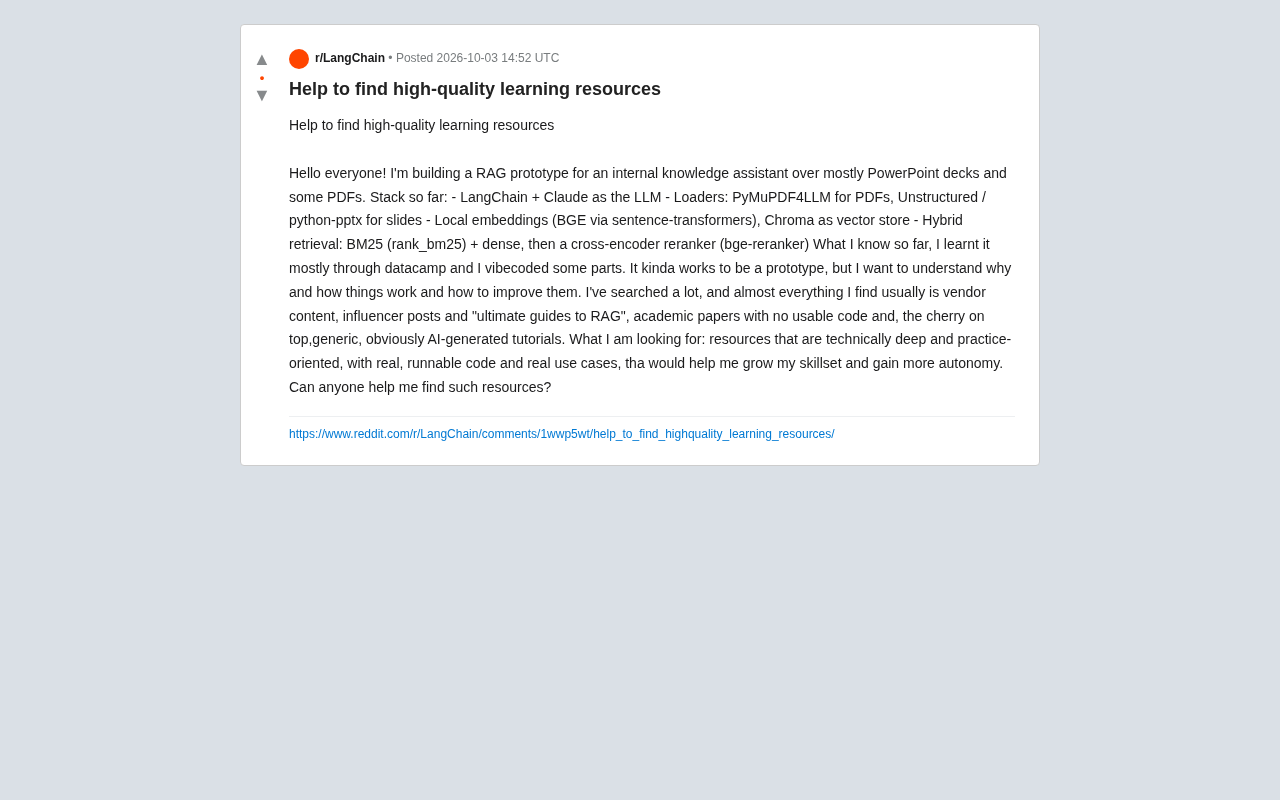
This combination covers the main components of a modern RAG system from an engineering standpoint. But the developer candidly admitted that most of his knowledge came from DataCamp courses, and parts of the code were assembled through "vibecoding" — piecing things together by feel. The prototype "kinda works," but what he truly wanted was to understand why each component is designed the way it is, how it actually works, and how to systematically improve it.
Why High-Quality RAG Resources Are So Hard to Find
This developer's frustration is remarkably representative — it's practically a collective pain point for AI learners today. He searched extensively and found that available resources generally fall into a few categories, none of which truly satisfy:
Vendor marketing content dominates search results. Its purpose is to sell products, so technical details are often dressed up impressively but lack transferability. Influencer posts and "Ultimate RAG Guides" look comprehensive on the surface but stay at the level of concept stacking, rarely touching the real engineering trade-offs involved in production. Academic papers go deep, but often lack runnable code, making reproduction extremely costly. Most frustrating of all are the obviously AI-generated generic tutorials — fluent in language, neat in structure, yet completely devoid of practical value.
This state of information overload with nutritional scarcity fundamentally reflects how fast the RAG field is evolving, while the production of high-quality, battle-tested educational content lags far behind.
What He Actually Needs
The developer expressed his needs clearly: resources that are technically deep, practice-oriented, and come with real runnable code and real use cases — content that can help him level up and develop stronger autonomy.
In other words, he's already past the "good enough to run" stage. What he needs is the leap from "knowing how to use it" to "understanding why it works." This type of learning progression actually follows a recognizable path.
Digging Into the Underlying Logic of Retrieval and Reranking
Since he's already using hybrid retrieval and cross-encoders, the next step is understanding why hybrid retrieval outperforms single-method approaches. BM25 excels at precise keyword matching, while dense vectors excel at semantic recall — the two are complementary. Cross-encoder reranking improves results because it performs finer-grained interaction computation between the query and document, at the cost of greater compute overhead. This makes it suitable only for second-pass reranking over a recalled candidate set. Understanding these trade-offs is what enables rational choices between latency, cost, and accuracy.
From an architectural perspective, hybrid retrieval typically merges results from both paths using Reciprocal Rank Fusion (RRF) or weighted linear combination. The core idea behind RRF is: regardless of a document's absolute score in any individual ranking, if it consistently ranks high across multiple retrieval paths, its final fused score improves. This approach is insensitive to score scale and tends to be more robust in practice than manually tuning weights. The fundamental difference between a Cross-Encoder and a Bi-Encoder is: a Bi-Encoder encodes queries and documents into independent vectors separately, with similarity computed as a dot product — extremely fast, suitable for coarse recall from millions of documents. A Cross-Encoder concatenates the query and document before feeding them jointly into the model, capturing fine-grained word-level interactions through attention mechanisms, yielding higher accuracy but with no precomputation possible, making it suitable only for reranking small candidate sets (typically tens to hundreds of results). Understanding this fundamental distinction is a prerequisite for correctly setting the top-k recall count and balancing latency against precision.
Document Parsing Is the Hidden Bottleneck in RAG
For scenarios centered on PPT and PDF files, document parsing quality often determines the system's ceiling. Slide layouts are complex, information is fragmented, and tables and charts are difficult to convert into high-quality text. This is exactly why tools like Unstructured and PyMuPDF4LLM exist — but each has its limitations. Deeply studying chunking strategies, how to preserve document structural semantics, and how to handle tables will yield more performance gains than simply tweaking models.
The impact of chunking strategy on retrieval quality is consistently underestimated. Common strategies include: fixed character-count chunking (simple but prone to cutting semantic units), sentence or paragraph chunking (more semantically intact but uneven in size), and recursive character chunking (LangChain's default, falling back through paragraph → sentence → character levels). A newer approach, Semantic Chunking, determines split points by computing embedding similarity between adjacent sentences, better preserving topic boundaries — but at higher computational cost. For documents like PowerPoints with uneven information density, a "Parent-Child Chunk" strategy is also worth considering: store small chunks to improve retrieval precision, but return larger contextual chunks to the LLM to avoid losing context due to over-segmentation. There is no universally optimal chunk size or overlap parameter — these must be tuned against an evaluation benchmark tailored to your specific document types and query patterns.
Building a Quantifiable Evaluation Framework
The phrase "kinda works" exposes a critical gap — the absence of evaluation metrics. Real advancement means establishing a process that can quantify both retrieval quality and generation quality, using metrics like retrieval hit rate, context relevance, and answer faithfulness. Only what can be measured can be improved; otherwise, all optimization is just guesswork.
RAG evaluation typically spans two dimensions: retrieval quality and generation quality. Common retrieval quality metrics include Recall@k (the recall rate of relevant documents within the top-k results) and MRR (Mean Reciprocal Rank). Generation quality is more complex — widely used frameworks like RAGAS provide three core metrics: Faithfulness (whether answers are grounded in retrieved content with no hallucinations), Answer Relevancy (whether answers actually address the question), and Context Precision (how much of the retrieved content was truly utilized). The minimum viable approach to building an evaluation set is manually annotating 50–100 (question, ground-truth answer, relevant document) triplets, then using them to repeatedly measure metric changes before and after component swaps. This is how "feels like it improved" becomes a reproducible engineering conclusion.
Advice for Learners in the Same Situation
This developer's situation represents a classic inflection point: transitioning from "framework consumer" to "system designer." Based on his challenges, a few actionable growth paths stand out:
Prioritize reading source code over tutorials. LangChain, Chroma, and sentence-transformers are all open source. Reading the implementations of core modules directly gives you far better insight into design intent than reading second-hand interpretations.
Seek out hands-on projects that include notebooks. Truly valuable learning resources come with runnable Jupyter notebooks or complete repositories, letting you modify and test your assumptions rather than passively receiving conclusions.
Adopt evaluation-driven development. Build your evaluation benchmark first, then systematically swap components — change the reranker, adjust chunk size — and observe metric changes. This "hypothesis → validation" loop is the fastest way to build genuine engineering intuition.
Be wary of AI-generated content. As the developer himself noticed, vast amounts of generic content are diluting information quality. A simple heuristic for judging the value of a resource: does it have the courage to discuss failure cases, edge conditions, and real trade-offs — or does it only showcase the happy path?
The developer's question itself is the beginning of quality learning — he didn't settle for a prototype that runs, but pushed to understand the principles beneath it. For anyone looking to build lasting competitive advantage in AI engineering, that drive to understand "why" is far more important than mastering any specific framework.
Related articles

Chain of Thought Isn't Just for AI: How Humans Can Use CoT to Improve Thinking Quality
Chain of Thought isn't just a prompt trick for large models. Starting from a Hacker News discussion, this article analyzes why CoT works for human thinking too, breaks down actionable ways to transfer it, and highlights the key differences between human CoT and machine CoT.
Cloudflare Teams Up with OpenAI: Closi…
Cloudflare Teams Up with OpenAI: Closing the Loop from Vulnerability Discovery to Defense with AI
Cloudflare uses OpenAI Daybreak to investigate security vulnerabilities and generate reviewable remediation plans, while developers use Codex to boost coding efficiency and quality.

Orca Multi-Agent Orchestration in Practice: A Guide to Parallel Collaboration with Claude and Codex
Orca is Stable AI's free open-source agent workbench supporting 34 agents like Claude Code and Codex in parallel. Learn its Git worktree isolation, multi-model orchestration, and mobile management.